I still remember the first time I tried sketching Mars. I was 14, staring at my telescope on a clear autumn night, captivated by that rust-colored dot. My drawing of Mars planet looked more like a sad orange blob than the majestic world I’d seen through the lens. That failure sparked a decade-long journey into planetary art.
When I drew the Mars planet for the first time, I was amazed by its fiery red color. Each crater and valley made me feel like I was exploring it myself. That simple sketch sparked my curiosity about space like never before.
Stay tuned with us, we will talk about drawing of Mars planet and share tips, insights, and fun experiences behind creating it.
Three Essential Tools Every Mars Artist Needs Before Starting
Let’s cut through the noise. You don’t need a $500 art supply haul to create a stunning drawing of Mars planet.
Here’s what actually matters:
Quality pencils make the difference between a flat circle and a dimensional sphere. I use a range from 2H (for light polar caps) to 6B (for Valles Marineris shadows). The graphite hardness directly impacts your ability to layer depth.
Blending stumps transformed my work overnight. Your finger oils smudge graphite unevenly. A proper stump gives you control over atmospheric gradients that make Mars feel three-dimensional.
Reference images are non-negotiable. I keep a folder of NASA’s high-resolution Mars photographs. Real surface features beat imagination every time.
| Tool Type | Recommended Brand | Price Range | Why It Matters |
| Graphite Pencils | Staedtler Mars Lumograph | $12-25 | Consistent hardness, doesn’t crumble |
| Blending Stumps | General’s | $5-8 | Tightly wound paper, precise tips |
| Sketch Paper | Strathmore 400 Series | $10-15 | Tooth holds multiple graphite layers |
| Kneaded Eraser | Prismacolor | $3-5 | Lifts highlights without paper damage |
The investment? Under $50. The improvement in your drawing of Mars planet? Immeasurable.
I learned this through expensive mistakes. I once spent $80 on “professional” colored pencils that couldn’t blend Martian dust colors properly. Stick with proven basics.
Understanding Mars’s Actual Appearance Before You Draw
Most beginners fail because they draw the Mars they think exists, not the Mars that actually exists.
Mars isn’t uniformly orange. NASA’s true-color images show variations from butterscotch to deep rust to almost chocolate brown. The southern highlands appear lighter than the northern lowlands.
Polar ice caps aren’t pure white. They’re layered—water ice with carbon dioxide frost. In sketches, this translates to off-white with subtle blue undertones, not stark brightness.
Surface features you should know:
- Olympus Mons (largest volcano in the solar system)
- Valles Marineris (canyon system spanning 2,500 miles)
- Syrtis Major (dark albedo feature visible from Earth)
- Hellas Basin (massive impact crater)
Here’s what changed my drawing of Mars planet approach: I started studying Mars during different seasons. The planet’s axial tilt causes seasonal changes—dust storms in southern summer, polar cap expansion in winter.
Atmospheric perspective matters too. Mars has a thin atmosphere that creates subtle hazing. Distant features appear slightly lighter and less defined than foreground elements.
Step-by-Step Process for Creating Your First Mars Sketch
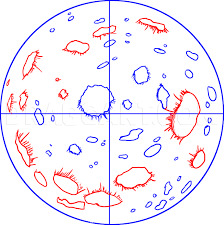
Start with the sphere. This sounds obvious, but proportion kills most attempts at a drawing of Mars planet.
Circle construction technique:
Use a compass or trace a circular object. Freehand circles rarely work—our eyes catch even minor ellipses. Your Mars needs to feel like a sphere, not a disk.
Draw a light horizontal line through the center. Mars’s equator helps position features accurately.
Add a second line tilted 25 degrees from vertical. This represents Mars’s axial tilt, crucial for realistic polar cap placement.
Layering the base tone:
Use your 2H pencil to create an even middle tone across the entire sphere. Light pressure, circular motion. This establishes Mars’s overall color value in grayscale.
Leave a small bright spot on the upper-left quadrant. This is your primary light source reflection.
Darken the right edge and lower-right quadrant with HB pencil. This creates the terminator line where day meets night.
Adding surface features:
Sketch Syrtis Major first—it’s the most prominent dark region. It appears as a triangular shape near the equator. Use 4B pencil with moderate pressure.
Block in Hellas Basin as a lighter oval in the southern hemisphere. This impact crater often appears bright due to frost and dust.
Add the polar ice cap as an irregular white shape at the top. Use your kneaded eraser to lift graphite, creating the brightest whites.
Blending for realism:
This is where your drawing of Mars planet transforms from sketch to art.
Blend the base tone with circular motions, following the sphere’s curvature. The paper should show no individual pencil strokes.
Soften the edges between dark and light regions. Mars features have gradual boundaries, not hard lines.
Add subtle texture with short, random marks in the darker regions. This suggests Martian dust and rocky terrain.
I spent three years figuring this out. My early attempts looked like flat clipart because I skipped the blending phase.
Color Theory for Painting Mars (Beyond Pencil)
If you’re ready to move beyond graphite, color opens new dimensions for your drawing of Mars planet.
The Mars color palette:
| Color Mix | Purpose | Application |
| Burnt Sienna + Yellow Ochre | Base desert tone | Overall surface color |
| Raw Umber + Touch of Purple | Dark regions | Syrtis Major, shadows |
| Titanium White + Cerulean Blue | Polar caps | Ice regions |
| Cadmium Orange + Venetian Red | Dust storms | Atmospheric effects |
Start with a warm underpainting. Unlike the moon’s cool grays, Mars demands warmth. I use a wash of diluted burnt sienna across the entire sphere.
Layer your colors wet-on-dry for control. Mars’s atmosphere is thin, so colors stay relatively saturated compared to Earth’s atmospheric diffusion.
Common color mistakes:
Making Mars too red. The “Red Planet” nickname misleads artists into oversaturating. Real Mars is more rust-orange than fire-engine red.
Using pure white for polar caps. Mix white with the faintest blue or cyan. Pure white looks artificial against Mars’s warm tones.
Ignoring the atmosphere. Mars has a pinkish-beige sky that affects how surface features appear. Add a subtle warm haze to distant features.
My breakthrough came when I started mixing my own Mars colors instead of using pre-made oranges. Custom mixes feel more authentic.
Digital Techniques for Mars Planet Illustrations
Digital tools revolutionized my drawing of Mars planet workflow.
Software recommendations:
Procreate (iPad) offers intuitive brush control and layer blending perfect for planetary textures. I use it for 70% of my current Mars artwork.
Photoshop provides unmatched detail work and texture overlays. The cloud brush tool creates convincing dust storms.
Krita (free) delivers professional results without subscription costs. Its wrap-around mode helps ensure seamless sphere mapping.
Digital workflow for Mars:
Create a new document at 3000×3000 pixels minimum. Mars deserves detail.
Use a perfect circle selection tool for your base sphere. Fill it with a medium-value warm gray.
Apply a spherize filter to create dimensional lighting automatically. This saves hours of manual shading.
Add surface features on separate layers. This non-destructive approach lets you experiment without starting over.
Texture techniques:
Download NASA’s Mars texture maps—they’re public domain. Wrap them onto your sphere using displacement mapping.
Use noise filters to create dusty surface variation. Set opacity to 15-20% so it’s subtle.
Add atmospheric glow with a soft orange brush on a multiply layer around the sphere’s edges.
The efficiency shocked me. What took four hours traditionally now takes ninety minutes digitally. But don’t let speed compromise learning fundamentals—master pencil work first.
Advanced Shading Techniques for Realistic Depth
Depth separates amateur sketches from professional drawing of Mars planet artwork.
The terminator line (the division between day and night) needs special attention. It’s not a hard edge—Mars’s thin atmosphere creates a gradual transition.
Create it by building up graphite slowly. Start with 2H at the day side, transition through HB at the terminator, finish with 4B in the night region.
Core shadow placement:
The darkest part of Mars isn’t at the edge—it’s about 30% inward from the terminator. This is the core shadow where light bends around the sphere.
Add it with your darkest pencil (6B or 8B). Use light pressure first, building gradually.
Reflected light:
Here’s what most tutorials miss: even Mars’s night side isn’t completely black. Sunlight bouncing off space dust creates subtle illumination.
Add the faintest tone to the far right edge of your sphere with a 2H pencil. It should barely be visible but makes the sphere feel three-dimensional.
Atmospheric effects:
- Create a subtle halo by smudging a light orange ring around the sphere’s edge
- Add lens glare with tiny white dots using a gel pen or white charcoal
- Suggest dust storms with irregular lighter patches using eraser
Practice these on separate spheres before applying them to your final drawing of Mars planet. I ruined six finished pieces before mastering core shadow placement.
What I Learned the Hard Way
I destroyed more Mars drawings than I care to admit. Here’s the brutal truth about my failures.
Mistake #1: Starting too detailed too fast
My first serious drawing of Mars planet attempt began with me trying to render Olympus Mons in perfect detail. Two hours in, I realized the entire sphere’s proportions were wrong. The volcano looked great, but it sat on a lopsided circle.
The lesson? Establish your foundation first. Get the sphere right, nail the lighting, block in major features. Details come last, always
Mistake #2: Overworking the graphite
I once spent seven hours on a single Mars sketch, adding layer after layer of graphite. The paper started pilling. drawing of mars planet The surface became shiny and slick. No amount of additional pencil work would stick.
Graphite has limits. After your fourth or fifth layer, you’re polishing, not adding. Know when to stop.drawing of mars planet.
Mistake #3: Ignoring reference images
Early on, I thought I could draw Mars from memory. My versions had features in impossible positions, polar caps at wrong angles, and proportions that defied physics.
Reality check: even experienced artists need references. Mars’s features have specific locations. Your drawing of Mars planet should respect actual geography.
Mistake #4: Fear of erasing
I treated my sketches like precious artifacts, afraid to erase and adjust. This timidity resulted in compromised compositions.
Your kneaded eraser isn’t just for mistakes—it’s a drawing tool. Use it to lift highlights, create texture, and refine edges. I now erase as much as I draw.
The vulnerability moment:
I entered a regional art competition with what I thought was my best drawing of Mars planet. The judge’s feedback was devastating: “This looks like a textbook diagram, not art.”
She was right. drawing of mars planet Technical accuracy meant nothing without emotional connection. That critique changed everything. I started asking: “What does Mars feel like?” Not just “What does Mars look like?”
My work improved immeasurably once I stopped trying to create perfect astronomical illustrations and started creating art that captured Mars’s lonely, ancient mystery.
Common Problems and How to Fix Them
Every artist hits the same walls when creating a drawing of Mars planet. Here are the solutions I wish someone had given me.
Problem: Flat-looking sphere
Your Mars looks like a circle, not a ball.
Fix: Strengthen your contrast. The difference between your brightest highlight and darkest shadow should be dramatic. Use the full range of your pencil set.
Problem: Muddy blending
Your surface looks smeared instead of smooth.
Fix: Clean your blending stumps frequently. Dirty tools spread old graphite around, muddying fresh work. I keep three stumps in rotation—one for lights, one for mids, one for darks.
Problem: Features in wrong positions
Your Olympus Mons appears where Syrtis Major should be.
Fix: Create a grid overlay on your reference image and your drawing. Transfer feature positions square by square. It’s tedious but accurate.
Problem: Oversaturated colors (in color work)
Your Mars looks like a neon orange.
Fix: Desaturate by adding the color’s complement. For orange Mars tones, add touches of blue. This creates natural-looking rust colors instead of crayon orange.
Problem: Harsh edges on features
Your craters and mountains have hard outlines.
Fix: Mars’s thin atmosphere still creates atmospheric perspective. Soften distant feature edges with gentle blending. Only foreground elements should have crisp definition.
Building confidence:
Practice spheres constantly. I filled an entire sketchbook with circles of different sizes before attempting another drawing of Mars planet. Boring? Yes. Effective? Absolutely.
Study other planetary artists. Don Wilson’s Mars paintings taught me color theory. Chesley Bonestell’s work showed me dramatic lighting. Don’t copy—learn their approaches.
Set up a critique group. My local astronomy club became my toughest but most valuable feedback source. Non-artists often spot what artists miss.
Enhancing Your Mars Drawing with Environmental Context
A drawing of Mars planet becomes more compelling with context.
Adding stars:
Wait until your Mars is completely finished before adding stars. Use a white gel pen or fine brush with white acrylic.
Vary star sizes—make some pinpoints, others small dots. Random distribution looks more natural than evenly spaced.
Don’t overdo it. Fewer stars with careful placement beats a cluttered starfield.
Including Mars’s moons:
Phobos and Deimos add narrative to your composition. These tiny, potato-shaped moons create visual interest.
Position them according to actual orbital mechanics if you’re going for accuracy. NASA’s JPL Horizons System can tell you where they’d be on any given date.
Keep them small and subtle. They’re only 22 and 12 kilometers in diameter respectively—specks compared to Mars.
Creating atmospheric effects:
Dust storms are Mars’s most dramatic weather events. Represent them as lighter, hazy regions obscuring surface features.
Add subtle glow around the sunlit edge of your Mars. The thin atmosphere scatters light, creating a faint halo effect.
Consider showing Mars during different seasons. The polar caps shrink and grow, creating dynamic seasonal artwork potential.
Composition tips:
- Rule of thirds: Position Mars off-center for dynamic compositions
- Negative space: Let darkness surround Mars—it emphasizes the planet’s isolation
- Leading lines: If adding spacecraft or rovers, use their trajectories to guide the eye to Mars
My favorite drawing of Mars planet includes Phobos casting a tiny shadow on the Martian surface. It took research to position correctly, but the astronomical accuracy elevates the entire piece.
Preserving and Displaying Your Finished Artwork
You’ve completed your drawing of Mars planet. Now protect it.
Fixative application:
Spray fixative in a well-ventilated area (outside is best). Hold the can 12-15 inches from your drawing.
Use light, even coats. Three thin layers beat one heavy coat that might drip or pool.
Let each coat dry completely—usually 15-20 minutes—before applying the next.
I use Krylon Workable Fixatif. “Workable” means you can add more pencil work after spraying if needed.
Framing considerations:
Use UV-protective glass or acrylic. Light degrades graphite and colored pencil over time.
Mount with acid-free materials. Regular cardboard and tape will yellow and damage your art within years.
Leave breathing room. Don’t let your drawing touch the glass—humidity can cause graphite to transfer.
Digital archival:
Photograph your work in natural light for accurate color representation. Avoid using flash—it creates hot spots and reflections.
Scan at 600 DPI minimum if you have access to a large-format scanner. This creates a print-quality digital backup.
Store files in multiple locations—cloud, external drive, and computer. Your drawing of Mars planet represents hours of work worth protecting.
Sharing online:
Instagram favors square formats—crop thoughtfully or present your Mars in a square composition initially.
Add process photos. People love seeing work-in-progress shots alongside finished pieces.
Use relevant hashtags: #marsart #planetaryart #astronomicalart #sciart. These communities actively engage with space artwork.
I learned the fixative lesson expensively. A drawing I’d spent twenty hours on smudged when I stacked it carelessly in my portfolio. Proper preservation isn’t optional—it’s essential.
Frequently Asked Questions
1. What’s the best paper for drawing Mars with colored pencils?
Strathmore 400 Series Mixed Media paper works best for color saturation and layering.
2. Can I use regular sketch paper for Mars drawings?
No, it’s too thin and can’t handle the layering needed for Mars’s colors.
3. How do I make my Mars drawing look three-dimensional?
Use highlights, midtones, core shadows, and reflected light to add realistic depth.
4. Do I need expensive art supplies to draw Mars?
No, basic pencils, paper, and a blending tool are enough to start.
5. How long does it take to complete a detailed Mars drawing?
4–6 hours for experienced artists; beginners may take 12–15 hours.
6. Why is Mars harder to draw than Jupiter or Saturn?
Its subtle colors and small surface features require careful shading and accuracy.
7. What pencils are best for Mars drawings?
Colored pencils for rust tones; graphite for sketches and smooth blending.
8. How can I study Mars for drawing?
Use high-resolution NASA photos to understand lighting, shadows, and surface details.
Summary
Creating a compelling drawing of Mars planet combines science and art. For a successful drawing of Mars planet, start with quality tools: graphite pencils, blending stumps, and proper paper. Practice spheres and shading before adding surface features. Studying NASA images helps make your drawing of Mars planet realistic and avoid oversaturated reds. Focus on light: highlight, midtone, core shadow, and reflected light bring depth. Mistakes are learning opportunities. Whether traditional or digital, the principles of a drawing of Mars planet remain the same. Adding stars or Mars’s moons enhances composition, making your drawing of Mars planet truly captivating.
Conclusion
In conclusion, creating a drawing of Mars planet is both a creative and scientific journey. Understanding light, shading, and Mars’s unique surface features transforms a simple sketch into a realistic, captivating artwork. With practice, study of NASA imagery, and the right tools, anyone can bring the Red Planet to life on paper or digitally. Each attempt teaches more about spheres, depth, and planetary details, making every drawing of Mars planet a learning experience. Stay patient, embrace mistakes, and let your artistic interpretation meet scientific accuracy to truly capture the wonder of Mars.