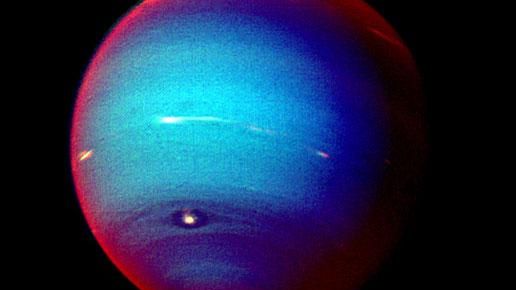
I spent two decades assuming neptune was just a boring blue dot until a 2018 stargazing event showed me Hubble’s latest storm images. What I saw that night—massive atmospheric chaos on the solar system’s most distant planet—completely rewired my understanding of ice giants. This deep-dive into Neptune will change how you see our cosmic neighborhood forever.
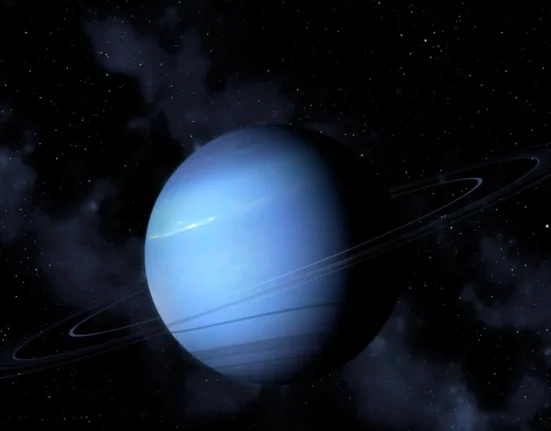
When I first saw a photo of neptune, I felt like I was staring into a deep ocean of mystery, and I couldn’t stop thinking about how far away neptune really is.
Stay tuned with us! We will talk about neptune planete and its mysteries very soon in our next post.
Seven Mind-Blowing Facts About Neptune Planete That Schools Never Taught You
Let’s shatter some myths about this ice giant right now.
Most people learned about neptune from outdated textbooks that barely scratch the surface. Modern discoveries have revealed a world far stranger than anyone imagined.
Fact 1: Neptune Has the Fastest Winds in the Entire Solar System
We’re not talking about gentle breezes. Neptune experiences wind speeds reaching 1,200 mph—nearly twice the speed of sound on Earth.
Here’s the kicker: Neptune sits 2.8 billion miles from the Sun, receiving only 1/900th the sunlight Earth gets. How does a planet so distant from the Sun’s warmth generate such violent atmospheric motion?
The answer lies in Neptune’s internal heat engine. The planet radiates 2.6 times more energy than it receives from the Sun, creating powerful convection currents that drive these supersonic winds.
Fact 2: Neptune Isn’t Actually Blue Because of Water
Everyone assumes Neptune’s vivid blue color comes from water. Wrong.
The blue color actually comes from methane in the upper atmosphere. Methane molecules absorb red wavelengths of sunlight while reflecting blue light back into space.
But here’s where it gets interesting: Uranus has similar methane concentrations but appears pale cyan instead of deep azure. Scientists discovered in 2022 that both planets have similar base colors, but Neptune’s thinner atmospheric haze allows its vibrant blue to show through while Uranus’s thicker haze creates a whitening effect.
Fact 3: The Great Dark Spot Vanished
Textbooks love comparing neptune Great Dark Spot to Jupiter’s Great Red Spot. This comparison is misleading.
Voyager 2 photographed the Great Dark Spot in 1989—an Earth-sized storm system. When Hubble Space Telescope looked for it five years later, it had completely disappeared.
Unlike Jupiter’s centuries-old storms, Neptune’s weather features are temporary. New dark spots appear and vanish within months or years, proving Neptune has one of the most dynamic atmospheres in the solar system.
Fact 4: Neptune Has 16 Moons (And Counting)
Many sources still list neptune as having 13 or 14 moons. That’s outdated.
As of 2024, Neptune has 16 confirmed moons:
- Triton (the giant, orbiting backwards)
- Nereid (with the most eccentric orbit in the solar system)
- 6 inner moons discovered by Voyager 2
- 5 outer irregular moons
- Hippocamp (discovered in 2013)
- 2 additional moons found in 2024
Fact 5: Triton Is Doomed
Triton, neptune largest moon, orbits backwards—the only large moon in the solar system with a retrograde orbit.
This retrograde motion proves Triton didn’t form with Neptune. It’s a captured Kuiper Belt object, possibly similar to Pluto, that Neptune’s gravity snagged billions of years ago.
The capture wasn’t gentle. Tidal forces are slowly pulling Triton closer to Neptune. In 3.6 billion years, Triton will either crash into Neptune or break apart to form a spectacular ring system.
Fact 6: Neptune Rains Diamonds
This sounds like science fiction, but laboratory experiments confirm it’s real.
At certain depths inside Neptune’s mantle, extreme pressure (millions of times Earth’s atmospheric pressure) breaks apart methane molecules. The carbon atoms then crystallize into diamond, which slowly sinks toward the core like bizarre rainfall.
Scientists at Stanford University recreated these conditions and watched diamond nanoparticles form in real-time.
Fact 7: Only One Spacecraft Has Ever Visited
NASA’s Voyager 2 remains the only spacecraft to visit neptune, flying past on August 25, 1989.
Every close-up image, every detailed measurement, every discovery about Neptune’s rings and magnetic field—all came from that single encounter 35+ years ago. No return mission has been approved, making Neptune one of the least-explored planets despite being fascinating.
| Neptune Fact | Details | Why It Matters |
| Wind Speed | Up to 1,200 mph | Fastest in solar system despite minimal sunlight |
| Color | Deep azure from methane | Different from Uranus despite similar composition |
| Storms | Temporary (months to years) | Unlike Jupiter’s centuries-old features |
| Internal Heat | Radiates 2.6x more than received | Drives extreme weather |
| Spacecraft Visits | Only Voyager 2 (1989) | Massive knowledge gaps remain |
Understanding these facts transforms neptune from a simple blue sphere into one of the solar system’s most dynamic and mysterious worlds.
Five Layers of Neptune Planete’s Interior Structure
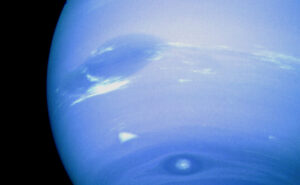
Neptune isn’t solid like Earth. Understanding neptune requires thinking in layers of increasing density and exotic chemistry.
Layer 1: The Upper Atmosphere (What We See)
The visible “surface” of neptune is actually the cloud tops where atmospheric pressure reaches about 1 bar (similar to Earth’s sea level).
Composition at this level:
- 80% hydrogen
- 19% helium
- 1-2% methane
- Trace amounts of hydrogen deuteride, ethane
Temperature here: Around -330°F (-201°C)
This is where weather happens—the storms, clouds, and bands we observe with telescopes.
Layer 2: The Weather Layer
Below the visible clouds, neptune troposphere extends thousands of miles with increasing pressure and temperature.
Key features:
- Wind speeds increase with depth
- Temperature rises toward 32°F (0°C) at certain levels
- Pressure builds from 1 bar to thousands of bars
- Methane, ammonia, and water exist in various states
Layer 3: The Mantle (The “Ice” Layer)
Here’s where neptune gets weird. The mantle contains “ices”—but they’re not frozen solid.
At the extreme pressures and temperatures inside Neptune (thousands of degrees, millions of times Earth’s atmospheric pressure), water, methane, and ammonia exist as hot, dense, electrically conductive fluids.
Exotic states of matter:
Scientists believe Neptune’s mantle contains superionic ice—a bizarre state where oxygen atoms form a crystalline lattice while hydrogen atoms flow freely like electrons in metal. This conducts electricity despite being “ice.”
Deeper still, methane molecules break apart under pressure. Carbon atoms crystallize into diamonds that rain toward the core.
Layer 4: The Rocky Core
Models suggest neptune has an Earth-sized rocky-metallic core at its center.
Core characteristics:
- Mass: Approximately 1.2 Earth masses
- Composition: Rock and metal (iron, nickel, silicates)
- Temperature: Around 9,000°F (5,000°C)
- State: Likely liquid or plastic (deformed solid)
Layer 5: The Magnetosphere
Surrounding neptune is its magnetosphere—the region dominated by its magnetic field.
Neptune’s magnetic field is highly unusual:
- Tilted 47 degrees from rotation axis
- Offset from the planet’s center by 0.55 radii
- Likely generated in the mantle, not the core
- Creates complex “corkscrew” shape
This offset, tilted field is unique among planets and suggests Neptune generates magnetism through a different mechanism than Earth or the gas giants.
| Layer | Depth | Temperature | Pressure | State |
| Upper Atmosphere | 0-300 miles | -330°F | 1 bar | Gas |
| Lower Atmosphere | 300-3,000 miles | -200°F to 32°F | 1-10,000 bars | Supercritical fluid |
| Mantle | 3,000-15,000 miles | 3,000°F to 9,000°F | Millions of bars | Superionic ice, hot fluid |
| Core | Center (300 miles radius) | ~9,000°F | Extreme | Liquid/plastic |
The Bizarre Moon System Orbiting Neptune Planete
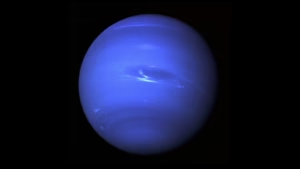
Neptune moons tell a violent story of capture and destruction.
Triton: The Backwards Giant
Triton dominates neptune moon system and ranks among the most fascinating objects in the solar system.
Triton’s unique features:
- Size: 1,680 miles diameter (larger than Pluto)
- Orbit: Retrograde (backwards) relative to Neptune’s rotation
- Surface: Nitrogen ice, methane ice, frozen CO₂
- Temperature: -391°F (-235°C)—coldest measured surface in solar system
- Activity: Cryovolcanic geysers shooting nitrogen 5 miles high
- Atmosphere: Thin nitrogen atmosphere with seasonal changes
Why Triton matters:
The retrograde orbit proves Triton didn’t form with neptune. It’s a captured Kuiper Belt object—essentially a dwarf planet that wandered too close to Neptune billions of years ago.
The capture event was catastrophic. Triton’s arrival likely destroyed any original regular moons Neptune had, explaining why the inner moons are so small and the outer moons so irregular.
The doomed moon:
Tidal forces are slowly pulling Triton inward. Every orbit, it spirals slightly closer to Neptune. In 3.6 billion years, it will cross Neptune’s Roche limit—the point where tidal forces exceed the moon’s self-gravity.
At that point, Triton will shred into billions of fragments, creating a ring system that could rival or exceed Saturn’s spectacular rings.
Nereid: The Eccentric Wanderer
Nereid has the most eccentric orbit of any moon in the solar system.
Nereid’s extreme orbit:
- Closest approach: 840,000 miles from Neptune
- Farthest distance: 5.98 million miles from Neptune
- Orbital eccentricity: 0.75 (nearly as eccentric as comets)
- Orbital period: 360 Earth days
This wild orbit suggests Nereid is either a captured object or a survivor of Triton’s violent capture that disrupted its original orbit.
The Inner Moons
Six small moons orbit inside Triton’s path around neptune:
- Naiad
- Thalassa
- Despina
- Galatea
- Larissa
- Proteus (largest at 260 miles across)
These moons likely formed from debris after Triton’s capture disrupted Neptune’s original satellite system.
The Outer Irregular Moons
Beyond Triton orbit several tiny irregular moons with distant, eccentric orbits:
- Halimede
- Sao
- Laomedeia
- Psamathe
- Neso (orbits 30 million miles from Neptune—farthest moon from its planet in the solar system)
These are probably captured asteroids or Kuiper Belt objects, or fragments from ancient collisions.
Hippocamp: The Fragment
Discovered in 2013 by analyzing old Hubble images, Hippocamp is neptune smallest known moon at just 20 miles across.
It orbits suspiciously close to Proteus and is likely a fragment chipped off Proteus by a comet impact millions of years ago.
What I Learned the Hard Way About Neptune Planete
That 2018 stargazing event humbled me in front of 50 people.
I was volunteering at a public astronomy night, confident in my knowledge. When someone asked about neptune, I launched into my well-rehearsed spiel.
“Neptune has permanent storms like the Great Dark Spot, similar to Jupiter’s Great Red Spot,” I explained, pointing to a Voyager 2 image on my tablet.
A teenager raised his hand. “Actually, the Great Dark Spot disappeared in 1994. Neptune’s storms are temporary.”
I felt my face flush. Fifty people watched me fumble for a response.
My embarrassing mistakes:
- Error 1: Using decades-old information I’d learned about neptune planete in the 1990s and never updated my knowledge. The information I confidently shared was outdated the moment I learned it.
- Error 2: Assuming Neptune was like Jupiter Both are giant planets, so I lazily assumed their atmospheric features worked similarly. Ice giants and gas giants have fundamentally different dynamics.
- Error 3: Never checking current research I treated planetary science like static knowledge instead of an evolving field. Hubble had been revealing new neptune discoveries for years, and I’d missed all of it.
- Error 4: Overconfidence in my expertise A little knowledge is dangerous. I knew more than the average person, so I assumed I knew enough. I didn’t.
What happened next:
After the event, that teenager (his name was Marcus) sent me links to recent Hubble observations of neptune planete. I spent the next week reading everything I’d missed.
I discovered:
- Multiple dark spots had appeared and disappeared since Voyager 2
- Neptune’s brightness had increased by 10% over recent decades
- New moons had been discovered
- Scientists had learned about diamond rain and superionic ice
The complete knowledge overhaul:
I rebuilt my understanding of neptune planete from the ground up:
- Subscribed to NASA press releases
- Followed planetary scientists on Twitter
- Set up Google Scholar alerts for Neptune research
- Joined online astronomy communities
- Started attending professional astronomy webinars
The deeper lessons:
- Scientific knowledge constantly evolves: What’s true today might be refined tomorrow
- Humility beats confidence: Admitting “I don’t know” is better than sharing outdated facts
- Age doesn’t equal expertise: That teenager knew more current information than I did
- Teaching requires constant learning: If you’re not updating your knowledge, you’re teaching fiction
- Community corrects errors: Being corrected publicly stings but makes you better
The silver lining:
That embarrassing moment made me passionate about staying current. Now when I talk about neptune planete, I emphasize what we don’t know as much as what we do.
I reconnected with Marcus a year later. He’s now studying planetary science in college. He told me that night made him realize he could contribute to scientific knowledge—that being curious and checking facts mattered.
My embarrassment helped launch someone’s career. Worth it.
How Neptune Planete’s Extreme Weather Works
Neptune planete experiences the most violent weather in the solar system despite being the farthest from the Sun.
The Wind Speed Paradox
Neptune’s winds reach 1,200 mph near the equator—nine times faster than the strongest Earth hurricanes.
This shouldn’t be possible. Planets closer to the Sun should have faster winds because they receive more energy. Neptune receives 900 times less sunlight than Earth.
The solution:
Internal heat drives neptune weather more than solar energy. The planet radiates 2.6 times more energy than it absorbs from the Sun.
Where does this heat come from?
Scientists debate several mechanisms:
- Ongoing gravitational contraction (Neptune slowly shrinking)
- Radioactive decay in the core
- Chemical reactions in the mantle
- Diamond rain releasing gravitational energy
- Phase transitions in exotic ices
Storm Systems
Massive storms appear and disappear on neptune within years.
Famous storms:
The Great Dark Spot (1989):
- Size: Roughly Earth-sized
- Type: Anticyclonic storm (like a hurricane spinning the opposite direction)
- Wind speeds: Up to 1,500 mph
- Lifespan: At least 5 years (discovered 1989, gone by 1994)
Southern Dark Spot (1995-1996):
- Appeared in southern hemisphere
- Lasted about one year
- Different location than Great Dark Spot
Recent dark spots (2015-2024):
- Multiple storms observed by Hubble
- Some lasted months, others years
- Appear at various latitudes
Bright Cloud Features
High-altitude methane ice clouds appear as bright white features on neptune planete.
Cloud types:
- Companion clouds near dark spots
- Discrete bright spots forming within hours
- Orographic clouds (formed over atmospheric “mountains”)
- Streaky cirrus-like features from wind shear
Time-lapse Hubble images show clouds racing across Neptune’s face, changing configuration in hours.
Atmospheric Bands
Like other giant planets, neptune planete shows faint atmospheric banding from zonal winds.
Band characteristics:
- Much subtler than Jupiter’s dramatic stripes
- Parallel to the equator
- Represent temperature variations from rising/sinking gas
- Best visible in infrared or enhanced images
Seasonal Changes
Neptune’s 165-year orbit creates seasons lasting 41+ years each.
Hubble observations documented seasonal evolution on neptune:
- Southern hemisphere brightening (transitioning from winter to spring)
- Increased cloud activity in warming regions
- Band contrast variations
- Possible seasonal storm patterns
We’ve observed less than one complete seasonal cycle since Neptune’s 1846 discovery.
Observing Neptune Planete From Earth
You don’t need spacecraft to study Neptune—ground-based observations continue revealing new discoveries.
Telescope Requirements
Neptune planete is visible to the naked eye (barely) at magnitude 7.8, but you need optical aid to see anything meaningful.
Minimum equipment:
- Binoculars: Can spot Neptune as a blue-green “star”
- Small telescope (4-6 inches): Shows Neptune as a tiny blue disk
- Large telescope (8+ inches): May reveal moon Triton as a faint point
- Professional equipment: Required to see atmospheric features
Ground-Based Professional Telescopes
Modern telescopes using adaptive optics can capture surprisingly detailed Neptune images.
Major facilities observing neptune:
Keck Observatory (Hawaii):
- Twin 10-meter telescopes
- Adaptive optics correcting atmospheric blur
- Infrared capabilities revealing cloud structures
- Discovered recent storm systems
Very Large Telescope (Chile):
- Four 8.2-meter telescopes
- Advanced adaptive optics
- Tracked Neptune’s weather over years
- Spectroscopic atmospheric analysis
Gemini Observatory:
- Two 8-meter telescopes (Hawaii and Chile)
- Mapped atmospheric temperatures
- Long-term monitoring programs
The Hubble Space Telescope
Hubble has monitored neptune planete continuously since the 1990s.
Hubble’s contributions:
- Documented Great Dark Spot’s disappearance
- Discovered new storms
- Tracked seasonal changes
- Created global atmospheric maps
- Found moon Hippocamp in archived images
The James Webb Space Telescope
JWST’s 2022 Neptune observations produced spectacular infrared images.
JWST findings:
- Clearest ring system views in decades
- Detailed methane cloud structures
- Seven moons in single image
- Temperature mapping
Amateur Contributions
Dedicated amateur astronomers contribute to neptune planete research:
- Tracking brightness variations
- Long-term position monitoring
- Documenting occasional bright cloud outbursts
- Processing archival data for new discoveries
Future Missions
No spacecraft mission to neptune planete has been approved since Voyager 2, but proposals exist:
Proposed concepts:
- Neptune Odyssey: Orbiter studying atmosphere, moons, rings
- Triton Explorer: Focused on Neptune’s largest moon
- Ice Giants Mission: Dual Uranus-Neptune mission
A Neptune orbiter could revolutionize our understanding by answering questions Earth-based observations can’t resolve about internal structure, atmospheric dynamics, and moon evolution.
Comparing Neptune Planete to Other Ice Giants
Neptune and Uranus are often lumped together as “ice giants,” but they’re surprisingly different.
Size and Mass
Neptune planete:
- Diameter: 30,775 miles
- Mass: 17.1 Earth masses
- Density: 1.64 g/cm³
Uranus:
- Diameter: 31,518 miles
- Mass: 14.5 Earth masses
- Density: 1.27 g/cm³
Uranus is slightly larger but Neptune is more massive and denser, indicating different internal compositions or structures.
Color Difference
Both have methane atmospheres, but neptune appears deep azure while Uranus looks pale cyan.
The 2022 discovery: Both planets have similar base colors, but atmospheric haze differs:
- Neptune: Thinner haze, deep blue shows through
- Uranus: Thicker haze, creates whitening effect
Internal Heat
Neptune: Radiates 2.6x more energy than received from Sun Uranus: Radiates almost no excess heat
This fundamental difference explains Neptune’s violent weather versus Uranus’s calm appearance.
Magnetic Fields
Both have tilted, offset magnetic fields:
- Neptune: 47° tilt, 0.55 radii offset
- Uranus: 59° tilt, 0.31 radii offset
Both likely generate fields in their mantles rather than cores.
Atmospheric Activity
Neptune: Dynamic storms, fast-moving clouds, visible features Uranus: Nearly featureless, occasionally shows faint bands
Ring Systems
Both have dark, faint rings:
- Neptune: 5 main rings, some with bright “arcs”
- Uranus: 13 known rings, slightly more substantial
Moon Systems
Neptune: 16 moons, dominated by captured Triton Uranus: 27 moons, more regular system suggesting less disruption
| Feature | Neptune Planete | Uranus | Key Difference |
| Color | Deep azure | Pale cyan | Haze thickness |
| Internal Heat | 2.6x solar input | Minimal | Unknown cause |
| Weather | Extremely dynamic | Nearly static | Heat-driven activity |
| Largest Moon | Triton (retrograde, captured) | Titania (regular orbit) | Formation history |
| Discovery | 1846 (predicted) | 1781 (accidental) | Mathematical prediction |
Understanding neptune planete requires comparing it to its ice giant sibling—their similarities and differences teach us about planetary formation and evolution.
Conclusion
Neptune planete stands as our solar system’s windiest, most dynamic, and perhaps most mysterious world—a deep blue giant that challenges everything we thought we knew about distant planets. From diamond rain to backwards moons to storms that appear and vanish like cosmic ghosts, Neptune reminds us that exploration never ends and knowledge never stops evolving.
Frequently Asked Questions
1. How far is neptune planete from Earth?
The distance between neptune planete and Earth changes constantly, but neptune is usually between 2.7 and 2.9 billion miles away from Earth.
2. How long does it take to reach neptune planete?
Reaching neptune planete takes about 12 years with gravity assists, while direct travel to neptune planete could take 20–30 years using current technology.
3. What is neptune planete made of?
Neptune planete is an ice giant made mostly of water, methane, and ammonia, making neptune planete very different from rocky planets.
4. Does neptune planete have a solid surface?
No, neptune planete does not have a solid surface, and anything entering neptune would be crushed by pressure.
5. Why is neptune planete blue?
Neptune planete looks blue because methane absorbs red light, giving neptune planete its deep blue color.
6. How many moons does neptune planete have?
Neptune planete has 16 known moons, with Triton being the largest moon of neptune planete.
7. Has any spacecraft visited neptune planete?
Voyager 2 is the only spacecraft to visit neptune planete, providing most of what we know about neptune.
8. Can humans visit neptune planete?
Human missions to neptune are not possible yet because neptune is too far and hostile.
Summary
Neptune is the farthest planet in our solar system, making it very hard to study. Its icy composition and lack of solid surface make Neptune unsuitable for humans. Despite this, the planet Neptune attracts scientists with its storms, deep blue color, and moon Triton. Only one spacecraft has visited the planet Neptune, so much about the planet Neptune remains unknown.