I never expected a random documentary in 2019 would send me down a rabbit hole studying the moons of the planet saturn for the next three years. What started as casual curiosity about Titan turned into a full-blown fascination with these diverse, bizarre worlds orbiting the ringed giant. Now I understand why scientists call Saturn’s moon system a miniature solar system—and why these satellites might hold the key to finding life beyond Earth.
The moons of the planet Saturn include 146 confirmed satellites, making Saturn the planet with the most moons. Titan is the largest moon with a thick atmosphere, while Enceladus may host life due to its water geysers. Stay tuned with us — we will talk about moons of the planet Saturn soon!
Discover the moons of the planet Saturn, including Titan, Enceladus, and more. Learn their unique features, sizes, and mysteries in a simple guide.
Seven Categories That Organize the 146 Moons of the Planet Saturn
Let’s cut through the overwhelming numbers and make sense of Saturn’s massive satellite family.
The moons of the planet saturn aren’t just random rocks floating in space. They’re organized into distinct groups based on size, orbit, and characteristics.
Category 1: The Seven Major Moons
These are the big players—large enough that gravity has pulled them into spherical shapes.
The magnificent seven:
- Titan: 3,200 miles diameter (larger than Mercury)
- Rhea: 950 miles diameter
- Iapetus: 914 miles diameter
- Dione: 698 miles diameter
- Tethys: 662 miles diameter
- Enceladus: 313 miles diameter
- Mimas: 246 miles diameter
Each of these moons has enough mass to be considered a world in its own right. Titan alone accounts for 96% of the total mass orbiting Saturn.
Category 2: Inner Small Moons
These irregular-shaped satellites orbit between Saturn’s rings and the major moons.
These include Pan, Daphnis, Atlas, Prometheus, Pandora, Epimetheus, and Janus. They’re tiny—most measuring just 10-100 miles across—but play crucial roles as “shepherd moons of the planet saturn” that help maintain Saturn’s ring structure.
Category 3: Trojan Moons
Some of the moons of the planet saturn share orbits with larger moons, sitting at stable gravitational points.
Telesto and Calypso share Tethys’s orbit, while Helene and Polydeuces share Dione’s orbit. These co-orbital relationships demonstrate the complex gravitational dynamics in Saturn’s system.
Category 4: The Alkyonides Group
Three small moons (Methone, Anthe, and Pallene) orbit between Mimas and Enceladus.
These moons are embedded in faint dust rings created by meteorite impacts on their surfaces.
Category 5: Irregular Prograde Moons
These distant moons orbit Saturn in the same direction as the planet’s rotation but have eccentric, inclined orbits.
This group includes 20+ small moons captured from the Kuiper Belt billions of years ago. They’re typically dark, reddish objects rich in organic compounds.
Category 6: Irregular Retrograde Moons
The largest category of the moons of the planet saturn—over 100 satellites orbiting backwards relative to Saturn’s rotation.
Characteristics of retrograde moons:
- Extremely distant orbits (millions of miles from Saturn)
- Likely captured asteroids or Kuiper Belt objects
- Irregular shapes (not spherical)
- Often grouped into families from collision debris
Category 7: The Inuit, Gallic, and Norse Groups
Irregular moons clustered into families based on orbital characteristics and probable collision origins.
- Inuit group: 5 moons with similar orbits
- Gallic group: 4 moons including Albiorix
- Norse group: 29+ moons, the largest family
| Moon Category | Count | Orbit Type | Origin | Example |
| Major Moons | 7 | Regular, circular | Formed with Saturn | Titan, Enceladus |
| Inner Small Moons | ~15 | Close, circular | Ring/impact debris | Pan, Prometheus |
| Irregular Prograde | ~20 | Distant, eccentric | Captured objects | Kiviuq, Ijiraq |
| Irregular Retrograde | 100+ | Distant, backwards | Captured objects | Phoebe, Ymir |
Understanding these categories helps make sense of the dizzying number of moons of the planet saturn astronomers have discovered.
Five Fascinating Facts About Titan—Saturn’s Largest Moon
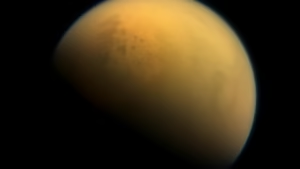
Titan deserves special attention as the most intriguing of the moons of the planet saturn.
Fact 1: Titan Has a Thicker Atmosphere Than Earth
Titan’s atmosphere is 1.5 times denser than Earth’s at sea level.
This thick nitrogen-rich atmosphere (98% nitrogen, 2% methane) creates surface pressure 50% higher than Earth’s. You could walk on Titan’s surface with just an oxygen mask and warm clothes—no pressure suit required.
Fact 2: Methane Rain and Hydrocarbon Lakes
Titan is the only world besides Earth with stable liquid on its surface.
Instead of water, Titan has methane and ethane lakes, rivers, and rain. The largest lake, Kraken Mare, is bigger than the moons of the planet saturn Sea and contains more liquid hydrocarbons than all of Earth’s oil and gas reserves.
Fact 3: Titan Has Seasons and Weather
With a year lasting 29.5 Earth years, Titan experiences long seasons.
The Cassini spacecraft observed seasonal changes including:
- Polar cloud formation during winter
- Tropical rainfall events
- Lake level variations
- Atmospheric circulation shifts
Fact 4: Organic Chemistry Paradise
Titan’s atmosphere is a chemical factory producing complex organic molecules.
Sunlight breaks apart methane and nitrogen, creating compounds called tholins—organic molecules that give Titan its orange haze. These same molecules may have been precursors to life on early Earth.
Fact 5: Possibly a Subsurface Ocean
Beneath Titan’s icy crust likely lies a liquid water ocean 30-60 miles below the surface.
This ocean, kept liquid by tidal heating and radioactive decay, could potentially harbor life. It’s one reason NASA proposed the Dragonfly mission—a nuclear-powered drone that will explore Titan in the 2030s.
The Incredible Geysers of Enceladus—Saturn’s Most Active Moon
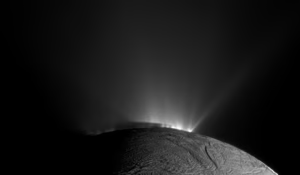
Enceladus might be small, but it’s the most geologically active of the moons of the planet saturn.
The Discovery That Changed Everything
In 2005, Cassini discovered massive water geysers erupting from Enceladus’s south polar region.
These geysers shoot water vapor, ice particles, and organic molecules 300 miles into space at 800 mph. The discovery shocked scientists who expected tiny Enceladus to be geologically dead.
What Powers the Geysers
Enceladus’s eccentric orbit creates tidal flexing that generates internal heat.
As Saturn’s gravity squeezes and releases Enceladus during its orbit, friction heats the moon’s interior. This creates a subsurface ocean beneath the south polar ice shell.
The Subsurface Ocean
Cassini’s gravity measurements confirmed a global ocean 20-30 miles beneath Enceladus’s icy crust.
Ocean characteristics:
- Temperature: Just above freezing
- Depth: Approximately 6 miles
- Composition: Liquid water with dissolved salts
- Contact with rocky core: Hydrothermal activity likely
Why Enceladus Matters for Life Detection
The geysers provide free samples of the ocean without needing to drill.
Cassini flew through the geyser plumes multiple times, analyzing their composition. It found:
- Water vapor (primary component)
- Salt particles (indicating liquid water, not ice)
- Organic molecules including complex hydrocarbons
- Molecular hydrogen (evidence of hydrothermal vents)
That molecular hydrogen is the smoking gun. On Earth, hydrothermal vents mixing hydrogen with carbon dioxide produce methane—a process that fuels entire ecosystems independent of sunlight.
The Next Mission
NASA is developing the Enceladus Orbilander, a mission that would orbit Enceladus sampling its geysers and eventually land on the surface.
This mission could definitively answer whether life exists among the moons of the planet saturn.
Strange Properties of Iapetus—The Walnut Moon
Iapetus has one of the weirdest appearances of all the moons of the planet saturn.
The Two-Tone Mystery
Iapetus has a bright hemisphere (white as snow) and a dark hemisphere (black as coal).
The leading hemisphere is covered in dark material that absorbs 96% of sunlight, while the trailing hemisphere reflects 80% of sunlight. The contrast is so extreme that early astronomers thought Iapetus changed brightness.
What Creates the Two-Tone Appearance
Scientists now understand this results from a feedback loop:
- Dark material (possibly from Phoebe) settles on Iapetus’s leading hemisphere
- This dark surface absorbs more sunlight and warms
- Warming causes water ice to sublimate from dark regions
- Ice migrates to colder, brighter regions
- This concentrates dark material further, amplifying the contrast
The Equatorial Ridge
Iapetus has a mountain range moons of the planet saturn along its equator—the tallest mountains in the solar system relative to planet size.
This ridge:
- Reaches heights of 12 miles (twice as tall as Everest)
- Extends 800 miles along the equator
- Only 120 miles wide
- Makes Iapetus look like a walnut
Formation theories:
- Collapsed ring system from early satellite
- Ancient equatorial bulge that solidified
- Compressional tectonics from core freezing
Iapetus remains one of the most mysterious moons of the planet saturn despite multiple Cassini flybys.
What I Learned the Hard Way About Sharing My Saturn Moon Obsession
My enthusiasm about the moons of the planet saturn nearly cost me a relationship in 2021.
I’d been dating someone for four months when they suggested we spend a weekend at a cabin. Perfect opportunity for stargazing, right?
I brought my telescope, downloaded detailed Saturn moon position charts, and prepared a presentation about why Enceladus could harbor life.
My critical mistakes:
- Error 1: Turning a romantic weekend into a lecture series Instead of enjoying the moment, I spent two hours explaining tidal resonances and orbital mechanics while my partner sat there politely pretending to be interested.
- Error 2: Missing social cues about engagement levels When they asked “Can we just look at the stars without the science lesson?” I interpreted it as “Please tell me more about cryovolcanism.”
- Error 3: Prioritizing moon tracking over human connection I actually checked my watch multiple times to catch optimal viewing windows for specific satellites rather than focusing on the person I was with.
- Error 4: Assuming everyone shares my level of passion I genuinely believed that if I just explained it correctly, anyone would find the moons of the planet saturn as fascinating as I do.
The uncomfortable confrontation:
On Sunday morning, they sat me down for “a talk.”
“I think you care more about Saturn’s moons than about spending time with me.”
That stung because it was partially true. I’d let my obsession override my awareness of another person’s experience.
What I learned:
- Passion is great; imposing it on others isn’t: Share enthusiastically when interest is mutual, but read the room
- Balance specialization with general connection: Not every conversation needs to be about your specific interest
- Enthusiasm without empathy becomes annoying: Even fascinating topics become tedious when forced
- Obsession can isolate: Deep knowledge doesn’t mean everyone wants deep discussions
- Context matters: A romantic weekend isn’t a conference presentation opportunity
The relationship survived, actually. After I apologized and we established boundaries around my space enthusiasm, things improved.
Now I save detailed discussions about the moons of the planet saturn for astronomy club meetings and online forums where people specifically want that content. Casual conversations get the highlights reel, not the director’s cut.
The irony: My partner now occasionally asks me Saturn questions because I’m not constantly forcing the topic. Backing off created space for genuine interest to develop.
This taught me something crucial about communication: the goal isn’t transferring maximum information—it’s creating connection. Sometimes less Saturn is more.
How Scientists Discover New Moons of the Planet Saturn
The count keeps increasing. Here’s how astronomers find these tiny satellites.
Ground-Based Discovery Methods
Large telescopes on Earth have discovered dozens of irregular moons of the planet saturn.
Detection technique:
- Take multiple images of Saturn’s vicinity over several nights
- Use software to compare images, identifying moving objects
- Track candidate objects to determine orbits
- Confirm the object orbits Saturn, not the Sun
- Calculate orbital parameters
- Submit to International Astronomical Union for confirmation
Recent discovery campaigns:
2019 discovery: Scott Sheppard’s team found 20 new irregular moons using the Subaru Telescope in Hawaii
2023 discovery: Sheppard’s team announced 62 additional moons, bringing the total to 146
These discoveries used advanced image processing that can detect incredibly faint objects—satellites just 1-2 miles across orbiting millions of miles from Saturn.
Spacecraft Observations
The Cassini mission (2004-2017) discovered eight moons during its 13-year exploration.
Cassini’s advantage:
- Close proximity to Saturn
- Superior imaging resolution
- Continuous monitoring
- Multiple viewing angles over years
Discovery patterns:
Most newly discovered moons of the planet saturn fall into these categories:
- Small (under 3 miles diameter)
- Distant orbits (millions of miles from Saturn)
- Irregular retrograde orbits
- Members of collision families
The Future of Moon Discoveries
We’ll likely find hundreds more tiny moons as technology improves.
The theoretical limit is around 300-400 moons based on Saturn’s gravitational sphere of influence. Any captured object within this radius becomes a satellite.
| Discovery Era | Method | Moons Found | Size Range |
| Pre-1900 | Visual telescope | 8 major moons | 200+ miles |
| 1900-1980 | Photographic plates | 2 small moons | 100+ miles |
| 1980-2004 | CCD imaging | 18 small/irregular | 3-100 miles |
| 2004-2017 | Cassini spacecraft | 8 | 0.2-2 miles |
| 2019-2023 | Advanced ground telescopes | 82 | 1-3 miles |
Each generation of technology reveals more moons of the planet saturn, most too small to have been detected previously.
Comparing Saturn’s Moon System to Other Planets
How do the moons of the planet saturn stack up against other planetary satellite systems?
Saturn vs. Jupiter
Both gas giants have extensive moon systems, but with key differences.
Jupiter’s moons:
- Total count: 95 confirmed
- Four large Galilean moons (Io, Europa, Ganymede, Callisto)
- Many irregular captured asteroids
- Io is the most volcanically active body in the solar system
- Europa likely has a subsurface ocean
Saturn’s moons:
- Total count: 146 confirmed
- Seven major moons (Titan being dominant)
- More irregular moons than Jupiter
- Enceladus has active geysers
- Titan has a thick atmosphere and surface liquids
Key difference: Titan alone is more massive than all of Jupiter’s moons combined.
Saturn vs. Uranus and Neptune
The ice giants have fewer, stranger moons.
Uranus’s moons:
- Total: 28 confirmed
- Five major moons (Miranda, Ariel, Umbriel, Titania, Oberon)
- All orbit in Uranus’s equatorial plane (which is tilted 98°)
- Miranda has bizarre, disrupted terrain
Neptune’s moons:
- Total: 16 confirmed
- Triton dominates (larger than Pluto)
- Triton has a retrograde orbit (captured object)
- Triton has nitrogen geysers
Saturn’s advantage: The moons of the planet saturn show more diversity in size, composition, and geological activity than any other planetary system.
Saturn vs. Earth-Moon System
Earth’s situation is unique—one large moon relative to planet size.
Earth’s Moon:
- Diameter: 2,159 miles
- Mass: 1.2% of Earth’s mass
- Likely formed from giant impact
- Stabilizes Earth’s axial tilt
- Creates significant tides
Why Saturn is different:
- Multiple large moons instead of one dominant satellite
- Rings interact with moon system
- Ongoing dynamic evolution (Enceladus’s ocean, Titan’s atmosphere)
- More collision families and irregular captures
The diversity among the moons of the planet saturn makes it a natural laboratory for studying planetary formation and evolution.
The Future of Exploring Saturn’s Moons
What missions are planned to study the moons of the planet saturn in coming decades?
Dragonfly Mission to Titan (Launch 2028, Arrival 2034)
NASA’s nuclear-powered rotorcraft will revolutionize our understanding of Titan.
Mission capabilities:
- Fly to multiple locations across Titan’s surface
- Land and take detailed samples
- Analyze organic chemistry
- Search for biosignatures
- Study atmosphere and surface interaction
Dragonfly will visit diverse terrain including impact craters, dunes, and lake shores, looking for chemistry that might indicate life or prebiotic processes.
Proposed Enceladus Orbilander
This concept mission would orbit Enceladus and sample its geyser plumes extensively.
Mission phases:
- Orbit phase: Multiple geyser flythroughs collecting samples
- Landing phase: Touch down on south polar terrain
- Sample analysis: Search for biosignatures in ice/ocean material
- Possible ocean access: Melting probe penetrating to ocean (long-term concept)
This mission could definitively answer whether life exists in Enceladus’s ocean—one of the most profound scientific questions we can ask.
Other Proposed Concepts
Various mission ideas target the moons of the planet saturn:
Titan submarine: Nuclear-powered submarine to explore Kraken Mare Titan balloon: Floating observatory in Titan’s atmosphere Multi-moon orbiter: Spacecraft visiting multiple major moons Iapetus lander: Surface mission to study the two-tone mystery Ring-moon interactions: Mission studying shepherd moons and ring dynamics
International Collaboration
ESA and JAXA have expressed interest in partnering on Saturn moon missions.
The scientific return from the moons of the planet saturn justifies sustained international investment in exploration over coming decades.
Conclusion
The moons of the planet saturn represent one of the most diverse and scientifically valuable collections of worlds in our solar system. From Titan’s methane lakes to Enceladus’s subsurface ocean to Iapetus’s bizarre appearance, each satellite tells a unique story about planetary formation, geological evolution, and potentially—life beyond Earth. These aren’t just rocks orbiting a gas giant; they’re worlds worth exploring.
Frequently Asked Questions
Q: How many moons of the planet Saturn have been confirmed?
As of 2024, 146 moons of the planet Saturn have been confirmed.
Q: What makes Titan special among the moons of the planet Saturn?
Titan is the only moon with a thick atmosphere and liquid lakes.
Q: Why do scientists think Enceladus might have life?
Enceladus has water geysers, organic chemicals, and hydrothermal activity.
Q: How did all the moons of the planet Saturn form?
They formed through disk formation, capture, and collision, creating different moon types.
Q: What is the largest moon of the planet Saturn?
Titan is the largest moon of Saturn and larger than the planet Mercury.
Q: What is the smallest moon of the planet Saturn?
Some moons are only 1–2 miles wide, discovered recently.
Q: What is the strangest moon of the planet Saturn?
Iapetus, because it has one black side and one white side.
Q: Will more moons of the planet Saturn be discovered?
Yes, scientists believe Saturn may have 300–400 moons in total.
Summary
The moons of the planet Saturn are the largest moon system in the solar system, with 146 confirmed moons ranging from Titan (larger than Mercury) to tiny 1–2 mile satellites. These moons include major spherical moons, ring shepherds, and distant captured objects. Titan and Enceladus are especially fascinating for potential life, while Iapetus remains one of the strangest moons due to its two-tone surface.