In late 2023, while preparing a technical briefing on emerging space communication architectures for a policy research institute focused on Indo-Pacific technology competition, I spent four weeks tracking every published paper, patent filing, and mission press release connected to china satellite laser communication programs. The volume was striking — over 340 peer-reviewed papers citing chinese laser satellite experiments published in 2022 alone, triple the output from five years earlier.
China satellite laser communication has quietly become the most consequential advance in orbital data transmission since the first geostationary relay satellite went live in 1965. What Beijing has built in less than a decade — from experimental quantum key distribution links to multi-gigabit free-space optical crosslinks between LEO constellations — has outpaced Western timelines and forced a complete reassessment of who leads the next generation of space-based connectivity.
China satellite laser communication is transforming space technology with faster data transfer and advanced optical networks. Discover 7 powerful breakthroughs shaping the future of satellite connectivity.
China Advances Satellite Laser Tech:

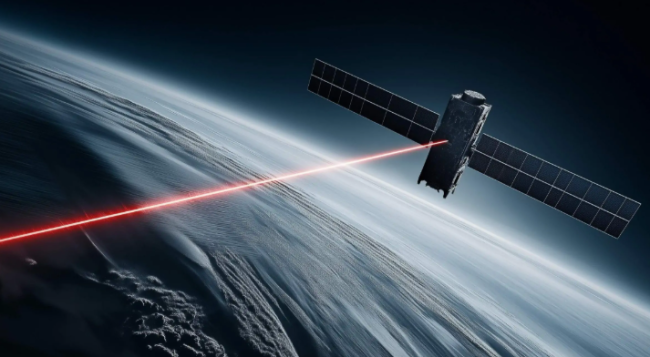
Here’s how it works. Sending signals by radio waves – the method used between satellites and Earth since Sputnik launched – hits a hard limit on data flow. Take a typical Ku-band connection using 500 MHz; its peak output reaches only several gigabits every second. Now picture light: a laser tuned to 1550 nm, with just 10 nm of spread, could handle up to about 1.25 terahertz in theory. That difference? Not just larger. Entirely new scale.
Out there among the stars, China’s satellite laser efforts take shape because radio frequencies just can’t handle tomorrow’s flood of data. One up-to-date imaging spy satellite gathers thousands of gigabytes each trip around the planet. Sending it all home using old-style X-band radio? That drags on for hours. But shoot the files with a light beam moving at 10 billion bits per second? Done before you know it. Speed hides in plain sight when photons replace waves.
The Micius Satellite Marks Milestone in Chinese Laser Space Communication:

Launched on August 16, 2016, the Micius quantum satellite stands out clearly among China’s efforts in laser-linked spacecraft. It marks a turning point – rarely has any mission reshaped space-based optical messaging so deeply over ten years. While others followed paths already lit, this one carved its own trail through quiet precision.
- A signal sent through space helped share secret keys across more than a thousand kilometers in 2017. Instead of relying on cables, the Chinese satellite Micius connected two distant ground points – Xinglong and Nanshan – with quantum encryption. This path stretched just over 1,200 km, exceeding what underground fibers could handle at that time. While earthbound networks struggled with distance limits, light particles beamed from orbit made long-range secure links possible. The experiment marked the first use of a satellite to enable such quantum communication between far-apart locations.
- A globe-spanning quantum talk happened in September two thousand seventeen. Beijing spoke live to Vienna using unbreakable encryption through space. The signal rode lasers from a Chinese satellite named Micius. Seven thousand six hundred kilometers separated the cities involved. This moment showed real-world use of advanced light signals from orbit. Secure government chats now had a new path across skies.
- Twelve hundred kilometers away, photons stayed linked through quantum ties – Micius made that happen where no experiment had reached before. Out there in orbit, the rules of physics faced their toughest trial yet under real cosmic conditions. A beam split by vastness still held its ghostly connection across continents. This leap pushed signals beyond past barriers into uncharted zones. Distance stretched thin, but the bond did not break.
- By 2020, sunlight no longer blocked secure quantum signals. The Micius group made daytime QKD work where it once failed. Solar interference used to drown everything out. Sharp filters sliced through the glare. Narrow wavelength selection helped spot faint photons. Precision alignment on the ground tightened control. Light from space slipped past the noise. Clear reception emerged midday. Background clutter dropped away. Detection became reliable even under full sun.
- At its highest point overhead, the Micius laser system managed about 1 Mbps in raw sifted key speed – slower than radio waves for large data transfers, yet proving how future Chinese satellite quantum experiments could align mechanically in orbit. While not built for heavy data loads, it laid groundwork others would follow using similar motion-based tracking approaches.
The Tech Setup of China’s Satellite Laser Links:

One way to look at China’s satellite laser setups is by noticing how different pieces fit across time, wavelengths, and uses. Not every beam does the same job – some handle quantum keys, others move regular data through space, while a few link satellites directly. Each type pushes engineers in separate directions, shaped by physics and purpose. What holds them together isn’t design but intent: getting light to carry information where metal cannot follow.
Most critical part? The unit grabbing, aiming, and holding the laser signal steady. Even when things shift in orbit, heat bends materials, or air wobbles light, this gear must stay precise. What separates early tests by china from reliable daily use boils down to how well this piece performs.
1: Acquisition Pointing and Tracking Systems
Keeping a laser on target between a Chinese satellite in low orbit and a station on Earth is extremely tough. Even though it moves seven and a half kilometers each second, the beam must stay locked within three millionths of a radian – about how wide a coin looks from seven thousand meters off. Shaking hardware, shifting air layers, and constant motion make that even harder.
Work from groups like the Changchun Institute of Optics, Fine Mechanics and Physics plus the National University of Defense Technology shows a split method. First comes rough alignment via a fast-steering mirror able to swing five degrees either way, reacting faster than a millisecond. That hands off to a delicate corrector – a tiny mirror moved by piezoelectric elements capable of adjustments smaller than one billionth of a radian.
2:m Wavelength Choices and Sky Transparency
Laser signals from Chinese satellites now mostly run at 1550 nanometers, matching the light used in ground-based internet cables. Because of this match, regular fiber optic boosters – those powered by erbium – fit right into the system without changes. This particular shade of infrared slips more easily through air compared to shorter ones like 780 or 850 nanometers, since gases overhead absorb it less. Earlier missions such as Micius relied on 780 nanometers; that choice tied back to how rubidium atoms store quantum information. Even so, newer models built for fast conventional data shifted away, locking instead onto 1550 as their go-to setting.
3: Coherent vs. Intensity-Modulated Direct-Detection Links
Laser talks between early Chinese satellites relied on switching the beam simply on and off – basic but effective. Instead of that method, newer efforts now lean on smarter ways to catch signals, like comparing wave shifts step by step or tracking twin signal lanes at once. These advanced methods let receivers pick up weaker whispers from space, gaining roughly three to six decibels in clarity.
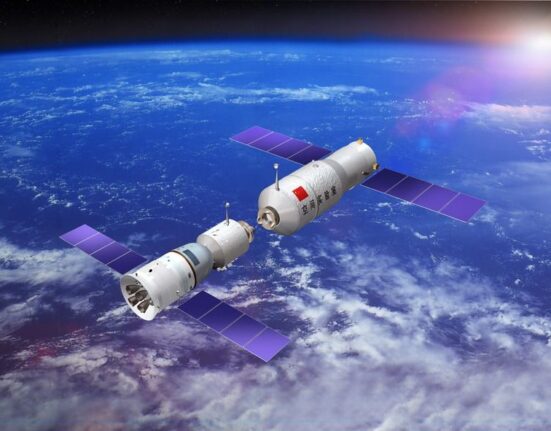
That edge means either reaching farther, sending faster, or using less energy while keeping reliability steady. In 2023, a test aboard China’s Tiangong outpost hit ten gigabits each second. It pulled it off using one of those refined techniques, precisely tuned to ride subtle changes in light waves. Choosing such a precise tool hints: what was once trial work has quietly become real-world tech.
Tiangong Space Station Serves China Satellite Laser Tests:
Years of real-space performance have poured into China’s orbiting lab since it started running in 2021. This floating base does more than host astronauts – it pushes light-based messaging further than any other setup on or above Earth. While labs down below try to mimic conditions, nothing matches what actually happens up there. Engineers now work with actual flight experience, something simulators simply cannot deliver:
- A speed of 10 Gbps was reached during a test in 2023. This link ran from Tiangong to Changchun on Earth. It kept steady performance over time. The connection used laser signals between satellite and ground. No earlier Chinese trial has shown faster results. Data moved at that rate without slowing. Results mark a new peak for such systems there.
- A twist in the setup – air wobbles get fixed on the fly by a mirror with 97 moving parts at the Changchun site. This sharpens the incoming light just enough to slide neatly into a narrow fiber channel. Smooth delivery happens because corrections happen faster than the blur can mess things up.
- Beaming several signals at once through one opening – Tiangong trials used different light colors to tell them apart. That method might let future Chinese satellites send data faster than ever before. Throughput heading toward terabits becomes possible without adding more hardware. One port, many streams, split by shade rather than space.
- Now tested between orbits: sending data via Tiangong, then bouncing it through Tianlian’s high-altitude relays down to Earth has proven how lasers can hop across multiple points. This web of light links fits right into what Guowang needs for its space-based network core.
- Out here, where skies sometimes block signals, Tiangong’s tests shine through. Its findings track how often clouds disrupt laser beams from low orbit down to Earth across China. This isn’t guesswork – real numbers, recorded over time, reveal actual gaps. Where connections flicker, answers start forming. Stations on land can now be spaced smarter, guided by evidence of what breaks and when. Laser paths between satellites and ground aren’t just shot into space blindly anymore. Decisions rely less on theory, more on patterns pulled straight from weathered sky routes. Each dropout becomes a clue for stronger setups later.
The Guowang Constellation and the Industrial Scale of China Satellite Laser Communication:
Guowang — meaning “national network” — is China’s government-backed LEO broadband megaconstellation, approved in 2020 and currently in early deployment. Its 12,992-satellite architecture is designed around china satellite laser communication inter-satellite links as the primary data transport mechanism between satellites, eliminating the traditional ground-station-relay topology that limits conventional RF constellations.
1: Shanghai Engineering Center for Microsatellites
The Shanghai Engineering Center for Microsatellites (SECM) is the primary production facility for Guowang’s initial deployment batches. Their laser terminal design, detailed in patents filed between 2020 and 2023, uses a 10 cm aperture transmit-receive telescope with a shared optical path — a monostatic configuration that reduces mass and volume compared to separate transmit and receive apertures. The published terminal mass budget is under 4 kg including electronics, targeting a terminal cost reduction to below $10,000 USD per unit at production volumes above 1,000 units per year. That cost trajectory, if achieved, makes china satellite laser communication economically viable for commercial constellation deployment at a scale that has no Western equivalent.
2: Production Capacity and Vertical Integration
China’s approach to building china satellite laser communication production capacity differs fundamentally from Western practice. Rather than relying on a small number of specialist optical component suppliers, Chinese space agencies have deliberately built vertically integrated supply chains. CIOMP manufactures optical components, photodetectors, and beam steering assemblies. The 13th Research Institute produces the laser diodes and semiconductor optical amplifiers. Assembly and test facilities at the Xichang and Wenchang launch centers can process completed satellites with laser terminals integrated and verified at a rate sufficient to support Guowang’s planned launch cadence of several hundred satellites per year.
3: Ground Infrastructure for Optical Links
A china satellite laser communication constellation only delivers its bandwidth advantage if the ground infrastructure can receive the optical signal. China has been building a network of Optical Ground Stations (OGS) since 2016, coordinated through the National Space Administration and the Chinese Academy of Sciences. Current confirmed facilities include Xinglong, Nanshan, Lhasa, Lijiang, and Ali — sites selected for low cloud cover frequency, high altitude, and geographic distribution to ensure statistical availability across China’s territory. The Lijiang facility, at 3,200 meters elevation in Yunnan Province, achieves clear sky fractions above 70% — the threshold typically considered minimum viable for LEO laser link operations without substantial ground diversity.
How China Satellite Laser Communication Compares to Global Competitors:
China satellite laser communication programs have developed in parallel with European, American, and Japanese efforts — and the comparison reveals both clear Chinese leads and areas where Western programs retain advantages.
The most meaningful comparison metric is not bandwidth but systems maturity: the degree to which a technology has transitioned from experimental demonstration to operational deployment with verifiable reliability statistics. By that measure, china satellite laser communication sits in a complex position — ahead in some categories, behind in others, and accelerating faster than any competitor.
- vs. ESA TESAT: Germany’s TESAT-Spacecom produces the laser terminals used on Alphasat, Sentinel, and European Data Relay System satellites; TESAT’s LCOD terminal achieves 1.8 Gbps on operational GEO-to-LEO links; china satellite laser communication has demonstrated higher peak throughput but TESAT has more cumulative operational hours.
- vs. NASA LLCD/LCRD: NASA’s Lunar Laser Communication Demonstration (LLCD) achieved 622 Mbps from lunar distance in 2013; LCRD has operated at 1.2 Gbps in GEO since 2021; china satellite laser communication now exceeds both in LEO throughput but has not demonstrated deep-space links.
- vs. SpaceX Starlink ISL: Starlink’s V2 satellites use laser inter-satellite links running at an estimated 100 Gbps between nodes; SpaceX has not published specifications; china satellite laser communication programs are almost certainly at lower ISL throughput currently but closing the gap.
- vs. SES O3b mPOWER: European MEO constellation using RF inter-satellite links, not optical; china satellite laser communication is directly competitive with this architecture for next-generation replacement designs.
- Quantum advantage: No Western operational satellite program has deployed QKD links; china satellite laser communication through Micius and its successors has a commanding lead in space-based quantum key distribution with no near-term Western challenger.
| Program | Country | Peak Throughput | Orbit | Link Type | Operational Status | QKD Capable |
| Micius / QUESS | China | 1 Mbps (QKD) | LEO 500 km | Ground-to-sat | Operational since 2016 | Yes |
| Tiangong FSO Exp. | China | 10 Gbps | LEO 390 km | Ground-to-sat | Experimental 2023 | No |
| Guowang ISL | China | ~10 Gbps (est.) | LEO 500–1200 km | Sat-to-sat | Early deployment | No |
| TESAT LCOD (EDRS) | Germany/ESA | 1.8 Gbps | GEO relay | GEO-to-LEO | Operational since 2016 | No |
| NASA LCRD | USA | 1.2 Gbps | GEO 35,786 km | GEO-to-ground | Operational since 2021 | No |
| Starlink V2 ISL | USA | ~100 Gbps (est.) | LEO ~550 km | Sat-to-sat | Operational | No |
| JAXA SOTA | Japan | 10 Mbps | LEO 628 km | Ground-to-sat | Experimental 2014 | No |
| Laser-COMM (Airbus) | EU | 10 Gbps (target) | LEO | Ground-to-sat | Development 2024 | No |
Military Implications of China Satellite Laser Communication Advances:
The national security dimensions of china satellite laser communication are not speculative — they are explicit in Chinese defense white papers, PLA-affiliated academic publications, and the structural design choices of military satellite programs.
China satellite laser communication for military applications addresses three specific operational problems that have plagued PLA space operations: bandwidth constraints on tactical reconnaissance data relay, vulnerability of RF command links to jamming and interception, and the limitations of ground-station-dependent relay architectures in contested environments.
1: Tactical Reconnaissance Data Relay
The PLA’s current-generation Yaogan reconnaissance satellites capture imagery and signals intelligence at volumes that outstrip their RF downlink capacity. Classified assessments suggest that tactical commanders in theater receive reconnaissance data with latency measured in hours — a direct consequence of RF bandwidth limits and limited downlink window availability. China satellite laser communication crosslinks integrated into a Guowang-style relay architecture would reduce this latency to minutes. The operational difference — for time-sensitive targeting, battle damage assessment, or ISR handoff between platforms — is the difference between actionable intelligence and historical record.
2: Jam-Resistance and RF Substitution
RF satellite command links can be jammed. The US and its allies maintain substantial electronic warfare capacity specifically designed to suppress satellite command, control, and data downlink channels in conflict scenarios. China satellite laser communication links are geometrically jam-resistant — the beam footprint at LEO altitude is physically smaller than the platform being targeted. Intercepting or jamming a 3-microradian divergence laser beam requires being within less than two meters of the intended receiver. No practical jamming system can achieve that. The PLA’s explicit interest in china satellite laser communication as an RF substitution technology for hardened military links is documented in papers published through the PLA National University of Defense Technology.
3 Inter-Theater Command Link Architecture
China’s military doctrine for large-scale joint operations requires continuous high-bandwidth links between command nodes separated by thousands of kilometers — across the Pacific, through the South China Sea operational zone, and between land-based command centers and naval task groups. A china satellite laser communication relay network using GEO and MEO satellites as optical relay nodes provides this connectivity with physical characteristics that make interception and jamming categorically harder than RF alternatives. The Tianlian-2 military data relay satellite series, which incorporates laser terminals in its published specifications, is the initial operational embodiment of this architecture.
The Quantum Satellite Network: China’s Most Unique China Satellite Laser Communication Achievement:
China’s quantum satellite network represents the one domain within china satellite laser communication where the country has no peer and no near-term challenger. The Micius demonstration has been followed by a program of expanding quantum network infrastructure that explicitly aims for a continental and eventually global quantum-secured communication backbone.
- Beijing-Shanghai quantum backbone: 2,000 km fiber quantum key distribution network connecting 32 relay nodes, operational since 2017 and integrated with Micius for satellite relay segments — the world’s first hybrid satellite-terrestrial quantum network.
- Micius-2 (planned): Next-generation QKD satellite with improved photon collection efficiency and daylight operational capability; intended to achieve 10× improvement in key generation rate over Micius baseline.
- Quantum constellation concept: CNSA and Chinese Academy of Sciences have published architecture studies for a 10-satellite quantum relay constellation that would provide continuous global QKD coverage — a capability with no Western programmatic equivalent.
- Mobile ground terminals: Chinese teams demonstrated QKD from Micius to a mobile receiver mounted on a ship in 2022 — extending china satellite laser communication quantum capability from fixed ground stations to tactical military platforms.
- Integration with 5G security infrastructure: China’s national quantum communication network, partially satellite-relayed, has been formally integrated into the government secure communications infrastructure serving financial regulators and classified government networks since 2020.
The Ground Station Network Supporting China Satellite Laser Communication:
An orbiting laser terminal is operationally useless without a ground network capable of receiving and routing its signals. China has invested as heavily in ground infrastructure as in space segments — a systems-level discipline that Western programs have sometimes underestimated.
The architecture of China’s china satellite laser communication ground network reflects a deliberate strategy of geographic redundancy and atmospheric window optimization. Cloud cover is the fundamental adversary of any ground-based optical receiver — a cloud overhead means a lost pass. The Chinese OGS network is designed to achieve statistical availability above 95% for any given satellite pass by ensuring that at least two geographically separated stations with uncorrelated weather are available at all times.
1: The Optical Ground Station at Ali, Tibet
The Ali Optical Ground Station, located at 5,100 meters elevation on the Tibetan Plateau, is China’s highest-altitude and most capable china satellite laser communication ground facility. At that elevation, the station sits above approximately 50% of Earth’s atmospheric mass, dramatically reducing the turbulence and absorption that degrade optical links at lower altitudes. The facility uses a 1-meter primary aperture telescope with active adaptive optics and has been the primary ground node for both Micius quantum experiments and the Tiangong 10 Gbps data relay demonstrations. Its location in western Tibet also gives it favorable geometry for passes over key orbital inclinations used by Chinese military reconnaissance satellites.
2: Urban Ground Station Integration
One of the most significant recent developments in china satellite laser communication ground infrastructure is the demonstration of building-rooftop optical ground stations in urban environments. A 2022 experiment conducted in Shanghai placed a compact 20 cm aperture OGS on a commercial building rooftop and successfully established a QKD link with Micius despite significant urban light pollution and aerosol loading. The key enabling technology was a narrow spatial filter — a 25-microradian field-of-view optical mask — that blocked background light while passing the satellite signal. This demonstration opens the possibility of dense urban china satellite laser communication ground networks without dedicated remote facilities.
3: Maritime and Airborne Terminals
China has demonstrated china satellite laser communication links with maritime and airborne platforms, extending the ground network beyond fixed terrestrial nodes. The 2022 ship-based QKD demonstration was followed in 2023 by an aircraft-to-satellite optical data link experiment using a modified commercial aircraft carrying a gimbal-mounted 15 cm aperture terminal. Maintaining sub-microradian pointing accuracy from a vibrating, maneuvering aircraft platform is considerably harder than from a fixed ground station — the Chinese team reported a link availability of 78% across a 20-minute flight segment, a number that validates the technical approach even while identifying the pointing stability challenge that must be solved for operational deployment.
Chinese Academic and Industrial Research Driving China Satellite Laser Communication:
The depth of Chinese institutional investment in china satellite laser communication research is visible in publication metrics, patent filings, and the career trajectories of researchers who move from academic positions directly into program roles at CASC, CAST, and affiliated defense institutes.
Changchun Institute of Optics, Fine Mechanics and Physics has published more peer-reviewed papers on free-space optical communication and laser APT systems than any other single institution globally over the past five years. Their output in 2022–2023 alone included detailed characterizations of atmospheric turbulence statistics at Tibetan Plateau altitudes, novel fast steering mirror designs achieving sub-microradian pointing stability, and coherent detection receiver architectures achieving within 1 dB of the Shannon limit at 10 Gbps — results that would be noteworthy from any institution globally.
Tsinghua University’s Quantum Information Center has been the academic lead for Micius experiment design and data analysis. Their publications in Science, Nature Photonics, and Physical Review Letters have defined the theoretical framework within which every subsequent china satellite laser communication QKD program has been designed. The Center’s current focus on satellite-mediated quantum memory protocols — experiments that store photonic qubits in atomic ensembles for relay across multiple satellite hops — represents the next technical frontier for china satellite laser communication quantum networks.
The Commercial Dimension of China Satellite Laser Communication:
China’s government programs are the most visible element of china satellite laser communication development, but a growing commercial ecosystem is emerging that operates alongside the state-led programs with genuine market orientation.
CAS Space, SpaceSail, Commsat, and GalaxySpace are among the commercial Chinese operators who have explicitly incorporated laser inter-satellite links into their constellation designs. GalaxySpace — backed by Alibaba and state capital — demonstrated a 10 Gbps inter-satellite optical link between two LEO satellites in 2023, the first commercially developed chinese laser inter-satellite link demonstration. The company’s Thousand Sail constellation plan calls for 1,000 satellites with optical ISLs — a direct competitive challenge to Starlink’s laser-linked architecture.
The commercial angle matters for china satellite laser communication technology diffusion. Government programs develop technology; commercial programs drive down cost through volume production. The competitive dynamic between Guowang (state) and the GalaxySpace/SpaceSail commercial operators is accelerating both technology development and manufacturing cost reduction in ways that government-only programs cannot achieve alone.
What China Satellite Laser Communication Means for the Future of Global Connectivity:
China satellite laser communication has moved decisively beyond laboratory demonstration. The question is no longer whether optical satellite links work — ten years of Chinese orbital experiments have answered that. The question is what a world looks like when China operates a fully deployed optical inter-satellite link constellation while controlling the dominant global QKD satellite infrastructure.
The bandwidth implications are transformative. A fully deployed Guowang constellation with operational optical inter-satellite links would carry data volumes comparable to a significant fraction of current global internet backbone capacity — from orbit, globally, without depending on any terrestrial cable infrastructure. The geopolitical implications of that capability — for surveillance, for financial communications, for military command — are profound and not yet adequately analyzed in Western policy circles.
China satellite laser communication also sets the performance floor for the next generation of Earth observation, scientific, and commercial satellite programs globally. Any constellation that wants to compete with Guowang’s data relay performance must incorporate optical links. ESA’s HYDRON program, NASA’s future Space Optical Communications Relay (SOCR) concepts, and Japan’s JDRS system are all explicitly responses to the competitive pressure that china satellite laser communication programs have created.
The 2030s will be defined, in orbital infrastructure terms, by who can deploy operational laser inter-satellite links at scale and at cost. China has demonstrated the technology, built the industrial base, and committed the policy resources. Whether Western programs can close the gap depends on decisions being made right now.
FAQ’s:
Q1: What is China satellite laser communication and why does it matter?
China satellite laser communication uses laser beams instead of radio waves to transmit data between satellites and ground stations at terabit-range capacities.
Q2: What was the Micius satellite’s key achievement in laser communication?
Micius demonstrated the first intercontinental quantum key distribution link over 7,600 km using satellite-relayed laser photons in 2017.
Q3: How fast is China’s satellite laser communication compared to radio frequency links?
The Tiangong station achieved 10 Gbps optical downlink — roughly 1,000 times faster than a typical high-throughput RF satellite downlink.
Q4: Does China’s laser satellite communication have military applications?
Yes — jam-resistant optical inter-satellite links for reconnaissance relay and command communications are explicit PLA development priorities.
Q5: What is Guowang and how does it use laser communication?
Guowang is China’s 12,992-satellite LEO constellation designed with optical inter-satellite links as the primary data transport backbone between nodes.
Conclusion:
China satellite laser communication has crossed the threshold from experimental to operational — and its trajectory is accelerating. Track Guowang deployment cadence through Space-Track.org, follow CIOMP and Tsinghua publications for technical benchmarking, and treat China satellite laser communication not as a future threat but as a present-tense capability reshaping the global satellite architecture right now.