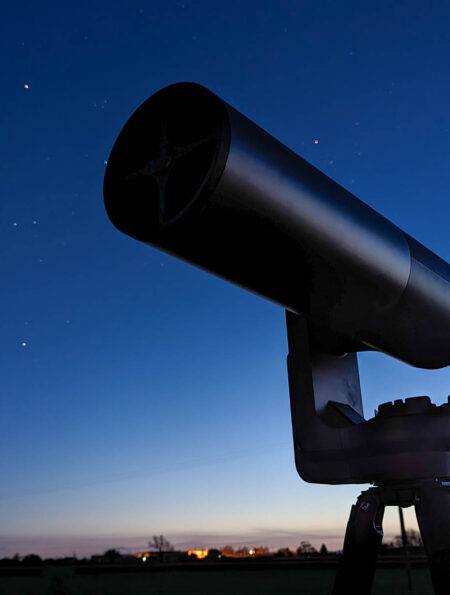
Professional Telescope: 10 Incredible Features for Advanced Astronomy!
I spent eleven days at the Kitt Peak National Observatory site in Arizona as part of an advanced observer program, working alongside staff astronomers who let me handle and observe through instruments ranging from a 16-inch Ritchey-Chrétien to a 36-inch Cassegrain. On day four, I was allowed to observe through the 2.1-meter telescope during a brief maintenance window — an experience that fundamentally reset my understanding of what professional telescope optics actually deliver versus what the amateur market approximates. The gap is enormous. And understanding exactly where that gap begins and ends is what determines whether a serious amateur’s investment in a professional telescope grade instrument produces genuine scientific results or just expensive disappointment.
A professional telescope isn’t defined by its price tag — it’s defined by the uncompromising optical and mechanical standards that separate instruments built for sustained scientific use from everything else sold as astronomy equipment. This guide covers every dimension of that distinction with the specificity that serious buyers actually need.
Explore the capabilities of a professional telescope, including superior optics, powerful magnification, and advanced tracking systems designed for serious astronomers and astrophotographers.
What Defines a Professional Telescope — The Technical and Institutional Standards That Actually Matter:
The term “professional telescope” gets applied loosely across the market. Manufacturers use it to describe $800 instruments. Serious astronomers reserve it for something far more demanding. Getting precise about the definition matters because it directly shapes what you should spend and what you should expect.
A professional telescope, by the standards of working astronomers, satisfies three criteria simultaneously. First, its optical system delivers diffraction-limited performance — meaning the only thing limiting image resolution is the physical wave nature of light itself, not manufacturing imperfections, optical aberrations, or thermal instability. Second, its mechanical system maintains alignment and pointing precision within fractions of an arcsecond over hours of continuous operation. Third, its design supports scientific instrumentation — cameras, spectrographs, photometers, adaptive optics systems — without compromising optical integrity.
Consumer telescopes, even expensive ones, typically meet the first criterion only partially, the second intermittently, and the third not at all. That’s not a criticism — it reflects the different engineering priorities of instruments built for personal enjoyment versus instruments built to generate publishable data.
The practical implication: when the serious amateur market uses “professional telescope” as a product descriptor, they generally mean instruments that approach professional performance standards in specific, defined areas. A Takahashi TOA-150 apochromatic refractor delivers genuinely professional-grade optical quality. Its mount, however, is not what an observatory would use. That partial achievement of professional standards is still enormously valuable — it just needs to be understood clearly before purchase.
The question isn’t whether a professional telescope is worth buying. It absolutely is, for the right observer. The question is which specific professional telescope attributes matter most for your observing goals, and which compromises are acceptable given budget constraints.
The Five Optical Designs Found in Professional Telescopes — And Where Each One Excels:

Every professional telescope uses one of five optical architectures. The choice between them isn’t arbitrary:
- Ritchey-Chrétien (RC) — The dominant design in large professional research observatories. Hyperbolic primary and secondary mirrors eliminate coma across a wide field. The Hubble Space Telescope is an RC. Amateur RC instruments from 8 to 16 inches offer genuine professional telescope optical geometry at accessible prices.
- Apochromatic Refractor (APO Triplet/Quadruplet) — The professional telescope standard for solar system imaging and astrometry. Three or four lens elements achieve color correction across visible and near-infrared wavelengths. Takahashi, Astro-Physics, and TEC produce the reference instruments in this category.
- Corrected Dall-Kirkham (CDK) — A modern professional telescope design by optical engineer David Dall-Kirkham and later refined by Planewave Instruments. Flat, wide corrected field with no coma or off-axis astigmatism — ideal for large-format imaging sensors.
- Classical Cassegrain — Long focal lengths in compact tubes. Used extensively in professional spectroscopy rigs and photometry setups. Less common in modern observatories but well-represented in university departmental telescopes.
- Nasmyth/Coude Reflex — Professional telescope configurations found in large observatory instruments where the focal point must be externally accessible for heavy instrumentation. Not available commercially at any consumer price point.
Apochromatic Refractors: The Professional Telescope Standard for Optical Purity:
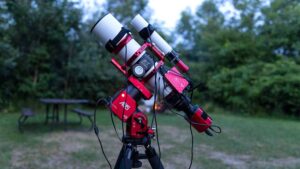
Apochromatic refractors occupy a unique position in the professional telescope hierarchy — they’re the design where amateur and professional optical standards overlap most directly. A Takahashi TOA-150 or Astro-Physics Starfire 160 isn’t a compromise instrument. It’s a genuinely professional telescope in its optical category, used by working astronomers for solar system monitoring, asteroid astrometry, and precision photometry.
Understanding why APO refractors achieve this status requires looking at the glass chemistry and manufacturing tolerances that separate them from ordinary achromats — and those details explain both the exceptional performance and the exceptional pricing.
1: ED Glass, Fluorite, and the Physics of Chromatic Correction
Standard crown and flint glass corrects chromatic aberration at two wavelengths. Apochromatic correction uses extra-low dispersion (ED) glass, fluorite crystal (calcium fluoride), or synthetic fluorite equivalents to bring three or more wavelengths to the same focal point simultaneously. In practice, this means a professional telescope APO refractor produces images with essentially no chromatic fringing around bright objects — a characteristic measurably different from an achromatic doublet at any aperture. Takahashi uses fluorite as the primary element in their FC and FSQ series. Astro-Physics uses proprietary ED glass formulations. The optical result is identical in principle; the manufacturing specifics differ by company.
2: The Strehl Ratio: How Professional Telescopes Are Actually Measured
Consumer telescopes are rated by maximum magnification. Professional telescope optics are rated by Strehl ratio — a measure of how closely the actual wavefront error matches the theoretical diffraction limit, expressed as a decimal from 0 to 1.0. A perfect optical system achieves Strehl 1.0. A professional telescope standard is typically defined as Strehl 0.80 or better, often called “diffraction limited.” Takahashi’s factory test certifications regularly report Strehl ratios above 0.95 for their premium APO objectives. Understanding Strehl ratio is the single most important conceptual shift from amateur to professional telescope evaluation.
3: Field Flatteners and Their Role in Wide-Field Professional Telescope Systems
An APO refractor without a field flattener produces sharp stars at the center of the image circle and soft, elongated stars toward the edges — acceptable for visual use, problematic for imaging with large sensors. Professional telescope imaging systems integrate field flattener/reducer optics that correct field curvature across the entire image circle. The Takahashi FSQ-106ED with its built-in field flattener produces a flat, sharp field across a 44mm image circle — large enough for full-frame camera sensors. That specific capability is why it became the reference instrument for wide-field survey imaging in the serious amateur community.
Ritchey-Chrétien Telescopes: Why the Most Serious Imagers Choose This Professional Telescope Design:
The Ritchey-Chrétien configuration appears in every major research observatory for one reason: it produces the flattest, widest corrected field of any two-mirror reflector design. For astrophotography at any scale, that field flatness translates directly into usable image area:
- Coma-free field — RC optics eliminate the coma aberration that plagues classical Newtonians at the image edges, producing point-like star images across the entire field without a corrector plate.
- Wide corrected field at f/8 — Most amateur RC professional telescope designs operate at f/8, giving a relatively long focal ratio that’s forgiving of guiding errors while maintaining a workable image scale for deep-sky targets.
- Native imaging readiness — Unlike a Newtonian that requires a coma corrector, or an SCT that requires a field flattener/reducer, an RC professional telescope works directly with a camera — though many users add a dedicated field corrector for the largest sensors.
- Mirror-based achromatism — Mirrors don’t disperse light by wavelength. An RC professional telescope delivers identical focus positions for red, green, blue, and infrared light — critical for multi-filter photometric work.
- Scale at f/8 with long focal lengths — A 12-inch RC at 2,400mm focal length produces an image scale of approximately 0.7 arcseconds per pixel with a typical astronomy camera — ideal resolution for the 1–2 arcsecond seeing common at most US observing sites.
Corrected Dall-Kirkham Telescopes: The Modern Professional Telescope Architecture Taking Over Serious Imaging:
The CDK design is, for many working professionals and advanced amateurs, the definitive professional telescope for imaging-focused applications. Planewave Instruments, based in California, has built its entire company around this design — and the adoption of Planewave CDK instruments by universities, research institutions, and remote observatory networks validates that commercial bet decisively.
The CDK overcomes the primary weakness of the classical Dall-Kirkham design — off-axis coma — by adding a corrector lens group that produces a flat, wide, coma-free field covering large-format sensors without additional accessory optics.
1: The Planewave CDK 12.5 — A Reference Standard Professional Telescope
The Planewave CDK 12.5 has become a reference instrument for the serious imaging community. Its 318mm aperture, 2541mm focal length at f/8, and 52mm corrected image circle cover a full-frame 35mm sensor with point-source stars to the corners. The professional telescope optical quality is substantiated by the instrument’s deployment in university observatories, citizen science networks, and remote hosting facilities worldwide. What makes it genuinely professional isn’t just the optics — it’s the interface: the CDK 12.5 integrates directly with Planewave’s own L-Series direct drive mounts, and the combined system achieves sub-arcsecond pointing accuracy and tracking precision below 0.3 arcseconds RMS. That performance level doesn’t exist in any consumer telescope mount pairing at any price.
2: Truss Tube Design and Thermal Stability
CDK professional telescope instruments use open truss tube designs that allow rapid thermal equilibration — the tube reaches ambient temperature within 30 minutes rather than the 60 to 90 minutes required by enclosed tubes. Thermal equilibration matters profoundly for a professional telescope because a tube containing air warmer than ambient generates internal turbulence that degrades image quality independently of atmospheric seeing. The truss design eliminates that self-inflicted degradation.
3: Remote Observatory Integration
The CDK design’s most commercially significant feature for US buyers is its architecture for remote operation. Integrated focusers with absolute position encoding, rotators that maintain field orientation across filter changes, and communication protocols that integrate directly with observatory automation software like Sequence Generator Pro and N.I.N.A. make the CDK the professional telescope of choice for unattended robotic observatory operation. Remote observatories in New Mexico, Arizona, and Chile running CDK instruments generate scientific-quality data on schedules no human observer could maintain.
Professional Telescope Mounts: The Mechanical Foundation That Either Enables or Destroys Everything:
The professional telescope optical tube is only half the system. The mount determines whether those optics produce usable data or beautiful but scientifically worthless imagery:
- Direct drive vs. gear drive — Professional observatory mounts increasingly use direct drive motors with no gears — eliminating periodic error, backlash, and gear wear simultaneously. The Planewave L-600 achieves 0.3 arcsecond RMS tracking without autoguiding — a performance standard on gear-driven mount approaches.
- Periodic error magnitude — The tracking error introduced by gear eccentricities in most commercial mounts runs 10 to 30 arcseconds peak-to-peak without correction. A professional telescope mount corrects PE below 3 arcseconds through precision gear manufacturing, and below 1 arcsecond with electronic periodic error correction.
- Payload capacity and real-world margins — A professional telescope imaging system including the optical tube, camera, filter wheel, focuser, guide scope, and cabling can easily weigh 40 to 60 pounds. The mount’s rated payload capacity should exceed that total by at least 30 percent for stable, accurate tracking performance.
- Polar alignment precision — Professional observatory equatorial mounts achieve polar alignment within 30 arcseconds using drift alignment or software-assisted plate solving. That precision level is required to maintain tracking accuracy during multi-hour imaging sessions without field rotation drift.
- Software integration depth — A professional telescope system in 2025 communicates via ASCOM or INDI protocols with planetarium, sequencing, plate solving, and autoguiding software simultaneously. The mount’s firmware determines how seamlessly that integration operates.
| Professional Telescope Model | Aperture | Design | Focal Length | Focal Ratio | Corrected Field | Mount Compatibility | Street Price (USD) | Primary Use |
| Takahashi TOA-150B | 150mm | APO Refractor (triplet) | 1,100mm | f/7.3 | 44mm circle | Temma 2Z, EM-400 | ~$12,000 (OTA) | Visual + imaging |
| Astro-Physics Starfire 160 EDF | 160mm | APO Refractor (triplet) | 1,200mm | f/7.5 | 45mm circle | AP 1100/1600 GTO | ~$14,500 (OTA) | Precision imaging |
| Planewave CDK 12.5 | 318mm | CDK Reflector | 2,541mm | f/8 | 52mm circle | L-Series direct drive | ~$10,000 (OTA) | Research imaging |
| Planewave CDK 17 | 432mm | CDK Reflector | 2,939mm | f/6.8 | 60mm circle | L-600 direct drive | ~$23,000 (OTA) | Observatory imaging |
| Celestron RASA 11 | 279mm | Rowe-Ackermann Schmidt | 620mm | f/2.2 | 42mm circle | CGX-L, custom | ~$4,200 (OTA) | Wide-field imaging |
| RC Optical Systems 12.5″ Truss | 318mm | Ritchey-Chrétien | 2,540mm | f/8 | 35mm corrected | Paramount, L-Series | ~$11,000 (OTA) | Photometry/imaging |
| TEC 180FL | 180mm | APO Refractor (fluorite) | 1,260mm | f/7 | 44mm circle | AP 1100, Paramount | ~$16,000 (OTA) | Solar system + imaging |
| Meade 16″ LX600 ACF | 406mm | ACF (SCT variant) | 4,064mm | f/10 | 35mm usable | StarLock integrated | ~$9,000 (system) | Visual + imaging |
Spectrographs and Scientific Instruments Paired With Professional Telescopes:
Visual observing represents only a fraction of what a professional telescope actually does in scientific practice. Spectroscopy — the analysis of light separated by wavelength — is where professional telescopes generate the majority of published astronomical data, and the accessibility of spectrographic instruments to serious amateurs has expanded dramatically over the past decade.
The integration of a spectrograph transforms a professional telescope from an imaging instrument into a physics laboratory capable of measuring stellar radial velocities, chemical abundances, stellar temperatures, and exoplanet atmospheric signatures.
1: The LHIRES III Spectrograph and Amateur Professional Telescope Science
The LHIRES III, manufactured by Shelyak Instruments in France, is the reference instrument for amateur professional telescope spectroscopy. At roughly $2,500, it couples to any professional telescope with a standard focuser and produces spectra with resolution sufficient to measure Doppler shifts in bright stellar targets. Observers using LHIRES III units on 8-inch to 14-inch professional telescopes have contributed published variable star radial velocity curves to the astronomical literature — genuinely professional science conducted from backyard observatories. The American Association of Variable Star Observers (AAVSO) maintains an active spectroscopy section that coordinates these observations.
2: Photometry: The Precision Measurement Application of Professional Telescopes
Precision photometry — measuring stellar brightness to fractions of a percent — is one of the most scientifically productive applications of a professional telescope in an amateur-accessible context. Exoplanet transit detection requires measuring the brightness of a host star to 0.1 percent accuracy or better as an orbiting planet blocks a fraction of its light. A 12-inch RC or CDK professional telescope with a cooled monochrome camera and a set of photometric filters (Johnson BVRI or Sloan ugriz) produces photometric accuracy sufficient to detect transits of hot Jupiter-sized planets around bright host stars. Multiple amateur observers using this configuration have submitted follow-up transit observations to NASA’s Exoplanet Archive.
3: Adaptive Optics at the Amateur Level
Large professional observatory telescopes use adaptive optics (AO) systems that measure atmospheric wavefront distortion 1,000 times per second and correct it with a deformable mirror — producing images near the diffraction limit from the ground. Amateur AO systems at the professional telescope level exist in limited form: Celestron’s older AO-8 and Starlight Xpress’s Lodestar AO unit apply partial correction that meaningfully improves guide star tracking and sharpness for smaller apertures. Full wavefront-correcting AO at the amateur level remains a research frontier, but the commercial availability of wavefront sensors from Thorlabs and others suggests that affordable amateur AO is a 5 to 10-year horizon technology.
Solar Observing With a Professional Telescope: White Light, H-Alpha, and Calcium-K:
The Sun is the one astronomical target that rewards professional telescope investment from observers limited to daylight hours. Solar astronomy using a professional telescope with appropriate filtration produces scientifically valid observations of sunspot activity, solar flares, prominences, and filaments:
- White light filtration — An optical glass or Baader Astrosolar film filter over the aperture of any professional telescope produces safe, high-contrast sunspot images. The Seymour Solar glass filter for 5-inch to 8-inch apertures allows sunspot penumbra and umbra detail at professional-quality image scales.
- H-alpha narrowband filtration — Dedicated H-alpha solar telescopes from Lunt Solar Systems and DayStar Instruments use etalon filters that pass only 0.5 to 0.7 angstroms of light centered on the hydrogen-alpha emission line at 656nm, revealing chromospheric detail — prominences, filaments, flares — invisible in white light.
- Calcium-K imaging — CaK filtration at 393nm reveals magnetic network structure in the solar chromosphere. The PST-Ca (calcium version) and Lunt CaK modules for professional telescope systems produce images used in solar cycle research.
- Continuum band solar imaging — Narrow solar continuum filters at 540nm or 600nm, used with a professional telescope at 0.5 arcseconds-per-pixel image scale, can resolve solar granulation — the convective cells approximately 1,000 km across that tile the photospheric surface.
- Solar spectroscopy — An H-alpha spectrograph on a professional telescope resolves the Doppler shift of individual prominence material, measuring speeds of solar plasma in real time — a genuinely professional measurement available to equipped amateur observers.
Selecting a Mount for Your Professional Telescope: The Decision Tree That Most Buyers Rush:
The mount selection decision is where more professional telescope investments go wrong than anywhere else in the system. Buyers spend months evaluating optical tubes and then rush the mount decision, often treating it as a secondary component. That priority inversion produces systems where exceptional optics sit on inadequate mechanical foundations.
The mount decision for a professional telescope system runs through four sequential filters, and skipping any one of them produces a mismatched system that underperforms regardless of optical quality.
1: Payload Analysis: Starting From Real Numbers
Before evaluating any mount for a professional telescope system, calculate your complete payload weight. Include the optical tube assembly, camera, filter wheel, off-axis guider or guide scope, focuser motor, rotator if used, dew heaters, and all connecting hardware. Then add 25 percent. That final number is your minimum mount payload rating. A mount rated at 60 lbs carrying a 60-lb load runs at 100 percent of rated capacity — meaning any additional cable tension, wind gust, or mechanical imprecision puts the mount into performance-degrading territory. The 25-percent buffer isn’t conservative paranoia; it’s the margin that separates consistent data from intermittent frustration.
2: Tracking Precision Requirements by Application
Different professional telescope applications demand different tracking precision levels. Visual observation requires tracking accurate enough to keep objects in the field of view — roughly 10 to 15 arcseconds RMS is sufficient. Planetary imaging with lucky imaging techniques tolerates 5 to 10 arcseconds because short exposure times freeze atmospheric and tracking motion simultaneously. Deep-sky imaging with guided exposures over 60 seconds requires sub-2-arcsecond RMS guided tracking. Unguided precision photometry demands sub-arcsecond RMS unguided tracking — a standard only direct-drive professional telescope mounts currently achieve reliably.
3: German Equatorial vs. Alt-Az for Professional Telescope Use
German equatorial mounts (GEMs) dominate the professional telescope market for imaging because they provide a single-axis tracking solution aligned to the celestial pole. The trade-off is meridian flip — when the telescope crosses the meridian, the tube must reposition to the other side of the mount to prevent hardware collision, interrupting imaging sequences at the worst possible moment. Alt-azimuth GoTo mounts with field derotators offer uninterrupted sky access but introduce image rotation that requires software correction. For the majority of professional telescope imaging applications, a GEM with automated meridian flip sequencing in software remains the standard choice.
Remote Professional Telescope Operations: The New Standard for Productive Observing:
The most productive professional telescope observers in the US today aren’t necessarily the ones with the best local sky conditions. They’re the ones who have deployed instruments remotely at dark-sky hosting facilities — and the infrastructure supporting that model has matured to the point where a serious amateur can operate a professional telescope in New Mexico from an apartment in Chicago with essentially zero degradation in observing quality.
Remote hosting facilities like New Mexico Skies, Deep Sky West in New Mexico, Sierra Remote Observatories in California, and Rancho Hidalgo in New Mexico offer climate-controlled pier pads, reliable power, fiber internet connections, and weather monitoring that trigger automated dome closures. Monthly hosting fees run $150 to $400 depending on pier space, power draw, and facility services — affordable when amortized against the equipment investment.
The software stack that makes remote professional telescope operation practical: ASCOM/INDI device drivers for mount, camera, focuser, and dome communication; N.I.N.A. or Sequence Generator Pro for automated imaging sequences; PHD2 for autoguiding; ASTAP or AstroTortilla for plate solving; and ACP Observatory Control Software for full observatory automation. A properly configured professional telescope remote system runs all-night imaging sequences that begin automatically at nautical twilight, select targets based on altitude and remaining darkness, plate-solve to verify pointing, focus using mask or Bahtinov analysis, and shut the dome at morning twilight — without human intervention.
Maintaining a Professional Telescope: Mirror Coatings, Collimation, and Long-Term Optical Care:
Professional telescope optical maintenance separates owners who get consistent, excellent performance from those who watch image quality degrade over months and attribute it to “atmospheric conditions.”
Mirror coatings in reflector-based professional telescope systems are the most critical maintenance variable. Aluminum coatings degrade over time through oxidation, condensation exposure, and particulate contamination. A fresh aluminum coating with silicon dioxide overcoat reflects approximately 88 to 92 percent of incident light. After three to five years without re-coating, reflectivity can drop to 70 to 75 percent — a loss of 15 to 20 percent of the light the professional telescope was designed to deliver. Observatory mirrors are re-coated every three to seven years depending on use conditions. Local coating facilities (Spectrum Coatings in Florida, Nova Optical in Colorado) offer primary mirror re-coating services for amateur professional telescope instruments at $300 to $800 depending on mirror diameter.
Collimation for a professional telescope RC or CDK instrument requires a laser collimator, an autocollimator, or a Ronchi tester — not eyeball alignment or cheap laser tools. Planewave provides step-by-step collimation documentation for their CDK instruments, and the process — while more involved than a Newtonian — produces quantifiably superior results when followed precisely.
The Investment Reality: What a Complete Professional Telescope System Actually Costs in the US:
Honesty about total system cost separates productive planning from expensive surprises. A complete professional telescope system — instrument, mount, camera, accessories, and observatory enclosure — represents a significant capital investment:
An entry-level professional telescope system built around a 5-inch APO refractor, a Sky-Watcher EQ6-R Pro mount, a cooled CMOS camera, and a basic set of narrowband filters runs approximately $5,500 to $7,000 total. That system delivers genuine professional telescope optical quality for solar system imaging and narrowband deep-sky work.
A mid-level professional telescope system centered on a Planewave CDK 12.5, an L-350 direct drive mount, a QHY 268M monochrome camera, and a 5-filter photometric set totals approximately $28,000 to $35,000. That system produces research-quality photometric and spectroscopic data.
A reference-level professional telescope system — Planewave CDK 17, L-600 mount, large-format monochrome sensor, spectrograph, full remote observatory enclosure — approaches $80,000 to $100,000. This is the territory of university departmental observatories and well-funded amateur research programs.
The return on those investments, measured in scientific productivity and observing satisfaction, scales with commitment and technical mastery. The professional telescope is the instrument. The astronomer operating it determines whether it produces science or snapshots.
FAQ’s:
Q1: What makes a telescope qualify as a professional telescope?
Diffraction-limited optics, sub-arcsecond mechanical precision, and compatibility with scientific instrumentation define professional telescope standards.
Q2: How much does a professional telescope cost for serious amateurs?
A capable entry-level professional telescope system starts at approximately $5,500 to $7,000 fully equipped.
Q3: Is a Celestron or Meade considered a professional telescope?
Their premium ACF and EdgeHD models approach professional telescope optical standards but use consumer-grade mounts.
Q4: What is the best professional telescope for astrophotography?
The Planewave CDK series and Astro-Physics APO refractors represent the current professional telescope standard for imaging applications.
Q5: Can a professional telescope be used for daytime solar observation?
Yes, with appropriate white light or narrowband H-alpha filtration — never without proper solar filtration under any circumstances.
Conclusion:
Identify your primary application — planetary imaging, deep-sky photometry, spectroscopy, or solar monitoring — before spending a dollar on a professional telescope system. Match aperture and optical design to that specific goal. Budget the mount at minimum 40 percent of total system cost. Those three decisions, made deliberately, determine everything about long-term performance and scientific productivity.