The sct telescope is the most misunderstood optical instrument in amateur astronomy — and simultaneously the most rewarding one you’ll ever own. Choosing wrong here costs hundreds of dollars and months of frustration.An SCT telescope combines powerful magnification with a compact design, making it popular among beginner and advanced astronomers alike.Known for sharp planetary and deep-sky views, an SCT telescope offers excellent performance for stargazing and astrophotography.
Discover everything about SCT telescopes in this guide. Learn 10 essential and amazing facts, features, and expert tips to get the best stargazing experience.
1. What Exactly Is an SCT Telescope and Why Does the Design Matter:

The sct telescope — short for Schmidt-Cassegrain Telescope — combines a spherical primary mirror with a corrector plate and a convex secondary mirror to fold a long focal length into a compact tube. The optical path bounces light twice, which is why an sct with an 8-inch aperture and a 2,000mm focal length fits inside a tube barely 18 inches long. That’s not a minor engineering trick. That’s the reason an entire generation of backyard astronomers could finally transport serious aperture in the back of a hatchback.
The Schmidt corrector plate at the front entrance pupil corrects the spherical aberration introduced by the primary mirror. Without it, point sources like stars would smear into blobs across the field. With it, the sc t telescope achieves diffraction-limited performance across a wide range of eyepiece focal lengths. The secondary mirror sits centrally on the corrector plate and is adjustable, which is both a feature and a responsibility — collimation matters, and an out-of-collimation sct telescope is a different instrument entirely from a well-tuned one.
Focal ratios typically run f/10 for standard SCT designs, though EdgeHD and RASA variants push this to f/7 or f/2. The high focal ratio of a classic sct telescope makes it naturally suited for planetary work and double-star splitting. Wide-field deep-sky imaging requires a focal reducer, typically reducing the system to f/6.3.
2. The 5 Core Advantages That Make the SCT Telescope Unbeatable:
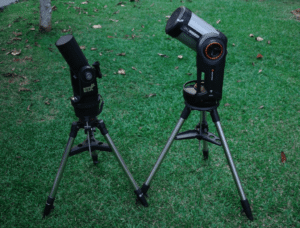
Serious observers who’ve owned multiple telescope types keep coming back to the sct telescope for specific, concrete reasons. Here’s what actually drives that loyalty:
- Aperture-to-portability ratio is unmatched — A 12-inch sct weighs around 30 lbs and packs into a single duffel bag, while a 12-inch Dobsonian needs a pickup truck and two people to move it safely.
- Dual-purpose performance — The same sct telescope can image Jupiter at 300x on Tuesday and photograph the Andromeda Galaxy with a DSLR on Thursday without swapping optical tubes.
- The corrector plate seals the tube — Unlike open-truss Newtonian designs, the sct sealed tube prevents thermal drafts inside the optical path, reducing internal seeing issues after the initial cool-down.
- Massive accessory ecosystem — Celestron, Meade, and third-party manufacturers have built decades’ worth of accessories specifically for the SCT rear-cell thread standard, making upgrades seamless.
- Resale value holds remarkably well — A well-cared-for sct telescope from ten years ago still sells for 60–70% of original retail, a retention rate few consumer optical products match.
3. SCT Telescope Optical Theory — Going Deeper Than the Manuals:
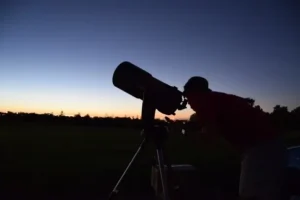
Most buyers read “Schmidt-Cassegrain” on the box and move on. The optical physics behind the sct telescope design are worth understanding because they directly explain both the instrument’s strengths and its quirks in the field.
The transitional behavior of the sct across different thermal conditions is one of those quirks that new owners hit first. Understanding why it happens eliminates frustration and sets realistic expectations.
1: Spherical Aberration and the Corrector Plate’s Role
The primary mirror in a standard sct telescope is spherical, not parabolic. Spherical mirrors are cheaper to grind accurately, but they focus different zones of the mirror at slightly different distances — this is spherical aberration. The Schmidt corrector plate introduces the exact opposite wavefront error, canceling it out. The corrector plate’s shape is a subtle, shallow curve — not a lens in the traditional refractive sense, but a figured optical element that manipulates the incoming wavefront before it hits the primary. The result is a system that performs like a parabolic mirror at a fraction of the manufacturing cost, while keeping the optical tube sealed.
2: The Focusing Mechanism and Image Shift
Unlike refractors and Newtonians that focus by moving the eyepiece or drawertubeoutward, the sct telescope focuses by moving the primary mirror along the optical axis via a central baffle. This is elegant in theory. In practice, mirror flop — where the primary shifts slightly sideways under gravity — introduces image shift during focusing. High-end sct models like the Celestron EdgeHD address this with a mirror lock, which freezes the primary after focusing and eliminates shift during tracking. Budget sct telescope designs skip this feature, so imaging long exposures requires a Crayford focuser added externally at the rear cell.
3: Thermal Equilibration and Why It Matters More Than With Any Other Design
A thick glass corrector plate and a large primary mirror store substantial heat energy. An sct taken from a 72°F living room to a 45°F observing site needs 45–90 minutes to reach thermal equilibrium. Before that, rising air currents inside and near the tube cause star images to boil. Running a small 12V fan across the rear cell vents accelerates this dramatically — experienced observers call this “force cooling,” and it cuts equilibration time to 20–30 minutes on most nights.
4. Choosing the Right SCT Telescope Size — Aperture vs. Portability Tradeoffs:
The sct comes in aperture sizes from 5 inches to 16 inches in mass-market form, with custom sizes beyond that. Here’s what actually drives the decision for most buyers:
- The 5-inch sct telescope — 127mm aperture, ideal for beginners or travelers — shows lunar craters, Saturn’s rings, Jupiter’s cloud bands, and bright Messier objects clearly.
- 6-inch sct telescope — Splits most double stars in the Struve catalog, resolves globular cluster stars like M13 individually, excellent planetary instrument at a manageable weight.
- 8-inch sct telescope — The gold standard. Most owned, most accessorized, most written about. Resolves detail on Mars during opposition, shows galaxy structure in Virgo Cluster members, images the Orion Nebula with color and structure.
- 11-inch sct telescope — Serious deep-sky territory. Finds objects that don’t appear on casual star maps. Mount requirements jump significantly — an EQ6 or CGX-L class mount becomes necessary.
- 14-inch sct telescope — Professional-grade aperture at semi-professional prices. Seeing conditions, not the telescope, become the limiting factor. Moving this instrument solo requires planning.
5. Mounting the SCT Telescope — Fork vs. Equatorial vs. AltAz:
The mounting system paired with an sct defines the entire experience more than most buyers anticipate. The optical tube is only half the story.
Understanding how each mount type interacts with the sct telescope’s physical characteristics determines whether the setup becomes a joy or a nightly battle. This is where most regrettable purchases originate.
1: Fork Mount Systems
The classic sct was born on a fork mount. Celestron shipped the original C8 on a fork in the early 1970s, and the pairing made sense — the sct telescope’s short, symmetrical tube balanced naturally between two fork tines without counterweights. Modern computerized fork-mounted sct telescope systems like the Celestron CPC series incorporate GPS alignment, two-star alignment procedures, and GoTo catalogs containing over 40,000 objects. The limitation: fork-mounted sct telescope systems are heavy as single units and require an optional wedge to track equatorially for astrophotography.
2: German Equatorial Mounts
Separating the sct telescope optical tube from a dedicated equatorial mount gives you maximum flexibility. Mount an 8-inch sct on an EQ6-R Pro and you have a platform capable of tracking accurately enough for 10-minute unguided exposures. German equatorial mounts require counterweights, but they eliminate the meridian flip issue only partially — the sct telescope itself must still be rotated to avoid cable wrap. The benefit is clear: the same mount accepts multiple optical tubes, so your equatorial mount investment outlasts any individual sct telescope.
3: AltAzimuth Computerized Mounts
Celestron’s NexStar SE series puts the sct on a single-arm computerized altazimuth mount that’s genuinely portable. The NexStar 8SE with an 8-inch sct telescope weighs under 30 lbs fully assembled. Visual observing? Superb. Extended astrophotography? The field rotation inherent to altazimuth tracking makes exposures beyond 30 seconds problematic without a field derotator. For the planetary imager shooting 30-frame-per-second video and stacking thousands of frames, field rotation is irrelevant — and the NexStar SE sct combination becomes an ideal planetary imaging rig.
6. Astrophotography With the SCT Telescope — From Planets to Deep Sky:
The sct telescope is a genuinely capable imaging platform when paired correctly with camera equipment. The 8-inch at f/10 gives you a 2,000mm focal length — long enough to image planetary detail at full resolution, short enough to frame nebulae without cropping.
- Planetary imaging — An sct telescope at f/10 paired with a ZWO ASI224MC planetary camera and Firecapture software captures Saturn, Jupiter, and Mars with detail rivaling observatory photographs from a decade ago.
- Lunar imaging — The Moon fills a full-frame sensor at 2,000mm. Mosaic imaging with the sct telescope produces prints large enough to cover a bedroom wall with crater-level detail.
- Deep-sky imaging with focal reducer — Adding a Celestron f/6.3 focal reducer brings the sct telescope to 1,260mm at f/6.3, a workable deep-sky focal length for galaxies, globular clusters, and planetary nebulae.
- Narrowband emission nebulae — Long narrowband exposures through an sct reveal hydrogen-alpha structure in objects like the Horsehead Nebula and Rosette complex that broadband imaging misses entirely.
- EAA (Electronically Assisted Astronomy) — Stacking live 10-second exposures with a CMOS camera through the sct telescope produces color, detail-rich views on a laptop screen in real time without full astrophotography processing.
SCT Telescope Comparison: Key Models and Specifications:
| Model | Aperture | Focal Length | Focal Ratio | Mount Type | Weight (OTA) | Best Use Case | Approx. Price (2025) |
| Celestron NexStar 5SE | 127mm (5″) | 1,250mm | f/10 | Single-arm AltAz | 6.5 lbs | Beginners, travel | ~$650 |
| Celestron NexStar 6SE | 150mm (6″) | 1,500mm | f/10 | Single-arm AltAz | 11 lbs | Planetary/visual | ~$850 |
| Celestron NexStar 8SE | 203mm (8″) | 2,032mm | f/10 | Single-arm AltAz | 12.5 lbs | All-around visual/imaging | ~$1,300 |
| Celestron CPC 800 | 203mm (8″) | 2,032mm | f/10 | Fork AltAz/GoTo | 35 lbs | GoTo visual, EAA | ~$1,800 |
| Celestron EdgeHD 8″ | 203mm (8″) | 2,032mm | f/10 (f/7 w/reducer) | OTA only | 13.6 lbs | Astrophotography | ~$1,500 (OTA) |
| Celestron EdgeHD 9.25″ | 235mm (9.25″) | 2,350mm | f/10 | OTA only | 14 lbs | Advanced imaging | ~$2,000 (OTA) |
| Celestron EdgeHD 11″ | 279mm (11″) | 2,800mm | f/10 | OTA only | 24 lbs | Deep-sky imaging | ~$2,800 (OTA) |
| Meade LX200 8″ | 203mm (8″) | 2,000mm | f/10 | Fork AltAz/GoTo | 30 lbs | Visual/EAA | ~$1,600 |
| Meade LX90 8″ | 203mm (8″) | 2,000mm | f/10 | Fork AltAz/GoTo | 28 lbs | Visual, beginner imager | ~$1,200 |
| Celestron RASA 8 | 203mm (8″) | 400mm | f/2 | OTA only | 15 lbs | Wide-field deep-sky imaging | ~$1,500 (OTA) |
7. Collimating Your SCT Telescope — The Step-by-Step Process Most Guides Skip:
Collimation of the sct telescope is one of those tasks that intimidates new owners and gets skipped — which is a mistake that costs resolution at every single session. A misaligned sct might still show Saturn’s rings, but the Cassini Division disappears, star images turn to seagulls instead of clean Airy disks, and planetary detail softens noticeably.
The good news: collimating an sct telescope is significantly easier than collimating a Newtonian. You adjust only the three secondary mirror collimation screws on the corrector plate. Nothing else moves.
1: Knowing When Your SCT Telescope Needs Collimation
Star test the sct at high power on a medium-bright star. Defocus slightly inside focus and slightly outside focus. If the diffraction rings are symmetrical and centered on both sides of focus, collimation is good. If the central shadow shifts position between inside and outside focus, or if the rings are thicker on one side, collimation needs attention. Many sct owners check collimation every three to four months or after any transport by vehicle.
2: The Defocused Star Method Step by Step
Center a bright star — Vega or Arcturus work well — in the sct telescope field of view at around 150–200x. Defocus until you see three or four diffraction rings with a dark central shadow. If the shadow is off-center, the secondary needs adjustment. Using a 1.5mm hex key or Phillips screwdriver depending on your specific sct model, make very small clockwise or counterclockwise turns to the three secondary screws, moving the star image toward the center of the diffraction rings. Never loosen all three simultaneously. Work one screw at a time, re-evaluate, repeat. On a typical sct telescope collimation session, experienced observers finish in under five minutes.
3: Using an Artificial Star for Daytime Collimation
An artificial star — a pinhole in a piece of aluminum foil over a flashlight, placed 30 or more feet away — lets you collimate the sct indoors in daylight. Set it up at the far end of a hallway or pointed out a window at something reflecting light. The diffraction rings appear the same way as on a real star. Daytime collimation sessions before a planned observing night are efficient because you’re not working in the dark and cold.
8. Best Eyepieces and Accessories for the SCT Telescope:
Pairing the right eyepieces with an sct dramatically changes what the instrument can do. The rear-cell 2-inch visual back opening accepts every major eyepiece brand, and the high focal ratio is forgiving with less expensive eyepiece designs.
- Televue Panoptic 35mm — Wide-field view of large nebulae at around 58x on an 8-inch sct telescope, flat field, high contrast, worth every dollar.
- Celestron X-Cel LX 7mm — Budget-friendly planetary eyepiece delivering 290x on an 8-inch sct, sharp across the field, no blackouts on eye position changes.
- Baader Hyperion 8mm — Middle-ground performer for both planetary and cluster work, modular design allows the barrel to accept a barlow element for 2x magnification.
- Televue Nagler 13mm Type 6 — Exceptional mid-power all-purpose eyepiece for globular clusters, planetary nebulae, and double stars on the sct telescope.
- Baader 2.6x Barlow — Pushes the 8-inch sct telescope to 520x on nights of excellent seeing, still maintains adequate sharpness on planetary targets.
9. Common Problems With the SCT and How to Actually Fix Them:
Owning an sct telescope long-term means encountering a predictable set of issues. Knowing the solutions before they arrive separates confident observers from frustrated ones.
The sct telescope, despite its sealed tube, is not maintenance-free. Internal dew, mirror shift, and collimation drift each require different interventions, and confusing them wastes significant time.
1: Dew on the Corrector Plate
The corrector plate cools faster than ambient temperature on humid nights, causing dew to form on its exposed front surface. A fogged corrector destroys image quality instantly — stars look like smeared streaks, and deep-sky objects vanish. The solution is a dew heater strip wrapped around the front cell of the sct , powered by a dew controller set to 30–40% output. Combine this with a dew shield — an extended tube that reduces radiant cooling from the sky. On most nights, the heater alone solves it. On very humid nights, the dew shield is essential. Never wipe a dewy corrector plate with anything — let the heater clear it or warm the telescope gently.
2: Focusing Difficulty During Temperature Drops
As temperature falls during a session, the sct telescope primary mirror cools and contracts. Because focusing works by moving the primary mirror, its resting position shifts with temperature. You’ll notice that the focus point moves slowly throughout the night on the sct , requiring periodic refocusing every 15–20 minutes during significant temperature drops. This is normal behavior, not a defect. Electric focusers with memory positions help during astrophotography sessions by automating the refocus routine.
3: Power Connector Issues on GoTo SCT Mounts
Celestron’s standard power connector for NexStar and CPC series sct mounts is a 12V center-positive 2.1mm barrel jack. Cold temperatures cause plastic connectors to contract and lose contact reliability. Carry a backup power cable and test the connection before leaving home. A dying battery mid-session with the sct telescope slews to unknown territory and requires a full re-alignment.
10. The SCT vs. Competing Designs — An Honest Comparison:
Choosing between an ac telescope and an apochromatic refractor, a Ritchey-Chrétien, or a large Dobsonian comes down to use case, not brand loyalty.
The sct loses to an apochromatic refractor on contrast and color fidelity for wide double-star work. A 4-inch APO at f/7 with good glass shows more contrast per inch of aperture than a 5-inch sct telescope, because the central obstruction in the sct telescope design — the secondary mirror and its shadow — reduces contrast at low magnifications. This central obstruction typically runs 30–35% of the aperture diameter, which transfers light energy from the central Airy disk into surrounding diffraction rings, reducing fine-detail contrast.
The sct telescope beats the Dobsonian on portability, tracking capability, and astrophotography suitability. A 10-inch Dobsonian shows more raw light-gathering than an 8-inch sct , but it can’t track objects, can’t mount a camera for long exposures, and requires more physical space to store and transport. For the observer who wants one instrument that does most things well, the sct telescope remains the most rational choice.
Against Ritchey-Chrétien designs, the sct telescope is cheaper, more widely supported, and easier to collimate. The RC’s advantage is a flat imaging circle without field curvature — but only at apertures where the RC becomes cost-competitive do these advantages outweigh the sct practical benefits.
11. Maintaining and Cleaning the SCT Corrector Plate:
The sct corrector plate is sealed from internal dust by design, but the external surface accumulates dust, pollen, and oils over time. Most experienced users clean the corrector no more than once every one to two years, because cleaning always risks scratching the anti-reflection coating.
When cleaning is necessary, start with a bulb blower to remove loose particles. Follow with a lens cleaning solution on a fresh cotton ball, using gentle circular motions from the center outward. Never use paper towels, tissues, or any fabric on the sct telescope corrector plate — even microfiber can scratch coatings. Photographic lens cleaning fluid or Eclipse optical solution are appropriate choices. If you see a persistent streak after cleaning, wait for it to dry completely before assessing whether a second pass is necessary.
The internal optical surfaces of the sct telescope — primary mirror, secondary mirror — should not be cleaned by the user. Internal dust on the primary barely affects performance (a few dust particles on a large mirror do negligible damage to image quality). Touching the primary mirror in a sealed sct requires disassembly and risks permanent collimation loss.
12. The Future of the SCT— Smart Telescopes, AI Alignment, and Where the Design Goes Next:
The sct design has survived sixty years of technological disruption because it adapts well to new technology rather than becoming obsolete. Current trends suggest the next decade accelerates this.
Celestron’s StarSense Explorer system now uses a smartphone camera and pattern-matching software to align an sct telescope without any manual star identification — the phone photographs the sky, matches star patterns to an internal database, and calculates precise pointing coordinates in under two minutes. This eliminates the single biggest barrier to act on telescope ownership: the learning curve of manual GoTo alignment.
Autoguiding has become accessible enough that a beginner can attach a ZWO ASI120MM guide camera to the sct telescope’s finder scope bracket, connect it to PHD2 guiding software on a $200 Raspberry Pi, and achieve guided imaging in their first month of ownership. Gear that required $10,000 and graduate-level technical knowledge in 2005 now costs under $300 and installs in an afternoon.
The sct itself? The optical design is already nearly optimal for its intended application. What changes is everything around it: smarter mounts, better cameras, more intuitive software. The sct telescope’s 40-year-old optical formula is the stable foundation that lets all these new technologies express themselves cleanly.
FAQ’s:
Q1:What does SCT stand for in sct telescope?
SCT stands for Schmidt-Cassegrain Telescope, named for the corrector plate (Schmidt) and the two-mirror folded optical system (Cassegrain).
Q2:How long does an sct telescope take to cool down before use?
Most 8-inch sct telescope models require 45–90 minutes of cool-down time; forced cooling with a rear fan cuts this to 20–30 minutes.
Q3:Can I use an sct telescope for astrophotography as a beginner?
Yes — an 8-inch sct telescope on a motorized equatorial mount is a capable beginner imaging platform when used with a DSLR and free stacking software.
Q4:Is the sct telescope good for deep-sky visual observing?
An 8-inch sct performs excellently on globular clusters, bright nebulae, and galaxies, though open clusters look better through wider-field, faster optical designs.
Q5:How often should I collimate my sct telescope?
Check sct telescope collimation every 3–4 months or after any significant transport, and immediately if star images appear asymmetric at high power.
Conclusion:
The sct telescope earns its place in serious astronomy through one undeniable quality: genuine versatility backed by a mature, proven optical design. Buy the largest sct your mount and budget honestly support, invest in a dew heater, learn the collimation process, and give the instrument one full year before judging it. The results will consistently exceed expectations.