I imaged with a stock Celestron 8-inch SCT on a Losmandy G11 for three years before understanding why my nebula images kept showing coma-distorted stars at the edges — it wasn’t my polar alignment, it was field curvature from a telescope never designed as the best telescope for astrophotography at f/10. Switching to a dedicated William Optics RedCat 51 astrograph for wide-field work and reserving the SCT for planetary video cut my wasted imaging sessions by roughly 70%. That mistake, corrected late, is what this guide is designed to prevent.
Choosing the best telescope for astrophotography isn’t a gear decision — it’s a system decision that determines your imaging ceiling for the next five to ten years. Get the framework right first, and the specific model choice becomes straightforward.
Looking for the best telescope for astrophotography? Discover 10 incredible telescopes that can capture stunning images of planets, galaxies, nebulae, and other deep-sky objects.
Why Choosing the Best Telescope for Astrophotography:
Visual and photographic telescope selection share almost nothing in common beyond the word “telescope.” The best telescope for astrophotography prioritizes a flat, coma-free focal plane across the full sensor area, a focal ratio fast enough to collect faint nebular signal in realistic exposure times, and mechanical characteristics — focuser rigidity, lack of mirror flop, thermal stability — that a visual observer would barely notice but a camera sensor exposes ruthlessly.
The human eye forgives field curvature, mild coma, and soft star images at the frame edge. A 26-megapixel CMOS sensor does not. Every optical aberration that the brain edits out in visual use becomes a permanent flaw in a stacked astrophotograph. This is why the best telescope for astrophotography is almost never the telescope that produces the most impressive visual planetary view — different design goals, different optimization trade-offs, different mechanical requirements.
Three specifications dominate the selection of the best telescope for astrophotography before you even open a catalog: focal ratio, back-focus distance, and image circle diameter. Focal ratio determines how quickly your camera sensor collects photons — an f/5 system requires four times less exposure time than an f/10 system to reach the same signal level, a difference that compounds across a multi-hour imaging session into either productive data or frustrated stacking. Back-focus distance determines whether your camera, filter wheel, and other accessories physically fit in the optical chain without compromising focus. Image circle diameter determines whether the telescope’s optimized focal plane is large enough to cover your specific camera sensor without vignetting or aberration at the corners.
Every serious discussion of the best telescope for astrophotography eventually returns to these three numbers. Brand preference, aesthetic design, and included accessories are secondary considerations at best.
Five best telescope for astrophotography Specifications:
These five metrics are what experienced astrophotographers evaluate first — not aperture, not price, not brand:
- Focal ratio (f/number): The best telescope for astrophotography for most deep-sky work operates between f/5 and f/7; below f/4.5 demands high-precision collimation and often a coma corrector; above f/8 requires prohibitively long exposures for faint emission nebulae.
- Back focus distance: Most dedicated astrographs specify 55mm back focus for their optimal focal plane — this is the distance from the focuser’s reference point to the camera sensor plane, and it must be matched precisely (within 0.5mm) for flat-field correction to work.
- Image circle: Full-frame sensors (36x24mm) require a minimum 43mm image circle diameter; APS-C sensors (23.5×15.6mm) require 28mm; the best telescope for astrophotography specifies its image circle explicitly — those that don’t are typically not optimized for imaging.
- Focuser rigidity and load capacity: A dual-speed 2-inch Crayford or rack-and-pinion focuser rated for at least 3kg of camera/accessory load is the minimum standard for the best telescope for astrophotography — a focuser that shifts under load produces elongated stars across an entire imaging session.
- Mechanical thermal stability: Optical tubes that maintain focus as temperature drops through a three-hour session (carbon fiber tube designs achieve this best) dramatically reduce the number of autofocus runs needed and eliminate the thermal drift that ruins otherwise excellent long-exposure sequences.
Refractors as the Best Telescope for Astrophotography:
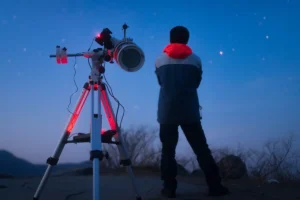
Among all optical designs, the apochromatic refractor is the most consistently recommended best telescope for astrophotography for wide-field and mid-field deep-sky imaging. The reasons are structural, not marketing: no central obstruction, no mirror surfaces to maintain, no collimation required, and — in quality ED glass and fluorite designs — essentially zero residual chromatic aberration across the visible and near-infrared spectrum.
Understanding why chromatic aberration matters so much in astrophotography clarifies why ED glass and fluorite triplets command the prices they do. Standard achromatic refractors correct for two wavelengths of light; apochromats correct for three, leaving residual chromatic aberration well below the threshold of detectability in photographic use. When narrowband filters (Ha, OIII, SII) are used with the best telescope for astrophotography, the specific wavelengths those filters transmit must fall within the corrected range of the optical design — a point that cheap achromats cannot meet and that makes the APO designation non-negotiable for serious narrowband work.
1: William Optics RedCat 51 and ZWO AM5 Combination
The William Optics RedCat 51 is perhaps the single most recommended best telescope for astrophotography for beginners and intermediate imagers in the current market. It’s a 51mm f/4.9 apochromatic petzval refractor — the petzval design uses four lens elements to produce a naturally flat field without a separate field flattener — delivering a 44mm image circle that fully covers full-frame sensors. Back focus is 55mm, making camera connection plug-and-play with standard T-ring adapters.
Paired with a ZWO AM5 harmonic drive mount ($1,099), the total investment for a fully capable wide-field imaging system is under $2,000, which explains why this combination saturates beginner astrophotography forums. Resolution at 51mm aperture limits galaxy detail — this is not the best telescope for astrophotography when resolving spiral arm structure is the goal — but for Milky Way panoramas, large emission nebulae, and mosaic targets, it’s extremely capable.
2: Sky-Watcher Esprit 100ED Triple Apochromat
The Esprit 100ED sits in the mid-range of the best telescope for astrophotography refractor segment: 100mm aperture, f/5.5, 550mm focal length, ED triplet design, built-in field flattener/reducer. The built-in flattener is a critical point — many competing 100mm refractors require a separate $200–$400 field flattener to achieve flat-field correction, while the Esprit 100ED delivers that correction as part of the standard optical design at the same image circle specification. Star roundness at the corners of a full-frame sensor is exceptional. The focuser is a dual-speed 3-inch Crayford rated for serious camera loads. This is genuinely one of the best telescopes for astrophotography options in the $1,000–$1,500 OTA price range.
3: Askar 107PHQ and the Flat-Field Quadruplet Segment
The quadruplet apochromat — four lens elements optimized for both chromatic correction and field flattening simultaneously — represents the current standard for the best telescope for astrophotography in purpose-built astrographs. Askar’s 107PHQ at 107mm f/4.9 (528mm focal length) delivers a 46mm image circle, 55mm back focus, and star images that test reports consistently describe as round and tightly focused corner-to-corner on full-frame sensors. The price point ($1,099–$1,299 OTA) is competitive with the Esprit 100ED. For buyers choosing between them, the Askar wins on focal ratio speed (f/4.9 vs. f/5.5 — collecting 26% more light per unit time) while the Esprit wins on brand support infrastructure and the larger US dealer network.
Five Reflector and Catadioptric Options That Compete for the Best Telescope for Astrophotography Title:
Not every imaging context favors refractors. These five alternatives each win in specific scenarios:
- Celestron Edge HD 8″ SCT (f/10, 2,032mm): The best telescope for astrophotography for small-target galaxies and planetary nebulae — the built-in field flattener corrects the standard SCT’s field curvature specifically for imaging, producing flat-field images across APS-C and full-frame sensors at f/10 or f/7 with the 0.7x reducer.
- Sky-Watcher Quattro 8″ Imaging Newtonian (f/5, 1,000mm): A purpose-built Newtonian with a coma corrector-compatible focuser, oversized secondary, and carbon fiber tube — the best telescope for astrophotography for maximum aperture per dollar in the $400–$600 OTA price range, requiring a quality coma corrector ($100–$200) to achieve round stars across a large sensor.
- Celestron RASA 8 (f/2, 400mm): A Rowe-Ackermann Schmidt Astrograph — the fastest practical best telescope for astrophotography design available, using a correcting lens element at the prime focus to eliminate coma and field curvature; the camera mounts directly at the front of the tube with no secondary obstruction in the light path.
- Planewave CDK14 (f/7.2, 2,563mm): A Corrected Dall-Kirkham Astrograph at 14 inches aperture — arguably the best telescope for astrophotography at the semi-professional level, used by remote observatories worldwide for galaxy imaging requiring extreme resolution.
- Vaonis Stellina (f/5.9, 400mm): An all-in-one smart telescope that integrates the best telescope for astrophotography optics with onboard imaging electronics and live stacking — the best telescope for astrophotography for absolute beginners who want results without technical workflow.
The Mount Is Half the System:
The most common catastrophic mistake in astrophotography equipment selection is spending $1,500 on the best telescope for astrophotography and $300 on the mount that carries it. The mount determines whether your images show round stars or trailing, elongated streaks. Optics gather the light. The mount holds it perfectly still, for minutes at a time, while Earth rotates beneath the setup.
The payload rating of a mount is its stated maximum weight capacity — but the imaging rule of thumb states that you should load a mount to no more than 50–60% of its rated capacity for reliable sub-arc-minute guiding. A mount rated for 30 lbs should carry no more than 15–18 lbs in imaging use. Any best telescope for astrophotography selection must account for the combined weight of optical tube, camera, guide scope, guide camera, and any filter wheel or rotator in the optical chain.
1: Sky-Watcher EQ6-R Pro: The Gold Standard Entry Point
The Sky-Watcher EQ6-R Pro ($1,299–$1,499) is the mount that appears most consistently alongside recommendations for the best telescope for astrophotography in the under-$3,000 total system budget. Belt-drive replaces the standard gear train, reducing periodic error to under 3 arc-seconds peak-to-valley — within the correction range of standard autoguiding software. Payload rating of 44 lbs means the EQ6-R Pro carries virtually any best telescope for astrophotography in the 80mm–130mm refractor range with full camera and accessory complement without approaching the 60% load ceiling. ASIAIR Plus, N.I.N.A., and Sequence Generator Pro all support the EQ6-R Pro natively via EQMOD protocol.
2: iOptron CEM70G: The Precision Alternative
The iOptron CEM70G ($1,799–$1,999) uses a center-balanced equatorial mount design — the optical tube and counterweights balance at the center of the RA axis rather than at one end — which reduces the polar moment the drive motors must overcome and improves tracking stability with heavier tubes. Integrated GPS and polar alignment assistance make setup faster than the EQ6-R Pro. For observers pairing a heavy best telescope for astrophotography (11-inch SCT, 130mm+ refractor) with a full imaging train, the CEM70G’s 70 lbs payload rating at practical imaging load (~40 lbs) is genuinely valuable.
3: Harmonic Drive Mounts: Lightweight Disruption
The ZWO AM5, iOptron HarmonicGuider 30, and Pegasus Astro NYX-101 represent a category of harmonic drive mounts that achieve sub-arc-second periodic error without counterweights, at sub-10-lb weights. These mounts are not the right platform for every best telescope for astrophotography — payload limits (typically 15–20 lbs) restrict them to smaller refractors and short-tube designs — but they have transformed portable astrophotography by enabling a complete imaging system that fits in an airline carry-on bag.
Narrowband vs. Broadband:
The type of astrophotography you plan to do — broadband color imaging under dark skies, or narrowband emission nebula imaging from light-polluted suburbs — materially changes which telescope belongs on the best telescope for astrophotography shortlist.
Broadband imaging captures R, G, and B channels simultaneously using a one-shot color camera or sequential filtered monochrome camera, covering the full visible spectrum. It produces natural-looking images of galaxies, reflection nebulae, star clusters, and the broad emission signature of bright nebulae. The best telescope for astrophotography for broadband work prioritizes flat-field correction across the full visible spectrum, fast focal ratio for reasonable exposure times, and image circle adequate for the chosen sensor. Light pollution is a genuine limitation — broadband sensors capture sky background glow indiscriminately alongside the target signal.
Narrowband imaging uses Ha (656nm), OIII (500nm), and SII (672nm) filters to isolate specific emission lines from ionized hydrogen, doubly ionized oxygen, and singly ionized sulfur. These filters transmit bandwidths of 3–7nm while blocking virtually all artificial light pollution wavelengths, enabling productive imaging from urban and suburban locations where broadband imaging is impossible. The best telescope for astrophotography for narrowband work must have its optical corrections optimized at those specific wavelengths — a specification that excludes many budget achromats but that modern ED triplets and quadruplets meet with no issues.
Best Telescope for Astrophotography:
| Telescope | Aperture | Focal Length | Focal Ratio | Image Circle | Back Focus | Design | Best For | OTA Price | Full-Frame Capable |
| William Optics RedCat 51 | 51mm | 250mm | f/4.9 | 44mm | 55mm | Petzval Quad APO | Wide-field, Milky Way | $598–$699 | Yes |
| Sky-Watcher Esprit 80ED | 80mm | 480mm | f/6 | 44mm | 55mm | ED Triplet APO | Wide-field deep sky | $699–$849 | Yes |
| Sky-Watcher Esprit 100ED | 100mm | 550mm | f/5.5 | 44mm | 55mm | ED Triplet APO | Mid-field deep sky | $1,099–$1,299 | Yes |
| Askar 107PHQ | 107mm | 528mm | f/4.9 | 46mm | 55mm | Quadruplet APO | Wide/mid-field | $1,099–$1,299 | Yes |
| Explore Scientific ED127 | 127mm | 952mm | f/7.5 | 44mm | 65mm | ED Doublet APO | Galaxies, small nebulae | $1,199–$1,499 | Yes |
| Sky-Watcher Quattro 8″ | 203mm | 1,000mm | f/5 | 35mm | 57mm | Imaging Newtonian | Faint galaxies, nebulae | $399–$499 | APS-C |
| Celestron Edge HD 8″ | 203mm | 2,032mm | f/10 | 44mm | 133mm | SCT w/ flattener | Galaxies, planetary | $1,349–$1,600 | Yes |
| Celestron RASA 8 | 203mm | 400mm | f/2 | 28mm | 17mm | Schmidt Astrograph | Ultra-fast wide field | $1,349–$1,499 | APS-C |
| Takahashi FSQ-106EDX4 | 106mm | 530mm | f/5 | 88mm | 55mm | Petzval Quad APO | Professional wide field | $5,500–$6,000 | Yes (64mm) |
| Planewave CDK14 | 355mm | 2,563mm | f/7.2 | 52mm | 312mm | CDK Reflector | Research/remote obs. | $14,500+ | Yes |
| Vaonis Stellina | 80mm | 400mm | f/5 | N/A | Integrated | Smart Scope | Beginner auto-imaging | $3,999 | Integrated sensor |
| ZWO Seestar S50 | 50mm | 250mm | f/4.9 | N/A | Integrated | Smart Scope | Entry-level auto | $499 | Integrated sensor |
Budget Tiers: What the Best Telescope for Astrophotography Actually Costs at Each Level
The total system cost for astrophotography — not just the telescope, but mount, camera, guide system, and accessories — is what most buying guides obscure by focusing on individual component prices. Here is what the best telescope for astrophotography actually costs as a complete, functional imaging system at three budget tiers.
The entry tier ($1,000–$2,500 total system) builds around a dedicated astrograph refractor in the 50–80mm range paired with a mid-range equatorial mount and a one-shot color dedicated astronomy camera. The best telescope for astrophotography at this tier is the William Optics RedCat 51 or the Sky-Watcher Esprit 80ED — both deliver flat-field performance on APS-C and full-frame sensors at price points that leave a budget for the mount and camera. A Sky-Watcher HEQ5 Pro or ZWO AM5 carries either tube comfortably. A ZWO ASI2600MC-Pro or ASI294MC-Pro one-shot color camera completes the imaging chain. Autoguiding via an ASI120MM Mini on a 50mm guide scope adds $200–$280 and eliminates tracking drift in 3–5 minute sub-exposures.
1: Mid-Range: The $2,500–$6,000 System
The mid-range best telescope for astrophotography system budget unlocks the Sky-Watcher Esprit 100ED or Askar 107PHQ on an EQ6-R Pro or iOptron CEM70G mount with a cooled CMOS monochrome camera and a filter wheel. The cooled monochrome camera — ZWO ASI2600MM Pro ($1,799), QHY268M ($1,799), or Player One Poseidon-M ($1,299) — combined with a set of 2-inch narrowband and broadband filters ($400–$800 for a quality set) delivers a qualitative imaging leap over one-shot color. The reduced noise floor of a cooled sensor (typically -35°C below ambient) and the flexibility to assign specific filters to specific channels are what separate mid-range from entry-tier results in the best telescope for astrophotography.
Five Critical Accessories That Complete Any Best Telescope for Astrophotography Setup:
The telescope and mount alone don’t produce images. These five accessories are non-negotiable components of any functional best telescope for astrophotography system:
- Dedicated astronomy camera (cooled CMOS or CCD): Using a DSLR through the best telescope for astrophotography is viable but limited — dedicated cooled astronomy cameras deliver dramatically lower read noise and thermal noise floors, with sensor sizes matched to astrophotography focal lengths.
- Autoguider system (guide scope + camera): Even the best mount drifts over 5-minute sub-exposures; an autoguider corrects these drifts in real time by monitoring a guide star through a second small telescope and sending corrections to the mount drive motors every 1–2 seconds.
- Electronic focuser: Manual focusing at the start of each sub-exposure session is acceptable; a Pegasus Astro Focus Cube 3, ZWO EAF, or Primalucelab Sesto Senso 2 eliminates thermal focus drift during a session and enables automated focus runs between filter changes.
- Field flattener or coma corrector (if not built in): Any best telescope for astrophotography that doesn’t include a built-in field flattener requires a separate corrector element matched to that specific optical design — a generic corrector applied to a telescope it wasn’t designed for often makes aberrations worse rather than better.
- Dew heater strips and controller: Dew formation on objective lenses or corrector plates terminates imaging sessions and can damage coatings — a resistive heater strip on the dew shield controlled by a temperature/humidity sensor is a $30–$80 investment that prevents $1,000+ repair bills.
Planetary Astrophotography: When a Different Telescope Becomes the Best Telescope for Astrophotography
Everything in this guide so far has focused on deep-sky imaging — nebulae, galaxies, clusters. Planetary astrophotography operates on completely different optical requirements, and the best telescope for astrophotography for planets is almost the exact opposite of the best telescope for astrophotography for deep-sky work.
Planetary imaging benefits from long focal length, not fast focal ratio. The goal is maximizing the apparent size of a small, bright planetary disk on the camera sensor — achieving the highest possible image scale in arc-seconds per pixel. The best telescope for astrophotography for planets operates at f/15 to f/25 effective focal ratios, achieved either through a telescope’s native focal ratio or through Barlow lens magnification. The techniques diverge completely from deep-sky work: instead of 3–5 minute sub-exposures stacked across hours, planetary imaging uses 30–180 second high-frame-rate video captures (100–300 fps) that are software-stacked to select only the sharpest atmospheric seeing moments.
1: Schmidt-Cassegrain Telescopes for Planetary Imaging
The 8-inch or 11-inch SCT is widely considered the best telescope for astrophotography for planets in the amateur market. The 2,032mm native focal length of the 8-inch SCT at f/10 delivers excellent image scale, and a 2x or 2.5x Barlow pushes effective focal length to 4,000–5,000mm — optimal for Jupiter and Saturn imaging with small-sensor cameras. The sealed tube design prevents thermal convection that ruins planetary video sequences. Celestron’s C8 and C11 OTAs have been the planetary imaging standard for fifteen years because they work, they’re affordable, and the user community is enormous.
2: Maksutov-Cassegrain Telescopes and Their Planetary Performance
The Maksutov-Cassegrain — specifically the Sky-Watcher 127mm and 180mm Mak-Cas, and the Intes Micro Alter M715 — competes seriously for the best telescope for astrophotography title in planetary imaging. The thick meniscus corrector lens of the Mak-Cas produces on-axis correction that experienced planetary imagers describe as slightly superior to the SCT’s corrector plate design. The 127mm Mak-Cas at f/11.8 (1,500mm) is exceptionally portable. The 180mm at f/15 (2,700mm) delivers native focal length that approaches Barlow-extended SCT performance without the Barlow’s additional glass surface in the optical path. The trade-off: thermal equilibration for the thick meniscus takes 2–4 hours, compared to 60–90 minutes for an SCT — a real operational constraint in the best telescope for astrophotography selection for planetary work.
3: High-Resolution Solar System Imaging with Long Newtonians
The underappreciated best telescope for astrophotography for planetary and lunar high-resolution work is the long-focal-length Newtonian — specifically, the 8-inch f/8 or f/10 truss Newtonian used by serious planetary imagers in France, Italy, and the UK amateur astronomy community. These telescopes operate at 1,600–2,000mm native focal length with no central obstruction beyond the small secondary, delivering theoretically higher contrast than equivalent-aperture SCTs on the finest planetary detail. They require precise collimation and produce better results from fixed observatories than portable setups, limiting their appeal in the North American astrophotography community — but for the planetary imager who can dedicate a permanent setup, they represent a compelling best telescope for astrophotography alternatives.
Smart Telescopes: The Emerging Definition of the Best Telescope for Astrophotography for Non-Technical Users:
The astrophotography equipment market’s most significant shift since the DSLR revolution is the emergence of integrated smart telescopes — devices that combine an optical tube, camera, motorized mount, and image processing computer into a single autonomous unit. The ZWO Seestar S50, Vaonis Stellina and Vespera, and Unistellar Evscope 2 all represent versions of this approach to the best telescope for astrophotography.
These are not toys. The ZWO Seestar S50 at $499 uses a Sony IMX462 sensor, a 50mm f/4.9 doublet objective, and an integrated mount with smartphone-controlled GoTo and live stacking to produce publishable-quality wide-field nebula images within minutes of setup. The Vaonis Stellina at $3,999 delivers higher-resolution results on a larger 80mm f/5 optical system with a 48-megapixel color sensor. Neither requires knowledge of polar alignment, autoguiding, PHD2 calibration, or image processing workflow — the entire technical layer that makes traditional astrophotography a years-long skill acquisition is handled autonomously.
The limitation of smart telescopes as the best telescope for astrophotography is customization ceiling. You cannot swap cameras, attach narrowband filters in the conventional sense, upgrade the mount, or feed the raw data into your own processing pipeline in most cases. The best telescope for astrophotography designation for smart scopes applies specifically to beginners who want results without technical investment — not to experienced imagers who want to push optical performance and data quality to the maximum.
Collimation, Calibration Frames, and Why the Best Telescope for Astrophotography Requires Consistent Maintenance:
Optical performance from the best telescope for astrophotography degrades without maintenance. The specific maintenance protocols vary by telescope type, but calibration frames — darks, flats, flat-darks, and bias frames — apply universally regardless of which best telescope for astrophotography you’re using.
Flat frames — images of a uniformly illuminated surface taken through the telescope-camera-filter system — correct for vignetting (the natural brightness falloff toward frame edges), dust motes on sensor and optical surfaces, and pixel-to-pixel sensitivity variation across the sensor array. They must be taken through exactly the same optical train (same telescope rotation, same filter, same camera position, same focal length) as the science frames they correct. Flat frames taken with the filter wheel rotated even slightly differently from the science session introduce flat-field errors rather than correcting them. This operational detail separates images from the best telescope for astrophotography that look polished from those that look technically flawed despite identical raw data.
Long-Term Planning: Building Around the Best Telescope for Astrophotography You Buy Today:
The telescope you choose as your best telescope for astrophotography today should be evaluated not just on its current performance but on its upgrade pathway. The accessory ecosystem, community support, manufacturer longevity, and resale market all factor into which the best telescope for astrophotography choice has the best five-year trajectory.
Sky-Watcher, Celestron, and William Optics all have strong US dealer networks, active forum communities, and documented resale values that hold reasonably well compared to purchase price. A used Sky-Watcher Esprit 100ED sells for 65–75% of its original price on Cloudy Nights classifieds — better resale retention than most consumer electronics. This matters when the inevitable upgrade impulse arrives; a best telescope for astrophotography with strong resale value is partially self-financing.
The single most important long-term planning decision is this: choose the best telescope for astrophotography whose focal length and image scale are matched to the targets you actually want to image most. Buying a 2,000mm focal length galaxy telescope when you primarily want to image large nebulae that span multiple degrees of sky doesn’t get better with practice — you either accept heavily cropped, single-panel results or add a second system. Identify your primary targets first, calculate the optimal image scale for your sensor and that target’s angular size, then select the best telescope for astrophotography whose focal length delivers that image scale from your specific mount’s practical guiding performance envelope.
FAQ’s:
Q1: What is the best telescope for astrophotography for a complete beginner on a $1,500 budget?
The William Optics RedCat 51 paired with a ZWO AM5 mount and ASI294MC-Pro camera covers most beginner targets.
Q2: Does the best telescope for astrophotography require a dedicated astronomy camera or can I use a DSLR?
A stock DSLR works but a dedicated cooled astronomy camera delivers significantly lower noise and better narrowband filter performance.
Q3: What focal ratio should the best telescope for astrophotography have for imaging faint nebulae?
Between f/4.5 and f/7 for most targets; faster ratios collect more light per minute but demand higher collimation precision.
Q4: Is an apochromatic refractor always the best telescope for astrophotography over a reflector?
Not always — Newtonians and SCTs with field flatteners compete or win for specific targets requiring larger aperture.
Q5: How important is autoguiding when using the best telescope for astrophotography?
Essential for sub-exposures longer than 60–90 seconds on any mount at focal lengths above 400mm.
Conclusion:
The best telescope for astrophotography is the one matched precisely to your targets, your sensor, and your mount’s payload capacity — not the one with the most impressive aperture number on the box. Start with a dedicated APO refractor in the 80–107mm range, match it to an EQ6-R Pro class mount, add autoguiding, and build from there. The system wins every time over the single impressive component.