The cassegrain telescope is the optical backbone of serious planetary and deep-sky astronomy — compact enough to transport, powerful enough to matter. Understanding its architecture completely changes what you buy, how you collimate, and what you see.
In 2018, I spent eleven consecutive nights at McDonald Observatory’s public viewing program comparing a 14-inch Celestron cassegrain telescope against a 12-inch Dobsonian Newtonian on the same target rotation — M13, Saturn, NGC 4889, and Epsilon Boötis. The cassegrain telescope delivered tighter star images at high magnification on seven of those nights, despite the Dob’s aperture advantage, because the sealed tube and long focal length played directly to what steady Texas air rewards most.
Discover the advantages of a Cassegrain , including its compact design, powerful optics, and why it’s a popular choice for astronomy and astrophotography enthusiasts.
What the Cassegrain Telescope Actually Is — The Optical Architecture Explained:
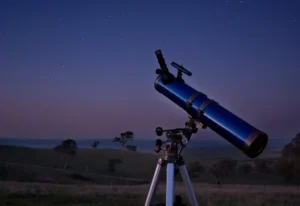
The cassegrain is a reflecting telescope that uses two mirrors — a large concave primary mirror at the bottom of the tube and a smaller convex secondary mirror near the top — to produce a long effective focal length in a physically short tube. Light enters the open front of the cassegrain to the primary mirror, reflects back up the tube to the secondary, then reflects again through a hole in the center of the primary to the eyepiece or camera behind the primary mirror.
This folded optical path is the design’s defining characteristic. A cassegrain with a 2,000mm focal length requires a tube only 400–500mm long — roughly one-quarter the physical length of a Newtonian reflector achieving the same focal length. That compression happens because the convex secondary mirror effectively multiplies the primary mirror’s focal length. In a classical cassegrain , the primary is parabolic and the secondary is hyperbolic. The two mirror surfaces work together to bring all incoming parallel light rays to a single focus point located conveniently behind the primary, accessible through the central perforation.
The practical consequences of this architecture are not abstract. The cassegrain long effective focal length — typically f/8 to f/15 in classical and Dall-Kirkham configurations — naturally produces high magnification with standard eyepieces, making it ideal for planetary observation, double star splitting, and small-target galaxies. The sealed tube (in catadioptric variants) protects mirror coatings from humidity, dust, and thermal convection that plagues open-tube Newtonians. And the rear-access focal point allows the cassegrain to accept cameras, spectrographs, and photometric instruments without the awkward side-mounting that Newtonian designs require.
Five Core Variants of the Cassegrain Telescope and Their Defining Differences:

The term “cassegrain ” covers a family of related designs, not a single configuration. Here’s what distinguishes each variant:
- Classical Cassegrain: Parabolic primary, hyperbolic secondary — the original design proposed by Laurent Cassegrain in 1672; excellent on-axis correction but significant coma and field curvature off-axis; rarely manufactured commercially today because parabolic primaries cost more to make than spherical ones.
- Dall-Kirkham Cassegrain: Elliptical primary, spherical secondary — easier to manufacture than the classical design with excellent on-axis correction; significant off-axis coma limits useful field of view, making it optimal for high-magnification visual use and narrow-field imaging.
- Corrected Dall-Kirkham (CDK): Adds a refractive corrector lens group in front of the focal plane to eliminate the Dall-Kirkham’s off-axis coma — the dominant cassegrain design in professional and semi-professional imaging observatories worldwide; Planewave Instruments’ CDK series is the benchmark.
- Ritchey-Chrétien (RC): Hyperbolic primary, hyperbolic secondary — the cassegrain design used in the Hubble Space Telescope and virtually every major professional research observatory; produces a wide, flat, coma-free field but is expensive to manufacture due to the dual hyperbolic surfaces.
- Schmidt-Cassegrain (SCT): Spherical primary, convex secondary, plus a thin Schmidt corrector plate at the tube entrance — the dominant commercial cassegrain design because the spherical primary is cheap to manufacture consistently; the corrector plate compensates for the spherical aberration a pure sphere would produce.
The Classical Cassegrain Telescope: Historical Context and Why It Matters:

Laurent Cassegrain, a French priest and amateur scientist, proposed the cassegrain design in April 1672 — just four years after Isaac Newton presented his first reflecting telescope to the Royal Society. The design was immediately controversial. Newton himself disputed the optical logic of Cassegrain’s convex secondary, arguing incorrectly that it would reduce image quality compared to his own flat secondary design. History vindicated Cassegrain entirely.
The classical cassegrain optical superiority for certain tasks became apparent only after mirror-grinding technology improved enough to fabricate the required parabolic and hyperbolic surfaces consistently. For roughly two centuries after its proposal, the cassegrain existed primarily as a theoretical design rather than a practical instrument. The 19th and early 20th centuries saw the first serious large-format cassegrain installations in professional observatories, particularly after silver-coated and later aluminum-coated glass mirrors replaced the speculum metal alloy mirrors of the original Newtonian era.
1: The 1672 Priority Dispute and Its Legacy
The Cassegrain-Newton priority dispute is a revealing footnote in astronomy history. Newton’s objections to the cassegrain design were based on his belief that the convex secondary would introduce more aberration than it corrected — a misunderstanding of how the two mirror surfaces interact mathematically. The correct analysis, developed by later optical mathematicians, showed that the hyperbolic secondary precisely compensates for the residual aberration of the parabolic primary, producing a theoretically perfect on-axis point image. Newton was wrong. The cassegrain works because the geometry he disputed is, in fact, mathematically exact.
2: Cassegrain’s Original Specifications and Modern Equivalents
The original cassegrain proposal described a primary mirror of approximately 12 inches diameter with a 12:1 focal ratio — a 144-inch effective focal length in a tube perhaps 24 inches long. No physical instrument from Cassegrain’s own hand survives. The earliest verifiable cassegrain instruments date to the 18th century, built by craftsmen working from published optical descriptions. Modern commercial cassegrain in the 6-inch to 14-inch aperture range directly descend from these design specifications, scaled and refined but structurally identical to what Cassegrain described on paper in 1672.
Five Reasons the Schmidt-Cassegrain Telescope Dominates the Commercial Market:
The SCT is the cassegrain variant most amateur astronomers actually own. Here’s why the design won the commercial market so completely:
- Spherical primary mirror: Unlike classical or Dall-Kirkham designs, the SCT uses a spherical primary mirror that’s significantly cheaper and faster to manufacture consistently — the production cost advantage translates directly into the price-to-aperture ratio that makes an 8-inch SCT affordable.
- Compact sealed tube: The SCT’s closed tube design eliminates the open-tube convection currents that degrade image quality in Newtonian reflectors during thermal equilibration — the cassegrain in SCT form reaches stable performance conditions faster than open designs of equivalent aperture.
- Rear-focus versatility: The SCT focuses by moving the primary mirror forward and back along the central baffle tube rather than moving the eyepiece — this mechanism allows the cassegrain to accept an enormous range of accessories at the rear port without changing balance or requiring a sliding focuser.
- Mount compatibility: The SCT’s short tube and compact mass distribution mean an 8-inch or 11-inch cassegrain balances well on mid-range equatorial mounts that couldn’t handle an equivalent-aperture Newtonian’s length and leverage.
- Focal reducer compatibility: A 0.63x focal reducer drops an f/10 cassegrain to f/6.3 instantly, dramatically expanding deep-sky imaging capability without changing the optical tube — no other telescope design offers this kind of in-field versatility.
Ritchey-Chrétien Telescope: The Professional Cassegrain Telescope Standard:
The Ritchey-Chrétien (RC) is the cassegrain variant that runs modern professional astronomy. Hubble. Keck. Very Large Telescope. Gemini. Every major ground-based and space-based professional research telescope built in the last sixty years uses the RC design or a closely related variant. Understanding why reveals what the cassegrain concept achieves at its theoretical peak.
The RC solves the classical cassegrain fundamental weakness: off-axis coma. In the classical design, stars near the edge of the field of view appear comet-shaped rather than pointlike — a coma aberration that limits the useful field of view to a small central zone. The RC eliminates this by using hyperbolic curves for both primary and secondary mirrors rather than a parabola-hyperbola combination. The two hyperbolic surfaces are designed together to cancel each other’s coma contributions, producing a field free of both spherical aberration and coma across a significantly wider angle. The cassegrain in RC form is the design that professional astronomers actually choose when performance, not cost, is the only criterion.
1: Manufacturing Challenges of the RC Cassegrain Telescope
Hyperbolic mirrors are harder to grind and test than parabolic or spherical mirrors. The deviation from a sphere is larger for a hyperboloid than for a paraboloid of equivalent focal length, and testing hyperbolic surfaces during manufacture requires interferometric techniques that were not widely accessible until the mid-20th century. This is why the RC cassegrain was theoretically described by George Willis Ritchey and Henri Chrétien in 1910 but not successfully built in a large format until 1927, when Ritchey completed a 40-inch RC for the US Naval Observatory. The 17-year gap between theory and practice was entirely a manufacturing problem.
2: Amateur RC Telescopes: Performance vs. Practical Reality
Affordable amateur RC cassegrain telescopes — the GSO RC series, Orion Truss Tube RCs, and Teleskop Service ONTC variants — carry f/8 focal ratios in 6-inch, 8-inch, and 10-inch apertures at $600–$1,400 for the optical tube. They deliver genuinely excellent field correction for wide-field imaging when the inherent back-focus distance (typically 200–300mm for an 8-inch RC) is managed with appropriate extension tubes. The practical challenge is that the RC cassegrain requires extremely precise collimation — much tighter tolerance than an SCT — and the long back-focus distance demands a careful accessory chain calculation before purchase.
3: RC vs. Classical Cassegrain Telescope for Astrophotography
For wide-field galaxy and cluster imaging where flat-field performance across a large sensor is the priority, the RC cassegrain wins clearly over the classical design. For narrow-field high-resolution work where only the central 10–15 arc-minutes of the field needs to be sharp — planetary imaging, double star measurements, photometry of point sources — the classical or Dall-Kirkham cassegrain performs equivalently and often better because on-axis correction is simpler to optimize when off-axis performance is explicitly deprioritized.
Collimation of the Cassegrain Telescope: A Step-by-Step Technical Guide:
Collimation is the procedure every cassegrain user must learn, and it’s also the maintenance task most frequently performed incorrectly or skipped entirely until image quality degrades visibly. The cassegrain telescope’s folded optical path means that misalignment between primary and secondary mirrors produces aberrations that compound — a small angular offset at the secondary creates a proportionally larger image degradation at the focal plane than the same angular error would produce in a Newtonian.
The standard collimation procedure for a cassegrain telescope has five sequential steps that must be performed in order: secondary mirror centering, secondary mirror tilt, primary mirror tilt, star test confirmation, and fine correction. Skipping or reversing steps produces either no improvement or active degradation. Here is how each step works in practice on a typical SCT cassegrain telescope.
Step 1 — Secondary centering: Remove the eyepiece and look down the focuser tube. The secondary mirror should appear centered within the focuser tube. If the secondary mirror’s reflection is off-center, the secondary holder’s position on the corrector plate needs physical adjustment — a procedure most users should not attempt without guidance, as misaligning the corrector plate introduces additional aberrations.
Step 2 — Secondary tilt: Using a Cheshire eyepiece or collimation tool in the focuser, adjust the three secondary tilt screws (on SCTs, these are the three Phillips screws on the front of the corrector plate, surrounding the secondary mirror) until the reflection of the primary mirror is centered within the secondary. Turn each screw in small increments — no more than a quarter turn — and recheck after each adjustment.
Step 3 — Primary tilt: Most cassegrain telescope designs allow primary mirror tilt adjustment via three push-pull screw pairs at the base of the tube. Center the reflection of the collimation tool’s crosshair within the primary mirror. Primary mirror adjustment is the more sensitive of the two adjustments on an SCT — the primary’s position directly determines where the focal point lands relative to the optical axis.
Step 4 — Star test: Defocus a 2nd-magnitude star to produce an expanded disk showing concentric diffraction rings. In a perfectly collimated cassegrain telescope, the central shadow (produced by the secondary mirror obstruction) appears perfectly centered within the rings. Any decentering indicates residual collimation error — return to Step 2 and make smaller adjustments.
Step 5 — Fine correction at high magnification: At 200x or above, a correctly collimated cassegrain telescope shows Airy disk diffraction patterns around point stars with the first diffraction ring symmetrical in all directions. Asymmetric rings visible only in specific orientations indicate astigmatism rather than collimation error, which requires optical diagnosis rather than alignment adjustment.
Cassegrain Telescope Design Variants: Full Specifications and Comparison Reference Table:
| Variant | Primary Mirror | Secondary Mirror | Native Focal Ratio | On-Axis Correction | Off-Axis Correction | Typical Aperture Range | Best Application | Manufacture Difficulty | Typical Price Range (OTA) |
| Classical Cassegrain | Parabolic | Hyperbolic | f/10–f/15 | Excellent | Poor (coma) | 6″–24″ | Visual planetary | Moderate | $800–$12,000+ |
| Dall-Kirkham (DK) | Elliptical | Spherical | f/8–f/12 | Excellent | Poor (coma) | 6″–20″ | Narrow visual/photo | Moderate | $1,200–$15,000+ |
| Corrected DK (CDK) | Elliptical | Spherical + corrector | f/6.8–f/8 | Excellent | Excellent | 8″–24″ | Wide-field imaging | High | $3,500–$35,000+ |
| Ritchey-Chrétien (RC) | Hyperbolic | Hyperbolic | f/8–f/9 | Excellent | Excellent | 6″–16″ (amateur) | Imaging, research | Very high | $600–$25,000+ |
| Schmidt-Cassegrain (SCT) | Spherical | Convex + corrector plate | f/10 (f/6.3 w/ reducer) | Good | Moderate | 4″–16″ | Visual + imaging | Low (spherical primary) | $400–$8,000+ |
| Maksutov-Cassegrain (Mak) | Spherical | Aluminized meniscus spot | f/12–f/15 | Excellent | Good | 90mm–10″ | Planetary visual | Low-moderate | $250–$4,000+ |
| Nasmyth-Cassegrain | Hyperbolic or parabolic | Hyperbolic + flat tertiary | f/11–f/20 | Excellent | Good | 8″+ (professional) | Observatory instruments | Very high | Professional only |
| Herschelian (modified) | Tilted spherical | None | f/10–f/20 | Good | Poor | 18″+ | Large visual | Moderate | Custom |
Maksutov-Cassegrain: The Compact Cassegrain Telescope That Punches Above Its Size:
The Maksutov-Cassegrain is the cassegrain telescope variant that most consistently surprises observers who encounter it for the first time. A 127mm Maksutov-Cassegrain sitting on a lightweight alt-azimuth mount fits in a carry-on bag, weighs under 5 lbs including the tube, and delivers planetary views at f/12–f/15 that embarrass many larger telescopes of competing designs.
The Mak-Cas solves the SCT’s one optical weakness — the Schmidt corrector plate’s susceptibility to manufacturing variation — by replacing it with a thick meniscus lens that corrects the spherical primary’s aberration through its own precisely calculated curvature rather than a thin aspheric plate. The meniscus is easier to test during manufacture than the Schmidt plate, and its greater thickness makes it more mechanically robust. The cassegrain telescope in Mak-Cas configuration also uses a simplified secondary arrangement: in most designs, the “secondary mirror” is simply an aluminized spot deposited directly onto the center of the meniscus lens, eliminating the separate secondary mirror mounting structure entirely.
1: Sky-Watcher 127mm Mak-Cas Performance Analysis
The Sky-Watcher 127mm Mak-Cas at f/11.8 (1,500mm focal length) is the cassegrain telescope I recommend most consistently to observers whose priority is planetary observation from a portable setup. At $250–$320 for the optical tube, it’s the least expensive cassegrain telescope that delivers consistently sharp planetary views. Saturn’s Cassini Division is visible in steady air above 150x. Jupiter’s cloud belt structure and the Great Red Spot show clearly at 180–200x. Splitting challenging double stars — Epsilon Boötis at 2.8 arc-seconds, Gamma Leonis at 4.4 arc-seconds — is routine work for this cassegrain telescope on nights of 3/5 seeing or better.
2: Thermal Equilibration: The Mak-Cas Cassegrain Telescope’s Main Limitation
The thick meniscus lens that makes the Mak-Cas optically excellent also makes it the slowest-cooling cassegrain telescope design in the consumer market. A 127mm Mak-Cas taken from a 70°F interior to a 45°F observing site needs 90–120 minutes before the meniscus’s core temperature stabilizes enough to stop generating tube currents.
A 180mm Mak-Cas requires 2–4 hours. This is not a flaw that patience and technique overcome — it’s a physical property of the glass mass involved. The correct protocol: remove the front dust cap and rear port cap immediately after bringing the cassegrain telescope outside, and avoid pointing it at the ground (which radiates heat upward through the tube). Use Astrospheric’s dew point and temperature forecasts to anticipate the cool-down requirement before the session begins.
Five Astrophotography Targets Where the Cassegrain Telescope Excels:
The cassegrain telescope’s long focal length and rear-access focal point make it specifically excellent for these five target categories:
- Compact planetary nebulae: Objects like NGC 7662 (Blue Snowball), NGC 6818, and IC 418 span 10–45 arc-seconds — too small for short-focal-length astrographs to show structural detail, but perfectly sized for the 2,000–3,000mm focal length of an 8-inch cassegrain telescope, which delivers image scales of 0.5–1.5 arc-seconds per pixel with common small-sensor cameras.
- Planetary imaging: The cassegrain telescope is the default planetary imaging platform — Saturn at f/10 (2,032mm on an 8-inch SCT) delivers an image scale of approximately 0.41 arc-seconds per pixel with a ZWO ASI224MC, which is near-optimal for high-resolution planetary work when atmospheric seeing permits it.
- Globular cluster core resolution: The dense stellar cores of M13, M5, and M22 require the angular resolution that only long focal length and generous aperture provide — a cassegrain telescope at 8 inches or above regularly resolves individual stars across the cores of these clusters in ways that shorter focal length systems cannot.
- Galaxy surface brightness profiles: Compact, high-surface-brightness galaxies — the Sombrero (M104), M81, NGC 4565 (Needle Galaxy) — show their structural details most clearly at the magnifications a cassegrain telescope naturally delivers, without requiring extreme eyepiece or Barlow combinations.
- Double star measurements: The cassegrain telescope has been the instrument of choice for professional and amateur double star astrometry for over a century — long focal length produces the image separation that makes precise position angle and separation measurements possible with modest cameras.
Selecting a Mount for the Cassegrain Telescope: Weight, Balance, and Tracking Requirements:
The cassegrain telescope’s compact form factor is its most practical advantage in the mount selection conversation. An 8-inch SCT cassegrain telescope weighs 13–15 lbs as an optical tube assembly — manageable for a mid-range equatorial mount where an equivalent-aperture Newtonian, at 46+ inches of tube, would challenge the same mount’s balance capacity.
Mount selection for a cassegrain telescope hinges on three variables: payload capacity, periodic error, and guiding compatibility. Payload capacity determines whether the mount can physically carry the cassegrain telescope plus camera, guide scope, and accessories without exceeding the 60% load rule for imaging applications. Periodic error determines whether tracked exposures show smooth star trails or scalloped patterns from gear imperfections. Guiding compatibility determines whether the mount accepts the ASCOM or INDI driver interfaces that astrophotography software requires.
1: Equatorial Mounts Specifically Suited to the Cassegrain Telescope
The Sky-Watcher EQ6-R Pro (44 lb payload, $1,299–$1,499) is the entry point for a cassegrain telescope dedicated astrophotography mount. The Celestron CGX ($1,699–$1,899) is Celestron’s own recommended pairing for their 8-inch and 11-inch cassegrain telescope designs. The iOptron CEM40 ($799–$999) is worth consideration for portable setups using lighter cassegrain telescope configurations — the 127mm Mak-Cas or 6-inch SCT sit well under the CEM40’s 40 lb payload ceiling. For pure visual use with no imaging ambitions, the Celestron CG-5 or Sky-Watcher HEQ5 Pro are entirely adequate platforms for an 8-inch cassegrain telescope, tracking smoothly enough for extended high-magnification planetary sessions without the periodic error specification that astrophotography demands.
2: Fork Mounts: The Traditional Cassegrain Telescope Platform
The fork mount — two arms extending from a motorized base, holding the cassegrain telescope tube between them — is historically the default mount design for commercial SCTs. Meade’s LX90 and LX200 series and Celestron’s NexStar GPS series all use fork mounts in alt-azimuth configuration, with optional equatorial wedges for tracking in equatorial mode. For visual observation, the alt-azimuth fork is excellent: GoTo capability, hands-free tracking, and a low center of gravity that makes the cassegrain telescope stable even in light wind. For astrophotography requiring tracked sub-exposures longer than 60–90 seconds, the equatorial wedge is non-negotiable — without it, field rotation produces star trails in long exposures.
Thermal Management: The Overlooked Science Behind Cassegrain Telescope Performance:
Thermal equilibration is not a patience exercise. It’s a physics problem with specific time constants determined by mirror mass, tube material, and temperature differential. Every cassegrain telescope owner who pushes to high magnification on targets requiring steady optics needs to understand what’s happening in the tube during cool-down and after.
When a cassegrain telescope is brought from a warm interior to a cool observing environment, the primary mirror — typically a large borosilicate or Pyrex disk — begins cooling from its surface inward. The cooling is uneven: the front face cools faster than the back, and the edges cool faster than the center. This temperature gradient across the mirror disk distorts its figure slightly, changing the curvature of the parabolic or spherical surface and introducing wavefront error that degrades the diffraction-limited performance the cassegrain telescope is capable of delivering once equilibrated.
Telescope cooling fans — small DC fans that force air circulation across the primary mirror’s rear face — dramatically accelerate equilibration. The Celestron NightWatch fan kit and the Bob’s Knobs line of aftermarket accessories include purpose-designed cooling fans for SCT cassegrain telescope models. Active cooling with a rear-face fan reduces 8-inch SCT equilibration time from 60–90 minutes to 20–35 minutes in typical conditions, which represents a meaningful expansion of productive observing time on nights when early setup isn’t possible.
Cassegrain Telescope Accessories That Deliver Real Performance Gains:
The cassegrain telescope’s rear-access focal point and long optical train make it exceptionally accommodating to a specific set of accessories that produce genuine, measurable improvements — not marginal optical tweaks.
A 2x or 2.5x Barlow lens paired with the cassegrain telescope is not redundant with the instrument’s already-long focal length — it’s an explicit tool for pushing beyond f/10 toward the f/15–f/20 effective focal ratios that planetary imaging at large apparent disk size requires. The Tele Vue 2x Powermate ($140–$175) and the Celestron X-Cel LX 2x Barlow ($50–$65) are both excellent pairings for any commercial cassegrain telescope.
A 0.63x focal reducer (SCT-specific) transforms the cassegrain telescope from an f/10 narrow-field instrument into an f/6.3 wide-field system with no optical tube changes. The Celestron 0.63x reducer is the standard — other manufacturers make compatible versions, but optical quality varies significantly and the Celestron version’s performance at the edge of a full-frame sensor has been independently tested and verified.
T-ring and T-adapter combinations that set the camera sensor at exactly 55mm back focus from the cassegrain telescope’s rear port (or whatever the field flattener’s specified back focus is) are the most commonly misconfigured part of an SCT imaging setup. Measuring the actual back focus distance with a millimeter ruler — not estimating it — eliminates the edge-star degradation that plagues cassegrain telescope images when camera-to-telescope distance is even 3–5mm off the optimal specification.
Buying the Right Cassegrain Telescope: Matching Design to Use Case:
The wrong cassegrain telescope for your specific use case doesn’t get better with accessories, collimation practice, or better eyepieces. Design selection is the first decision, and it locks in the performance ceiling for everything that follows.
For primarily visual planetary observation — Saturn, Jupiter, Mars, double stars — the Maksutov-Cassegrain cassegrain telescope wins at apertures up to 150mm. Its superior on-axis correction, simpler secondary arrangement, and sealed tube combine to produce planetary views that consistently impress observers who arrive expecting the SCT to dominate. The Sky-Watcher 127mm Mak-Cas is the specific recommendation for under $400. The Orion 150mm Mak-Cas at $599 delivers another 40% increase in light-gathering area if the budget allows.
For mixed visual and photographic use — planets some nights, deep-sky imaging others — the SCT cassegrain telescope is the right design. The Celestron NexStar 8SE at $1,350–$1,600 complete, or the Celestron C8 OTA alone at $799–$899 for observers who already own a mount, represents the dominant configuration for good reason. The upgrade path is clear, the accessory ecosystem is enormous, and the resale market for SCT cassegrain telescope equipment is the deepest of any telescope design segment.
For dedicated wide-field imaging where the cassegrain telescope form factor is explicitly desired over a refractor — typically because aperture above 100mm matters and budget doesn’t support a quality 5-inch APO — the RC cassegrain telescope in the GSO or Orion Truss Tube format at $600–$1,000 deserves serious consideration. Factor in the back-focus extension tube requirements, plan the accessory chain before purchase, and collimate precisely.
FAQ’s:
Q1: What is a cassegrain telescope and how does it differ from a Newtonian reflector?
A cassegrain telescope uses two mirrors to fold a long focal length into a short tube; a Newtonian uses a flat diagonal mirror to direct focus to the side.
Q2: How often does a cassegrain telescope need collimation?
Check collimation after every transport; at a permanent site, every four to six weeks of regular use is typically adequate.
Q3: What is the best cassegrain telescope for beginners on a budget under $500?
The Sky-Watcher 127mm Maksutov-Cassegrain at $250–$320 delivers excellent planetary views and requires minimal maintenance.
Q4: Can a cassegrain telescope be used for deep-sky astrophotography?
Yes — an SCT with a 0.63x focal reducer or an RC cassegrain telescope with a field flattener are both viable deep-sky imaging platforms.
Q5: What causes the donut-shaped defocused star image in a cassegrain telescope?
The central shadow of the secondary mirror obstruction creates the characteristic donut ring — this is normal and expected in all cassegrain telescope designs.
Conclusion:
The Cassegrain telescope rewards informed selection more than almost any other instrument class. Match the variant to the job: Mak-Cas for planetary portability, SCT for mixed use versatility, RC or CDK for serious wide-field imaging. Collimate consistently, cool down properly, and choose the mount first. Those four principles unlock everything this telescope family is capable of delivering.