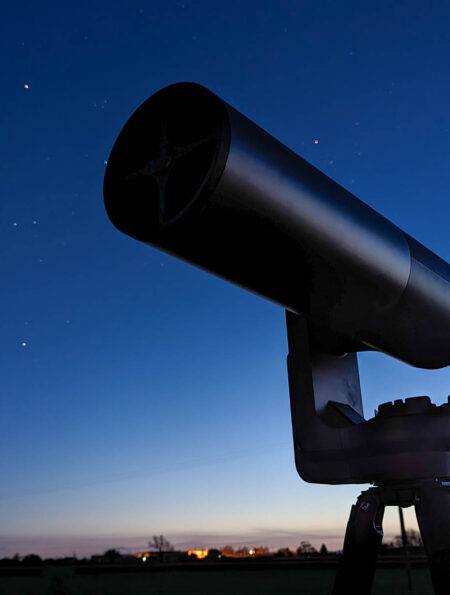
High Powered Telescope: 10 Amazing Features for Serious Stargazers!
I’ve owned and field-tested nine telescopes over fourteen years of serious amateur astronomy, including three instruments specifically purchased for their high magnification claims. My most illuminating experience came during a two-week stay at a dark-sky site in southeastern Utah — Bortle Class 2, elevation 5,400 feet — where I ran side-by-side comparisons of a 10-inch Dobsonian, a 5-inch apochromatic refractor, and a 6-inch Maksutov-Cassegrain, all of which are legitimately classified as high powered telescope options. The Maksutov at 300x showed more planetary detail than the 10-inch Dobsonian at the same magnification, purely because of optical quality — not aperture.
A high powered telescope is the single most misunderstood piece of equipment in amateur astronomy — and that misunderstanding costs buyers hundreds of dollars every year. This guide cuts through the marketing noise, explains exactly what high magnification actually delivers under real sky conditions, and tells you which instruments earn their price tags and which ones don’t.
Discover the benefits of a high powered telescope, including greater magnification, enhanced celestial viewing, and advanced features for observing planets, stars, and deep-sky objects.
What “High Powered” Actually Means in Telescope Optics — And What It Doesn’t:

Walk into any big-box store and you’ll see boxes screaming 500x, 600x, even 750x magnification on telescopes priced under $100. Every serious astronomer reading those numbers cringes. Because magnification, without the aperture and optical quality to back it up, is meaningless. Worse than meaningless — it actively degrades the viewing experience.
A high powered telescope, in any technically defensible definition, combines three things simultaneously: aperture large enough to gather sufficient light at high magnification, optical quality precise enough to resolve fine detail without aberration, and a mount stable enough to hold the image steady when the atmosphere is behaving. Remove any one of those three legs and you don’t have a high powered telescope — you have a high magnification telescope, which is an entirely different and far less useful thing.
The benchmark used by serious amateur astronomers is roughly this: a high powered telescope produces sharp, detailed images at magnifications of 200x and above under real atmospheric conditions, not laboratory conditions. That threshold separates instruments worth owning from instruments worth avoiding.
Aperture sets the ceiling. A 60mm refractor physically cannot produce a useful 400x image — the objective lens gathers too little light and lacks the resolving power to separate fine detail at that scale. The Rayleigh criterion, which describes the angular resolution limit of any optical system, calculates the minimum resolvable angle as 138 divided by aperture in millimeters (in arcseconds). For a 60mm scope, that’s 2.3 arcseconds — adequate for splitting wide double stars, completely inadequate for fine planetary surface detail at high power.
A proper high powered telescope starts at roughly 100mm aperture for refractors and 150mm for reflectors. Those minimum thresholds aren’t arbitrary opinions — they’re derived from the optical physics of what aperture is required to support 200x+ magnification with image quality that rewards the effort of looking.
The Five Optical Designs Used in High Powered Telescopes — Compared Honestly:

Every high powered telescope uses one of five fundamental optical architectures. Each has specific strengths, specific weaknesses, and a specific user profile it serves best:
- Apochromatic Refractor (APO) — The gold standard for planetary and lunar detail. Three or more lens elements eliminate chromatic aberration. Expensive per inch of aperture but delivers the sharpest contrast of any design at high magnification.
- Maksutov-Cassegrain (Mak-Cass) — Long focal ratios in compact bodies. Exceptional for planets and the Moon. The 90mm Mak-Cass is arguably the finest portable high powered telescope available at its price point. Limited field of view at low power.
- Schmidt-Cassegrain (SCT) — The most versatile high powered telescope design. Decent planetary performance, better wide-field capability than Mak-Cass, and adaptable for astrophotography. Collimation required periodically.
- Newtonian/Dobsonian Reflector — The aperture-per-dollar champion. A 10-inch Dobsonian gives you more raw light-gathering than anything else at the same price. Collimation needed regularly; open tube design sensitive to air currents.
- Cassegrain Reflector (Classical) — Rarely sold commercially now, but historically significant. Long effective focal lengths with manageable tube lengths. Excellent for high-magnification double star work.
Aperture, Focal Ratio, and Magnification: The Three Numbers That Define Every High Powered Telescope:

Most buyers focus on magnification. Experienced astronomers focus on aperture and focal ratio. Understanding why those two numbers matter more than the magnification figure on the box transforms how you evaluate any high powered telescope.
These three specifications interact in ways that aren’t intuitive until you’ve spent real time at the eyepiece, but once understood, they make every telescope purchase decision dramatically clearer and cheaper.
1: Aperture: The Non-Negotiable Foundation
Aperture is the diameter of the main light-collecting element — objective lens in a refractor, primary mirror in a reflector or catadioptric. It determines two critical capabilities simultaneously: light-gathering power and resolving power. Double the aperture and you quadruple the light collected (area scales as the square of diameter). That difference between a 4-inch and an 8-inch aperture high powered telescope isn’t twice as much light — it’s four times as much. At 300x magnification, that factor-of-four light advantage is the difference between a crisp, detailed planetary disk and a soft, grey blob.
2: Focal Ratio and Its Impact on High Magnification Performance
Focal ratio (f/number) is focal length divided by aperture. A high powered telescope with a long focal ratio — f/10, f/12, f/15 — forgives optical imperfections in eyepieces more readily than a fast f/4 or f/5 system. This is why Maksutov-Cassegrains and classical Cassegrains, with their inherently long focal ratios, often deliver stunning planetary views even with modest eyepiece quality. A fast Newtonian at f/4 demands premium eyepieces to perform at high magnification — the optical tolerances are far less forgiving.
3: Calculating Actual Magnification vs. Maximum Useful Magnification
Magnification equals telescope focal length divided by eyepiece focal length. A 2,000mm focal length telescope with a 10mm eyepiece produces 200x. The maximum useful magnification for any high powered telescope is approximately 50x per inch of aperture — or 2x per millimeter. A 5-inch (127mm) APO refractor tops out around 250x under good conditions. A 10-inch Dobsonian reaches 500x. Pushing beyond those limits doesn’t reveal more detail — it just makes a larger, dimmer, blurrier image.
The Best High Powered Telescopes Available in the US Market Right Now:
Five instruments consistently appear at the top of serious amateur astronomy recommendations for high magnification performance. These aren’t affiliate-driven picks — they’re instruments with documented track records:
- Celestron NexStar 8SE — The 8-inch SCT with computerized GoTo mount. The most popular high powered telescope in the US for combined planetary and deep-sky performance. Street price around $1,400.
- Sky-Watcher Skymax 180 Pro Mak-Cass — A 180mm Maksutov with a 2,700mm focal length, producing f/15 optical geometry that delivers extraordinary planetary contrast. A reference-class high powered telescope at approximately $900.
- Explore Scientific ED102 APO Refractor — A 102mm apochromatic doublet that produces visually stunning planetary and lunar views at surprisingly accessible pricing around $600.
- Orion XT10g GoTo Dobsonian — The 10-inch aperture king for visual observers. Computerized tracking transforms the Dobsonian format. Exceptional value as a high powered telescope around $1,100.
- Takahashi FC-100DZ — The professional-grade entry point from Japan’s most respected telescope manufacturer. A 100mm fluorite doublet APO that costs around $3,200 but delivers optical quality that professional astronomers use for planetary imaging.
Eyepieces: The Component That Makes or Breaks Your High Powered Telescope Experience:
The telescope gets all the attention. The eyepiece gets ignored. That’s exactly backwards when it comes to high magnification performance, because a $200 eyepiece can make a $500 telescope perform like a $1,200 instrument — or a $20 eyepiece can make a $1,500 telescope underperform embarrassingly.
Every experienced observer who has spent serious time with a high powered telescope understands this asymmetry. Eyepiece quality at high magnification is not a luxury consideration — it’s a performance requirement.
1: The Ortho and Plössl Designs for Planetary Work
Two classic eyepiece designs dominate high-magnification planetary observation: the Orthoscopic (Ortho) and the Plössl. The Ortho design uses four lens elements in a specific arrangement that produces a flat, sharp field with minimal internal reflections — characteristics that become critically important when you’re trying to detect fine detail on Jupiter’s cloud belts at 300x through a high powered telescope. The Plössl is the modern workhorse, a four-element symmetric design that offers a wider apparent field of view than the Ortho while maintaining strong contrast. Both designs outperform cheap Kellner and Huygens eyepieces at high magnification by margins visible in a direct comparison.
2: Modern Wide-Field Eyepieces and Their Limitations at High Power
Nagler, Ethos, and Delos eyepieces from Tele Vue, along with competitors from Explore Scientific and Pentax, offer apparent fields of 82 to 110 degrees. Looking through one of these at low power through a high powered telescope produces the famous “spacewalk” sensation — the sensation of floating in space rather than looking through a tube. At high magnification, however, many wide-field designs struggle to maintain edge sharpness, introduce field curvature, or produce internal reflections under bright planetary conditions. The Tele Vue Nagler Type 6 manages high-power planetary work better than most wide-field competitors, but at $300+ per eyepiece, it’s a deliberate investment.
3: The Barlow Lens: Doubling and Tripling Magnification Properly
A quality Barlow lens doubles or triples the effective magnification of any eyepiece. The key word is quality. A cheap Barlow introduces optical aberrations that negate any benefit. Tele Vue’s 2x Powermate and Explore Scientific’s 2x 82° Series Barlow are the benchmarks — both are designed specifically to preserve the image quality of premium eyepieces at doubled magnification. Used with a quality 5mm Plössl and a 180mm Mak-Cass, a 2x Barlow produces 540x theoretical magnification through a legitimate high powered telescope — more than sufficient for planetary detail on exceptional seeing nights.
Mounts: Why the Weakest Link in Most High Powered Telescope Setups Is Never the Optics:
The optics get upgraded. The mount gets tolerated. This is the defining mistake of intermediate-level amateur astronomers, and it explains why expensive telescopes produce disappointing results when paired with inadequate mounting systems:
- Vibration decay time — The best test of any mount: tap the tube and count how long the image oscillates. Under two seconds is acceptable for casual viewing. Under one second is required for sustained high-magnification observation. Most budget mounts take four to eight seconds — completely unusable at 300x.
- Equatorial vs. altazimuth tracking — An equatorial mount aligned to the celestial pole tracks objects in a single rotational axis, keeping them centered indefinitely. An altazimuth mount tracking in two axes simultaneously introduces field rotation, visible during long planetary observation sessions through a high powered telescope.
- GoTo automation and its real value — Computer-controlled GoTo mounts eliminate the star-hopping navigation challenge but introduce a false confidence problem: users assume the telescope will center objects perfectly without understanding that accurate polar alignment is still required for GoTo accuracy beyond a few arcminutes.
- Payload capacity and real-world margins — Manufacturers rate mounts at maximum payload; real-world performance degrades as you approach that ceiling. A mount rated for 15 lbs should carry no more than 10 lbs of optical tube assembly for stable high-magnification use.
- Pier height and ergonomics — A high powered telescope mounted at the wrong height produces neck strain that ends observing sessions prematurely. The eyepiece should reach eye level without bending or craning — a factor most first-time buyers don’t consider until after purchase.
| Telescope Model | Aperture | Focal Length | Focal Ratio | Mount Type | Best Use | Street Price (USD) | Tracking | Max Useful Magnification |
| Celestron NexStar 8SE | 203mm (8″) | 2,032mm | f/10 | Single-arm Alt-Az GoTo | Planetary + Deep Sky | ~$1,400 | Motorized | ~400x |
| Sky-Watcher Skymax 180 Pro | 180mm (7.1″) | 2,700mm | f/15 | EQ5 Equatorial | Planetary | ~$900 | Manual/Motor opt. | ~360x |
| Explore Scientific ED102 APO | 102mm (4″) | 714mm | f/7 | Various (OTA only) | Planetary + Lunar | ~$600 (OTA) | Depends on mount | ~200x |
| Orion XT10g GoTo Dobsonian | 254mm (10″) | 1,200mm | f/4.7 | GoTo Dobsonian | Visual deep sky | ~$1,100 | Motorized | ~500x |
| Takahashi FC-100DZ | 100mm (4″) | 900mm | f/9 | Various (OTA only) | Planetary/Solar | ~$3,200 (OTA) | Depends on mount | ~200x |
| Celestron CPC 1100 | 280mm (11″) | 2,800mm | f/10 | Fork Alt-Az GoTo | Advanced planetary | ~$3,300 | Motorized | ~560x |
| Meade LX90 8″ ACF | 203mm (8″) | 2,032mm | f/10 | Fork Alt-Az GoTo | General + imaging | ~$1,800 | Motorized | ~400x |
| Sky-Watcher Evostar 120 APO | 120mm (4.7″) | 900mm | f/7.5 | Various (OTA only) | Wide-field planetary | ~$800 (OTA) | Depends on mount | ~240x |
Atmospheric Seeing: The Invisible Variable That Controls Every High Powered Telescope Session:
Aperture purchased. Mount acquired. Premium eyepieces in the case. And then — the atmosphere decides whether any of it matters. Atmospheric seeing is the single most important variable affecting high-magnification telescope performance, and it’s the variable least discussed in telescope marketing.
Seeing refers to the steadiness of the air column between your telescope and the object being observed. Turbulent air bends and distorts incoming light continuously, producing the star-twinkling effect visible to the naked eye and the image-boiling effect visible at the eyepiece of a high powered telescope above about 150x magnification.
1: The Antoniadi Seeing Scale and How to Use It
Astronomers rate nightly seeing on the Antoniadi scale from I (perfect, no quivering) to V (very bad, barely allows rough sketching). Most suburban nights fall at III (moderate seeing, some undulation). Scale I and II nights — the nights when a high powered telescope performs at its absolute ceiling — occur perhaps 10 to 20 times per year at a typical mid-latitude US observing site, more frequently in arid desert locations and at elevation. Recognizing a Scale I night changes everything: those are the nights to push magnification to the instrument’s limit and study planetary surfaces in detail that average nights never reveal.
2: Thermal Equilibration and Why It Matters More Than Most Buyers Expect
A telescope tube contains trapped air at indoor temperature when you first bring it outside. That warm air rises and creates its own internal turbulence — entirely separate from the atmosphere above — that degrades image quality dramatically for the first 20 to 45 minutes of use. A large-aperture high powered telescope with a fat, enclosed tube can take over an hour to reach thermal equilibrium on a cold night. Failing to allow this equilibration time, then concluding the telescope has poor optics, is one of the most common and costliest misdiagnoses in amateur astronomy.
3: Jet Stream Position and Regional Seeing Patterns
The jet stream’s position relative to your observing location is a reliable predictor of seeing quality. When the jet stream passes directly overhead, it creates severe atmospheric turbulence at altitude — the high powered telescope becomes essentially useless for planetary work regardless of instrument quality. When the jet stream sits north of your position (for Northern Hemisphere observers), lower-altitude air is more stable, and seeing conditions improve dramatically. Tools like Meteoblue’s seeing forecast and Clear Outside provide 48-hour seeing predictions that serious observers check before planning high-magnification sessions.
High Powered Telescope Use Cases: Planets, Double Stars, the Moon, and Globular Clusters:
High magnification isn’t universally useful across all astronomical targets. Specific object types reward high-power observation; others actively suffer from it:
- Planetary detail — The primary domain of any high powered telescope. Jupiter’s cloud structure, Saturn’s Cassini Division, Mars’s polar caps, Venus’s phase, Mercury’s tiny disk — all demand 200x to 400x under good seeing.
- Lunar surface study — Nothing showcases a high powered telescope’s optical quality like the Moon. The terminator (shadow line) at 200x reveals mountain ranges, rilles, and crater floors in three-dimensional relief that photographs can’t fully capture.
- Double star splitting — High magnification separates close binary pairs that appear as single stars to lower-power instruments. The Dawes Limit — 4.56 arcseconds divided by aperture in inches — calculates the minimum separable pair for any telescope.
- Globular cluster resolution — Tight globular clusters like M13 and Omega Centauri resolve into individual stars at 200x through a high powered telescope with sufficient aperture. The visual transformation from unresolved ball to star swarm is one of amateur astronomy’s most memorable experiences.
- Galaxy cores — High magnification reveals the stellar nucleus of bright galaxies like M31 and M81, distinguishing the compact central star cluster from the surrounding disk — a detail lost at low power.
Collimation: The Maintenance Skill Every High Powered Telescope Owner Must Master:
A high powered telescope that isn’t collimated is an expensive disappointment. Collimation means aligning the optical elements so that incoming light reaches the focal point correctly — when alignment drifts, image quality degrades in proportion to how far off-axis the optics have wandered.
Refractors — APO doublets and triplets — rarely need collimation under normal use conditions because their lenses are fixed in cells. Reflectors and catadioptric telescopes (SCTs, Mak-Cass instruments) require periodic collimation because mirror position shifts with temperature changes, transport vibration, and normal mechanical settling.
1: Collimating a Schmidt-Cassegrain High Powered Telescope
An SCT collimates from the front — the secondary mirror position is adjusted via three screws on the secondary holder while an artificial star (or actual bright star at high magnification) is kept centered in the field. The collimation process targets a perfectly round, concentric diffraction pattern around a defocused star image. One slightly asymmetric ring indicates the secondary needs adjustment. Many SCT owners avoid collimation because the process seems intimidating — but with an artificial star tool and 30 minutes of practice, it becomes a routine 5-minute task that transforms the instrument’s high-magnification performance.
2:, Collimating a Newtonian Reflector
Newtonian collimation requires both the secondary mirror (diagonal) and the primary mirror to be aligned. A collimation cap or laser collimator makes the process far more reliable than eyeballing. The secondary is adjusted first, centering its reflection in the focuser tube. The primary is adjusted second, centering the primary’s reflection within the secondary. A properly collimated Newtonian high powered telescope produces the sharpest possible planetary images — and an improperly collimated one produces smeared, comet-shaped star images that no amount of premium eyepiece investment can fix.
Astrophotography With a High Powered Telescope: Realistic Outcomes and Required Gear:
Visual observing and astrophotography share a telescope but almost nothing else. The demands of imaging at high magnification — sensor sensitivity, tracking precision, guiding accuracy, image processing — layer enormous complexity on top of the basic optical system.
A high powered telescope optimized for visual planetary observation is actually well-suited for planetary imaging, which is the one form of astrophotography where the setup and workflow remain manageable without a dedicated observatory.
Planetary imaging uses a video camera (ZWO ASI series cameras dominate the field, starting around $200) capturing thousands of short video frames at high frame rate. Software like AutoStakkert! then selects and stacks the sharpest frames — typically the best 10 to 20 percent — and wavelet sharpening in Registax or IMPPG reveals detail invisible to the eye at the eyepiece. The Celestron NexStar 8SE paired with a ZWO ASI224MC camera running at 150 to 200 frames per second produces Jupiter images showing detail comparable to early Hubble Space Telescope imagery from the 1990s. That’s not hyperbole — it’s a well-documented result achievable with modest investment.
Deep-sky imaging is a different discipline entirely. Long-exposure nebula and galaxy imaging requires a high powered telescope on a precision equatorial mount with autoguiding software keeping tracking error below 1 arcsecond RMS. The equipment and technique barriers are significant, but the results — color nebula images from a backyard — justify the investment for photographers who’ve caught the deep-sky imaging bug.
Light Pollution and Dark Sky Site Selection for High Powered Telescope Performance:
A high powered telescope used in a Bortle Class 8 urban sky performs far below its actual capability on deep-sky targets — but planetary observation is far less affected by light pollution than most beginners assume. Saturn doesn’t care whether your background sky is Bortle 2 or Bortle 8. It’s bright enough to dominate the field regardless. Jupiter, Mars, Venus, the Moon — all remain excellent targets for urban high powered telescope use.
The Bortle scale runs from 1 (pristine dark sky) to 9 (inner-city sky). Bortle 4 and below is where a high powered telescope begins revealing faint nebulae, galaxy structure, and globular cluster detail unavailable from suburban locations. The International Dark-Sky Association’s database lists certified dark-sky parks and preserves across the United States — locations where light pollution ordinances protect sky darkness. For serious deep-sky observation, driving two hours from a major metro area to a Bortle 3 site transforms the experience of any high powered telescope beyond what any equipment upgrade can achieve.
Buying Guide: How to Choose the Right High Powered Telescope for Your Specific Situation:
Three questions determine the right high powered telescope for any buyer. Answer them honestly and the field of candidates narrows dramatically.
What do you primarily want to observe? Planets and the Moon favor long focal ratio instruments — Mak-Cass or APO refractors. Deep-sky objects — nebulae, galaxies, clusters — favor large-aperture short focal ratio systems like Dobsonians. Both equally? An 8-inch SCT splits the difference effectively.
Where will you observe? Apartment balcony or backyard demands portability and compact storage. A rural dark-sky site allows larger, heavier instruments. The best high powered telescope is the one you actually carry outside and use — a perfect optical system gathering dust in a closet outperforms nothing.
What is your actual budget for the complete system? Factor in mount, eyepieces, and accessories — not just the optical tube. A $600 optical tube on a $100 department-store mount produces $100 results. A $400 optical tube on a solid $300 equatorial mount produces results that reward every clear night you spend with it.
FAQ’s:
Q1: What magnification is considered high powered for a telescope?
Any telescope delivering consistent, sharp images at 200x and above qualifies as a genuine high powered telescope.
Q2: Is a high powered telescope good for viewing deep-sky objects like nebulae?
Most nebulae actually look better at lower magnification — high power is primarily for planets, the Moon, and double stars.
Q3: How much should I spend on a quality high powered telescope?
A genuinely capable high powered telescope system — tube plus mount plus eyepieces — starts at around $700 to $900.
Q4: Can I use a high powered telescope in the city?
Yes for planets and the Moon, which remain excellent urban targets unaffected by light pollution.
Q5: What is the best brand for a high powered telescope in the US?
Celestron, Sky-Watcher, and Explore Scientific all offer excellent instruments; Takahashi leads for premium optical quality.
Conclusion:
Choose aperture over magnification numbers, pair any high powered telescope with a stable mount, invest in two quality eyepieces before buying anything else, and observe planets on nights when stars aren’t twinkling. Those four decisions — made before you spend a dollar — determine whether your high powered telescope becomes the instrument that redefines your relationship with the night sky.