
I spent three consecutive nights in the Chiricahua Mountains of southern Arizona with a Celestron EdgeHD 8 — a premium Schmidt467890-oiuysa Cassegrain telescope — chasing a specific target: the Virgo Cluster’s faint ellipticals down to magnitude 13.5. On the second night, after careful collimation and a two-hour thermal cooldown, the images I pulled through that instrument made my jaw tighten. Flat, sharp stars edge to edge at f/10, with coma so thoroughly controlled that I questioned whether I was looking through a refractor.
The Schmidt Cassegrain telescope sits at an unusual crossroads — compact enough to carry to a dark-sky site in a backpack, yet powerful enough to image galaxies 50 million light-years away. Most buyers only discover what this design is genuinely capable of after they have already committed to one.
Discover 7 amazing Schmidt Cassegrain telescope features, including powerful optics, compact design, and versatile performance for astronomy enthusiasts.
The Optical Design: What Makes a Schmidt Cassegrain Telescope Different From Everything Else:
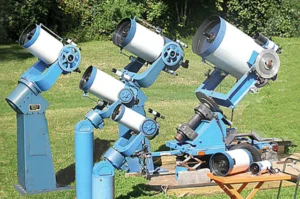
A schmidt cassegrain telescope is a catadioptric instrument — meaning it uses both lenses and mirrors to form an image. The front of the tube is sealed by a thin, aspheric corrector plate made of glass. Behind it, a spherical primary mirror sits at the rear of the tube. A small convex secondary mirror is mounted at the center of the corrector plate. Light enters through the corrector plate, bounces off the primary, reflects off the secondary, and travels back through a hole in the primary to reach the focuser at the rear of the tube.
This folded optical path is the design’s central genius. A schmidt cassegrain telescope with a 2,000mm focal length collapses into a tube roughly 400mm long — about one-fifth the physical length of a refractor with equivalent focal length. The implications are enormous for portability, for mount requirements, and for storage. A Celestron C8 SCT has a focal length of 2,032mm in a tube that fits in a medium-sized duffel bag. An equivalent refractor would be the size of a small child.
The corrector plate corrects for the spherical aberration introduced by the spherical primary mirror. Without it, the image would be an unacceptable blur. With it, on-axis optical performance of a well-manufactured schmidt cassegrain telescope approaches theoretical limits. The tradeoff? Off-axis field curvature and coma, which affects the usefulness of wide-field eyepieces and flat-field astrophotography at native focal ratio without field-flattener accessories.
Understanding the optical chain of a schmidt cassegrain telescope is not just academic. Every practical decision — which eyepieces to buy, how to collimate, what kind of astrophotography is achievable — flows from understanding this design. Observers who skip this step constantly fight their equipment instead of using it.
The Five Specifications That Actually Matter When Buying a Schmidt Cassegrain Telescope:
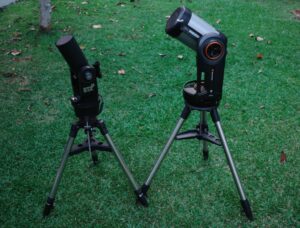
Most buyers focus on magnification numbers printed on boxes. Wrong metric entirely. Here are the five specifications that determine real-world performance of any schmidt cassegrain telescope:
- Aperture (diameter of the primary mirror): Measured in mm or inches — 6″, 8″, 9.25″, 11″, 14″ are the common SCT sizes. More aperture = more light = fainter objects visible and finer planetary detail resolvable. This number matters more than everything else combined.
- Focal ratio (f/number): Standard schmidt cassegrain telescope models run f/10. EdgeHD variants offer f/7 with a corrector. Fast-focus reducers can bring this to f/6.3. Focal ratio directly controls image scale in astrophotography and the field of view per eyepiece.
- Back focus distance: The distance from the rear port to the focal plane. A schmidt cassegrain telescope typically offers 130–160mm of back focus — generous by any standard and a major advantage for camera and accessory stacking.
- Obstruction ratio: The secondary mirror blocks a percentage of incoming light, typically 33–36% by diameter in a schmidt cassegrain telescope. This reduces contrast compared to an unobstructed refractor — a real effect, not a myth, though manageable.
- Optical quality grade: Mass-market models versus premium optical grades (Celestron’s EdgeHD line, Meade’s ACF) differ measurably in mirror surface accuracy. Specify what you want to do first — visual astronomy tolerates slightly lower grades; flat-field astrophotography demands the premium tier.
Celestron vs. Meade: The Two Giants of the Schmidt Cassegrain Telescope Market:
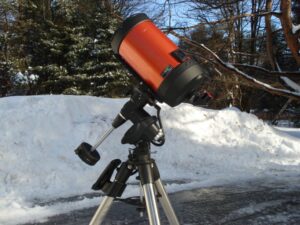
No buying conversation about a schmidt cassegrain telescope proceeds very far without landing on this comparison. Celestron and Meade have dominated the SCT market for fifty years, and their product lines have converged and diverged in ways that matter concretely to buyers.
The rivalry between these two companies has directly shaped how the schmidt cassegrain telescope evolved as a consumer product — from the original orange-tube Celestron C8 in the 1970s to the computerized GoTo systems of today. Understanding what each company currently does well is the fastest path to a smart purchase.
1: Celestron’s Schmidt Cassegrain Telescope Lineup
Celestron’s current SCT line divides into three tiers. The NexStar SE series (5″, 6″, 8″) represents the entry-level computerized schmidt cassegrain telescope — single-arm fork mount, hand controller with 40,000-object database, WiFi-enabled models that interface with the SkySafari app. Optical quality is solid, mount quality is adequate for visual use but marginal for serious astrophotography. The NexStar 8 SE runs approximately $1,099 and remains the best-selling schmidt cassegrain telescope in the US market by unit volume.
The Advanced VX series pairs 6″ and 8″ SCT optics with a German equatorial mount — a major upgrade for astrophotographers who need precise polar alignment and tracking. The AVX mount’s periodic error runs around 6–8 arcseconds peak-to-valley, manageable with autoguiding.
Celestron’s EdgeHD line is a premium, apochromatic-corrected variant of the schmidt cassegrain telescope design. The corrector plate is re-optimized to eliminate field curvature across a flat imaging circle — 36mm for the EdgeHD 8, 42mm for the EdgeHD 11. These are serious instruments designed for dedicated astrophotographers. The EdgeHD 9.25 on a CGEM II mount is arguably the finest mass-market schmidt cassegrain telescope system available below $3,000.
2: Meade’s Schmidt Cassegrain Telescope Offerings
Meade’s ACF (Advanced Coma-Free) design modifies the standard Schmidt cassegrain telescope formula by replacing the spherical primary with a hyperbolic mirror — reducing coma more aggressively than Celestron’s standard SCT while also addressing field curvature. The optical claim is a Ritchey-Chrétien-like performance at SCT prices. In testing, Meade’s ACF design delivers measurably better off-axis star shapes than a standard Schmidt cassegrain telescope, though the EdgeHD correction remains flatter for dedicated imaging.
Meade’s LX90 ACF (8″ and 10″ models) targets serious visual observers who want a self-contained GoTo alt-azimuth system without a separate mount. The LX200 ACF takes this further with a fork mount, GPS alignment, and an optional zero-image-shift Crayford focuser — premium features that justify the $2,000+ price tag.
Mount Compatibility: Choosing the Right Platform for Your Schmidt Cassegrain Telescope:
The Schmidt Cassegrain telescope’s compact form factor is deceptive. An 8″ SCT tube weighs roughly 5.5 kg without accessories — add a camera, guide scope, dew heaters, and a focuser motor and you’re carrying 8+ kg of payload. Mount choice is not optional; it determines whether your schmidt cassegrain telescope performs at its potential or constantly frustrates you.
Here are the five mount categories and what each delivers with an SCT:
- Single-arm fork alt-azimuth (NexStar SE style): Convenient, portable, excellent for visual use and casual lunar/planetary work — the most popular platform for the schmidt cassegrain telescope among casual users. Not suitable for long-exposure astrophotography due to field rotation.
- Dual-arm fork equatorial (LX200, CGE Pro fork): The traditional professional schmidt cassegrain telescope platform. Heavy, stable, excellent tracking — used by observatories for decades. Requires a wedge for equatorial tracking mode.
- German equatorial mount (AVX, CGEM II, EQ6-R): Best astrophotography platform for a schmidt cassegrain telescope — precise polar alignment, easy autoguiding, no meridian wedge needed. Requires counterweights and adds complexity.
- Dobsonian-style alt-azimuth: Some observers fit SCT tubes to manual Dobsonian rockerboxes for pure visual use — a cost-effective choice for large-aperture schmidt cassegrain telescope visual observation.
- Tracking wedge (equatorial wedge for fork mounts): Converts a fork-mounted schmidt cassegrain telescope from alt-azimuth to equatorial tracking, enabling long-exposure imaging — a key accessory for NexStar and LX90 owners.
Collimation of a Schmidt Cassegrain Telescope: The Step-by-Step Method That Actually Works:
This is the single topic most schmidt cassegrain telescope owners either fear or approach incorrectly. Collimation anxiety is common — and unnecessary, once you understand what is actually being adjusted. Unlike a Newtonian reflector with its two independently adjustable mirrors, the schmidt cassegrain telescope has one adjustable element: the secondary mirror, controlled by three collimation screws on the front of the corrector plate.
The collimation process for a schmidt cassegrain telescope is methodical, repeatable, and takes under ten minutes once you have done it three or four times. The key is starting with the right target and working systematically rather than randomly.
1: Selecting the Right Test Star for Collimation
Use a bright star between magnitude 1.5 and 3.5 — Vega, Arcturus, Capella. Fainter stars are too dim to show the diffraction pattern clearly; brighter stars introduce atmospheric turbulence effects that masquerade as collimation errors. The star should sit at least 30° above the horizon to minimize atmospheric dispersion. Let the schmidt cassegrain telescope thermally equilibrate for at least 45 minutes before attempting precise collimation — thermal gradients inside the tube create false collimation errors that disappear once temperatures stabilize.
2: The Defocused Star Test
Rack the focuser out until the star appears as a large disk with concentric rings. In a perfectly collimated schmidt cassegrain telescope, the central dark shadow (the secondary mirror’s obstruction) appears as a perfect circle centered in the disk. If it is off-center — sitting closer to one edge of the rings — the secondary needs adjustment. Move slowly: the three front screws on a schmidt cassegrain telescope are sensitive to small turns. Use a 1.5mm hex key and move in quarter-turn increments. The shadow moves toward the screw you are tightening. Work one screw at a time, check the result, and repeat until the shadow is centered.
3: Confirming Collimation on a Real Target
After defocused-star collimation, verify on a planetary target or a tight double star. A well-collimated Schmidt cassegrain telescope on Jupiter at 200× should show crisp belts with no directional smearing. On a close double star at the resolution limit, both components should be equally sharp — if one is soft, the secondary is still slightly off. Re-center the obstruction shadow in the defocused test and re-check. Most experienced SCT users reach stable collimation within two or three iterations.
Astrophotography With a Schmidt Cassegrain Telescope: The Honest Capability Map:
The schmidt cassegrain telescope is simultaneously one of the most used and most misunderstood instruments in amateur astrophotography. Its long focal length is ideal for some targets and actively hostile to others. Mapping those categories clearly saves both money and frustration.
Here are the five astrophotography categories and where the schmidt cassegrain telescope fits:
- Lunar and planetary imaging: The Schmidt cassegrain telescope’s long focal length (2,000–3,500mm) is ideal for high-resolution planetary work. Using high-frame-rate video cameras (ZWO ASI224, IMX462-based sensors) and lucky imaging software, an 8″ SCT consistently produces planetary images that outperform any other consumer instrument at the price.
- Bright deep-sky objects at native f/10: Challenging. Long focal length means small field of view, slow focal ratio, long exposure times. The Orion Nebula core at f/10 through a schmidt cassegrain telescope is spectacular but the full nebula won’t fit the frame.
- Deep-sky imaging with f/6.3 reducer: Adding a focal reducer transforms the schmidt cassegrain telescope for broader deep-sky targets. M42, M31’s core, globular clusters, and planetary nebulae become accessible with exposure times cut by 60%.
- Flat-field imaging (EdgeHD or ACF required): Standard SCT optics produce strong field curvature that blurs stars at frame edges. The EdgeHD and ACF variants correct this for flat-field cameras — non-negotiable for serious wide-field imaging.
- Electronic visual observing (EAF + ASIAIR): Pairing a schmidt cassegrain telescope with an electronic focuser, a modern CMOS sensor, and a device like the ZWO ASIAIR creates a live-stack observing experience that recovers the wide-field flexibility that visual eyepiece use sacrifices.
Reference Table:
| SCT Model | Aperture | Focal Length | F/Ratio | Mount Included | Optical Grade | Best Use Case | Price (USD, 2025) |
| Celestron NexStar 5SE | 127mm (5″) | 1250mm | f/10 | Single-arm AZ GoTo | Standard | Visual + casual planetary | ~$699 |
| Celestron NexStar 8SE | 203mm (8″) | 2032mm | f/10 | Single-arm AZ GoTo | Standard | Visual + planetary imaging | ~$1,099 |
| Celestron AVX 8″ SCT | 203mm (8″) | 2032mm | f/10 | German EQ GoTo | Standard | Astrophotography entry | ~$1,499 |
| Celestron EdgeHD 8 | 203mm (8″) | 2032mm | f/10 (f/7 opt.) | Tube only | Premium flat-field | Serious imaging | ~$1,299 (OTA) |
| Celestron EdgeHD 9.25 | 235mm (9.25″) | 2350mm | f/10 | Tube only | Premium flat-field | Imaging + visual | ~$1,599 (OTA) |
| Celestron EdgeHD 11 | 279mm (11″) | 2800mm | f/10 | Tube only | Premium flat-field | Deep-sky imaging | ~$2,199 (OTA) |
| Meade LX90 8″ ACF | 203mm (8″) | 2032mm | f/10 | Dual-arm AZ fork | Advanced coma-free | Visual + planetary | ~$1,799 |
| Meade LX200 10″ ACF | 254mm (10″) | 2500mm | f/10 | Fork EQ | Advanced coma-free | Observatory-grade visual | ~$3,299 |
| Celestron CGEM II 8″ | 203mm (8″) | 2032mm | f/10 | German EQ GoTo | Standard | Mid-level imaging | ~$1,899 |
| Celestron NexStar 6SE | 150mm (6″) | 1500mm | f/10 | Single-arm AZ GoTo | Standard | Portable visual + planets | ~$849 |
Planetary Observing With a Schmidt Cassegrain Telescope: A Target-by-Target Breakdown:
The Schmidt cassegrain telescope earns its most genuine praise in the domain of planetary observing. No other consumer instrument type delivers comparable aperture at comparable cost in a package this portable — and at f/10, the image scale through a quality eyepiece is exactly right for planetary detail.
The practical performance on each major planet differs significantly, and understanding those differences shapes realistic expectations for every schmidt cassegrain telescope owner.
1: Jupiter Through a Schmidt Cassegrain Telescope
Jupiter is the most rewarding planetary target for any Schmidt cassegrain telescope at virtually any aperture. Even the 5″ NexStar delivers the North and South Equatorial Belts clearly, the Galilean moon disk as distinct spots, and occasional glimpses of the Great Red Spot when it transits the central meridian. Scale up to an 8″ schmidt cassegrain telescope and the detail becomes remarkable: festoons in the equatorial zone, irregular boundaries on the belts, the shadows of Galilean moons as perfectly circular dark circles, and on nights of excellent seeing, hint of cyclonic structure in the polar regions. Peak magnification for Jupiter in a well-collimated 8 “Schmidt cassegrain telescope is around 250–300× under good seeing.
2: Saturn Through a Schmidt Cassegrain Telescope
Saturn at opposition through a schmidt cassegrain telescope is the reason many observers stay in the hobby. The ring system, Cassini’s Division, the shadow of the rings on the disk, and the disk’s own shadow on the rings are all routinely visible in an 8″ SCT under decent seeing. Titan is easy at magnitude 8.5. Rhea, Dione, and Tethys appear as magnitude 10–11 points accessible to a 6″ or larger Schmidt cassegrain telescope. The Encke Minima — a faint division near the outer edge of the A ring — requires exceptional seeing and a well-collimated 10″+ schmidt cassegrain telescope, but it is within the design’s theoretical resolution.
3: Mars, Venus, and Mercury
Mars rewards the Schmidt cassegrain telescope only during opposition — its disk diameter expands from under 4 arcseconds to 25+ arcseconds at favorable opposition, and the difference is dramatic. Syrtis Major, Hellas Basin, and the polar ice cap are clearly resolved in an 8″ SCT at opposition. Venus shows phases beautifully and through UV/violet filters reveals the banded atmospheric structure that white-light views miss. Mercury — always low and heavily atmospherically affected — shows phases but rarely fine surface detail through any ground-based amateur instrument, including the schmidt cassegrain telescope.
Accessories That Transform a Schmidt Cassegrain Telescope Into a Complete System:
Buying a schmidt cassegrain telescope tube or basic bundle is step one. The accessory ecosystem around it determines whether the instrument reaches its potential. These five additions, in order of priority, deliver the most performance gain per dollar:
- f/6.3 focal reducer/corrector (Celestron #94175): Reduces the native 2,032mm focal length of an 8″ schmidt cassegrain telescope to 1,280mm and improves field flatness simultaneously — the single highest-impact accessory for visual observers wanting wider fields and for photographers wanting faster exposures.
- Electronic focuser (Celestron Focus Motor or Pegasus FocusCube): Manual focusing at high magnification through a schmidt cassegrain telescope introduces vibration that ruins fine planetary views and makes astrophotography focus runs impractical. Motorized focusing is not a luxury after the first observing session.
- Dew shield and dew heater strap: The schmidt cassegrain telescope’s corrector plate is highly prone to dewing — the sealed tube creates thermal conditions that accelerate moisture deposition. A 12V dew heater strap on the front end and a passive dew shield are mandatory for observers in humid climates.
- Dielectric diagonal (2″): The standard star diagonals shipped with many schmidt cassegrain telescope bundles are 1.25″ prism diagonals with reflectivity in the low 90% range. Replacing it with a 2″ dielectric mirror diagonal increases effective light transmission and enables 2″ wide-angle eyepieces — a dramatic visual improvement.
- High-quality 24mm Panoptic-class eyepiece: At f/10 through a schmidt cassegrain telescope, a 24mm eyepiece delivers approximately 85× magnification with a 45-arcminute true field. This is the single most-used magnification for deep-sky visual observing and deserves the best glass you can afford — Tele Vue Panoptic, Explore Scientific 82°, or Baader Hyperion.
Thermal Management: The Overlooked Performance Factor in Every Schmidt Cassegrain Telescope:
Ask experienced SCT owners what the single biggest image quality killer is on most nights, and a significant number will answer the same thing: thermal equilibration. The schmidt cassegrain telescope’s closed tube design, which contributes to its portability and optical stability, also traps heat and creates internal air currents that destroy image definition until temperatures equalize.
Thermal management is not optional if you want consistent high-magnification performance from a schmidt cassegrain telescope. It is a systematic practice that separates observers who understand why their views vary from observers who blame the seeing, the optics, or the alignment.
1: How Long Does a Schmidt Cassegrain Telescope Actually Need to Cool?
The answer depends on temperature differential and tube size. As a rule of thumb: 30 minutes per inch of aperture, starting from room temperature. An 8″ schmidt cassegrain telescope moved from a 72°F house to a 45°F backyard needs approximately four hours to fully thermalize. Most observers use 45–90 minutes as a practical compromise — enough to eliminate the grossest turbulence — but peak performance requires full equalization. Two observational signs indicate incomplete cooling: stars appear to boil at high magnification even when the atmosphere is steady, and collimation seems worse than last session despite no physical changes to the instrument.
2: Active Cooling Strategies
Several active approaches accelerate thermal equilibration of a schmidt cassegrain telescope. The most effective: a 12V computer fan mounted at the rear port blowing air through the telescope tube in reverse — drawing outside air across the primary mirror and out through a small gap. This forced-convection cooling cuts equalization time roughly in half. Commercial cooling fans like the Celestron CoolGuard are designed for this purpose but a 40mm case fan and a USB power supply work identically. The second strategy: store the schmidt cassegrain telescope in an unheated garage or shed during winter months so it is already at ambient temperature before each session. Obvious in retrospect, but transformative in practice.
3: Tube Currents and Their Optical Signature
A partially thermalized Schmidt cassegrain telescope shows a characteristic defocused star test signature: instead of clean concentric rings, the rings shimmer and writhe in a specific pattern, often showing a flame-like asymmetry consistent with rising warm air from the primary mirror. This is distinct from atmospheric seeing turbulence, which produces random, rapid dancing. Tube currents are slower and more structured. Once you know this signature, you will never confuse it with atmospheric seeing again — and you will stop chasing collimation adjustments on a thermally unstable instrument.
The Schmidt Cassegrain Telescope for Beginners: Is It Actually the Right First Instrument?
The astronomy community debates this sincerely. The schmidt cassegrain telescope demands more from its user than a Dobsonian reflector or a simple alt-azimuth refractor — thermal management, collimation, a complex GoTo alignment procedure, and the optical nuances of a catadioptric design. These are not insurmountable challenges, but they are real ones.
For a beginner who wants to point a telescope at something and immediately see it clearly, a simple 8″ Dobsonian costs less and delivers more light-gathering power with zero alignment complexity. The tradeoff: size. An 8″ Dobsonian is a large, heavy instrument that is genuinely difficult to transport. The Schmidt Cassegrain telescope at the same aperture fits in the back of a sedan.
If you observe from a fixed backyard, the Dobsonian wins on value for money for pure visual astronomy. If you travel to dark sites, want imaging capability, or plan to grow into astrophotography, the schmidt cassegrain telescope’s portability and versatility justify the added complexity. The GoTo computerized mount, once aligned, eliminates the steep learning curve of manual star-hopping — a genuine advantage for beginners who would otherwise spend their first year just learning to navigate the sky rather than observing it.
The practical verdict: a beginner who reads this article, commits to understanding thermal management and collimation before their first session, and buys a computerized schmidt cassegrain telescope in the 8″ class will have a rewarding experience from the start. A beginner who opens the box cold, skips the manual, and expects plug-and-play performance will be disappointed. The instrument rewards preparation.
Used Schmidt Cassegrain Telescope Market: What to Look For, What to Avoid:
The Schmidt Cassegrain telescope holds its value exceptionally well. A used Celestron C8 from the 1990s with original optics in clean condition is still a highly functional instrument — the optical design has not been superseded, and the glass does not degrade with age. This makes the used market an excellent place to access serious aperture at significant discounts, but only with careful inspection.
The primary risk in a used Schmidt cassegrain telescope is corrector plate damage. The large aspheric glass plate at the front is the most expensive single component in the instrument and the hardest to replace. Inspect it for chips at the edges (common from careless storage), cleaning scratches across the optical surface (from owners who wiped the plate with a paper towel — a category error), and delamination of the anti-reflection coating (visible as iridescent patches under raking light). Any of these defects are negotiating leverage but not necessarily dealbreakers — minor edge chips have no optical effect; coating delamination does.
The secondary mirror — a small convex mirror bonded to the center of the corrector plate — rarely suffers damage but can develop a slight tilt if the bonding adhesive has degraded. Check this by confirming collimation during the purchase test. A schmidt cassegrain telescope that cannot reach collimation with the standard three-screw adjustment has either a shifted secondary or a warped primary — both are serious problems.
The focuser drawtube and mirror-shift mechanism are wear points. On older schmidt cassegrain telescope models, focusing is achieved by moving the primary mirror forward and backward — a design that introduces image shift as you approach focus. Test this: focus on a star, note its position, then continue racking the focuser through and past focus. The star should return to almost exactly the same position in the field. Excessive mirror shift indicates worn mirror cell threads — a nuisance for visual use and a significant problem for astrophotography.
The Future of the Schmidt Cassegrain Telescope: Where the Design Is Heading:
The schmidt cassegrain telescope design is over 80 years old in its current form. What makes it remarkable is not that it is perfect — it is not — but that it remains genuinely difficult to improve upon at its price tier. Competing designs have carved out niches: the Ritchey-Chrétien dominates professional observatories, the aplanatic Cassegrain addresses off-axis coma more aggressively, the Dall-Kirkham design is favored by high-end visual observers. None of them, at amateur pricing, deliver the combination of aperture, portability, and versatility that the schmidt cassegrain telescope provides.
The most significant development in the design’s recent history is integration with digital systems. Modern computerized Schmidt cassegrain telescope mounts communicate wirelessly with planetarium software, autoguiders, electronic focusers, and cloud-based observation planning tools in ways that transform the observing workflow. Celestron’s CPWI software turns the schmidt cassegrain telescope into a fully software-controlled research instrument from a laptop. ZWO’s ASIAIR Pro performs the same function from a smartphone.
The next generation of schmidt cassegrain telescope designs will likely feature factory-installed CMOS sensors for focus assist, active thermal management systems that use small fans controlled by firmware rather than the observer, and modular corrector plate systems that allow field-flattening and focal reduction as configurable optical elements rather than afterthought accessories. These advances are already visible in prototype systems from both Celestron and third-party optical engineering firms. The foundational design — corrector plate, spherical primary, convex secondary — will persist because the optical physics that make it optimal have not changed.
FAQ’s:
Q1: What is a schmidt cassegrain telescope best used for?
It excels at planetary observing, lunar imaging, and versatile deep-sky work in a compact, portable package.
Q2: How often does a schmidt cassegrain telescope need collimation?
Most owners collimate every 3–6 months during routine use, or after any rough transport.
Q3: Can a schmidt cassegrain telescope do astrophotography?
Yes — especially planetary imaging, and deep-sky with a focal reducer and equatorial mount.
Q4: What aperture Schmidt cassegrain telescope should a beginner buy?
The 8″ (203mm) model is the standard recommendation — best balance of aperture, weight, and price.
Q5: Is a Schmidt cassegrain telescope better than a Dobsonian?
For portability and imaging versatility yes; for pure visual aperture per dollar, the Dobsonian wins.
Conclusion
The Schmidt cassegrain telescope rewards those who invest time in understanding its specific requirements: thermal equilibration, careful collimation, and purposeful accessory selection. Match aperture to your site’s sky conditions, choose a mount rated for twice your payload weight, and prioritize an 8″ or larger model. The universe does not compress its wonders for unprepared observers — but it generously reveals them to patient, systematic ones.