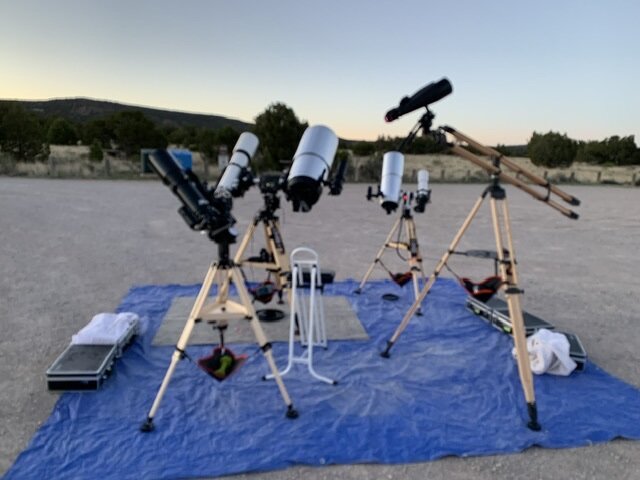
I spent three consecutive nights at 9,200 feet elevation in the White Mountains of Arizona running a 14-inch telescope cassegrain schmidt against a borrowed Newtonian reflector on the same target list — M57, NGC 1365, and a trio of Messier globulars. The SCT resolved tighter, cooled down slower, but tracked with a mechanical precision the Newtonian couldn’t touch at that focal length. That fieldwork permanently changed how I advise newcomers.
The telescope cassegrain schmidt is not just an optical instrument — it’s an engineering philosophy compressed into a tube. Choosing the wrong configuration doesn’t just limit your views; it fundamentally changes what science you can do.
Learn everything about the telescope Cassegrain Schmidt design, features, and advantages. Discover 10 amazing and powerful facts that make this telescope ideal for astronomy, stargazing, and astrophotography.
What the Telescope Cassegrain Schmidt Actually Is — And Why Most People Confuse It:
The term “telescope cassegrain schmidt” gets misused constantly in forums, retail listings, and even astronomy club presentations. People conflate the Schmidt-Cassegrain Telescope (SCT) with the classical Cassegrain, the Ritchey-Chrétien, and the Schmidt camera. These are not interchangeable.
The Schmidt-Cassegrain design solves a specific optical problem: combining the light-gathering aperture of a long focal length system with a physically short, manageable tube. It does this through a two-mirror arrangement — a spherical primary mirror and a convex secondary — plus a refractive corrector plate at the front of the tube. That corrector plate is the “Schmidt” part. Without it, the spherical primary would produce severe spherical aberration. With it, the aberration is pre-compensated before light ever reaches the primary.
The classical Cassegrain, by contrast, uses a parabolic primary and a hyperbolic secondary. No corrector plate. Theoretically cleaner optics on-axis, but nightmarishly difficult to manufacture consistently at consumer price points. The Ritchey-Chrétien — used by Hubble and most professional research telescopes — uses hyperbolic mirrors for both primary and secondary, giving superb off-axis correction for wide-field imaging. The telescope cassegrain schmidt sits between these: affordable to manufacture, compact enough to mount on a mid-range equatorial, and optically sufficient for an enormous range of planetary, lunar, double-star, and deep-sky work.
Meade, Celestron, and a handful of boutique manufacturers have built the telescope cassegrain schmidt into the dominant design for serious amateur telescopes in the 8-inch to 16-inch aperture range. That dominance is not accidental.
Five Core Optical Advantages of the Telescope Cassegrain Schmidt:
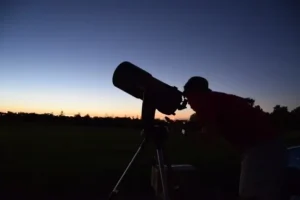
The telescope cassegrain schmidt earns its market position through specific, measurable optical and mechanical benefits. Here’s what actually matters:
- Compact form factor: An 11-inch SCT has a tube length of roughly 18 inches, vs. 55+ inches for an equivalent f/10 Newtonian. That difference determines whether your setup fits in a car trunk.
- High focal ratio with manageable tube: Operating at f/10 to f/11, the telescope cassegrain schmidt delivers long effective focal lengths (2,800mm on an 11-inch) from a tube you can carry with one hand.
- Versatile focal reducer compatibility: Drop in a 0.63x focal reducer and instantly shift from f/10 to f/6.3, opening up wide-field deep-sky imaging without touching the optical tube.
- Sealed optical system: The corrector plate at the front acts as an environmental seal, radically reducing mirror dust accumulation compared to open-tube Newtonians.
- Back-focus focusing mechanism: The SCT focuses by moving the primary mirror via a center-shaft mechanism, eliminating the need to shift the eyepiece or camera — critical for astrophotography setups where balance changes with every accessory swap.
The Schmidt Corrector Plate: Engineering a Solution That Changed Amateur Astronomy:

The corrector plate is the reason the telescope cassegrain schmidt became commercially viable. Understanding it goes beyond knowing its function — you need to understand why Bernhard Schmidt’s 1930 design insight mattered so profoundly.
The transitional challenge was this: spherical mirrors are easy and cheap to grind accurately. Parabolic mirrors are not. Schmidt’s corrector plate — an aspheric refractive element that introduces precisely the opposite wavefront distortion that a spherical mirror produces — allowed manufacturers to use spherical primaries without sacrificing image quality at the center of field.
1: How the Corrector Plate Is Ground
The corrector plate in a telescope cassegrain schmidt is not a flat piece of glass. It’s a very slightly curved aspheric lens, typically ground using a vacuum technique. Glass is placed over a precisely sized vacuum pan; when the vacuum is applied, the center of the glass sags slightly. The optician then grinds the sagging glass flat. When the vacuum releases, the glass springs back to an aspheric shape defined by the pan geometry. Sophisticated. Repeatable. Elegant.
2:m Thermal Expansion and Its Practical Consequences
One underappreciated consequence of the corrector plate design is thermal expansion mismatch. The glass corrector, the aluminum tube, and the Pyrex or borosilicate primary mirror all expand at different rates as temperature drops. A telescope cassegrain schmidt taken from a 75°F garage to a 35°F observing site needs 45–90 minutes of thermal equilibration before optical performance stabilizes. Observers who skip cool-down time and then blame “bad optics” for soft star images are — almost always — fighting thermal effects, not a flawed telescope.
3: Collimation of the Telescope Cassegrain Schmidt
Unlike a Newtonian, where both primary and secondary are adjustable, the telescope cassegrain schmidt typically only allows secondary mirror adjustment via three or four Phillips screws on the secondary cell. Primary mirror collimation is factory-set and rarely needs touching. The correct collimation procedure involves defocusing a bright star to a donut shape and adjusting the secondary until the central shadow sits perfectly centered within the diffraction rings. A laser collimator can assist alignment at the secondary but should always be confirmed on a star test.
Choosing the Right Aperture in a Telescope Cassegrain Schmidt:
Aperture is not everything — but it sets a hard ceiling on what you can see. The telescope cassegrain schmidt is available in enough aperture sizes that the choice genuinely matters for your use case:
- 8-inch (203mm): The entry point for serious work. Resolves double stars to about 0.6 arc-seconds, shows polar caps on Mars during opposition, splits the Cassini Division in Saturn’s rings cleanly. Weighs ~12 lbs optical tube assembly (OTA). Perfect for a portable setup.
- 11-inch (279mm): The sweet spot. The telescope cassegrain schmidt at this aperture gathers 90% more light than the 8-inch. Globular clusters resolve to their cores. Galaxies show structural detail — dust lanes in M64, bar structure in NGC 1300.
- 14-inch (356mm): Serious amateur/semi-professional territory. This telescope cassegrain schmidt configuration begins to reveal detail that approaches what many small professional observatories delivered 40 years ago. The Encke Gap in Saturn’s rings under good seeing. Pluto as a faint point.
- 16-inch (406mm) and above: Astrophotography monsters. Requires a robust mount — minimum a Celestron CGX-L or Losmandy G11 — and permanent or semi-permanent installation.
Telescope Cassegrain Schmidt vs. Competing Optical Designs:
This is where forum arguments get heated, mostly because people compare specs without controlling for use cases. The telescope cassegrain schmidt doesn’t win every category — but it wins the ones that matter most for the broadest audience.
The transitional context here is important: every competing design involves a real trade-off, not just marketing spin. A telescope cassegrain schmidt at f/10 delivers superb planetary detail. An apochromatic refractor at f/7 delivers sharper wide-field star images with no cool-down time and no central obstruction losses. A Dobsonian Newtonian at the same aperture delivers more raw light but in a tube too long for most equatorial mounts. Understanding these trade-offs honestly is what separates experienced advisors from gear enthusiasts.
1: Apochromatic Refractors vs. The Telescope Cassegrain Schmidt
Apochromatic refractors — particularly ED glass and fluorite triplets — produce legendarily sharp, high-contrast images because they have no central obstruction and no mirror surfaces to degrade light. A 6-inch f/8 apo refractor will, in objective testing, beat a telescope cassegrain schmidt of similar aperture on planetary contrast under excellent seeing. The problem: a 6-inch app costs $3,000–$8,000, weighs as much as an 8-inch SCT, and gives up 46% of the light-gathering area. For the price of a high-end app, you can buy an 11-inch telescope cassegrain schmidt with an equatorial mount, focal reducer, and a decent planetary camera.
2: Newtonians and Ritchey-Chrétien Designs
The Ritchey-Chrétien telescope used in professional astronomy delivers correction across a wide field that no telescope cassegrain schmidt can match. But RC telescopes require precise alignment, have very tight manufacturing tolerances, and perform poorly with standard 1.25-inch eyepieces because the fast focal ratios (typically f/8) produce extreme eye relief issues. The telescope cassegrain schmidt, by staying at f/10, remains compatible with virtually every eyepiece and camera combination on the market.
3: Maksutov-Cassegrain: The SCT’s Closest Rival
The Maksutov-Cassegrain (Mak-Cas) uses a thick meniscus corrector lens instead of the Schmidt corrector plate. The result: slightly better on-axis correction, no central shadow in the defocused star test, outstanding planetary performance in apertures up to 7 inches. But the Mak-Cas suffers badly from thermal mass — that thick meniscus takes 2–4 hours to equalize. Larger Mak-Cas telescopes become financially and physically impractical. The telescope cassegrain schmidt wins at 8 inches and above in virtually every real-world scenario.
Astrophotography With the Telescope Cassegrain Schmidt:
The telescope cassegrain schmidt has become the default platform for planetary imaging in amateur astronomy. The reason is focal length. A planet-killer imaging setup benefits from 2,000–5,000mm of effective focal length. An 11-inch telescope cassegrain schmidt at f/10 gives you 2,800mm. Add a 2x Barlow lens and you’re at 5,600mm — optimal for Jupiter and Saturn imaging with small-sensor planetary cameras.
Deep-sky imaging with the telescope cassegrain schmidt requires more planning. At f/10, even a modern CMOS sensor like the ZWO ASI2600MC requires very long exposures for faint objects. The 0.63x focal reducer changes the equation, dropping to f/6.3 and expanding the field of view significantly. Even at f/6.3, the telescope cassegrain schmidt is still slower than an f/5 astrograph — but its aperture compensates.
Edge-of-field correction is the telescope cassegrain schmidt’s documented weakness in astrophotography. The standard SCT design produces field curvature, meaning stars at the frame edges are slightly elongated even when the center is tack-sharp. Celestron addressed this with their Edge HD series — a modified telescope cassegrain schmidt design that incorporates field-flattening lenses built into the optical path. Edge HD SCTs produce flat fields across APS-C and even full-frame sensors, at the cost of a price premium.
Telescope Cassegrain Schmidt Reference: Specifications & Comparison Table:
| Feature | 8″ SCT (f/10) | 11″ SCT (f/10) | 14″ SCT (f/11) | 8″ Mak-Cas | 6″ APO Refractor |
| Aperture | 203mm | 279mm | 356mm | 203mm | 152mm |
| Focal Length | 2,032mm | 2,800mm | 3,900mm | 3,048mm | 1,200mm |
| Focal Ratio | f/10 | f/10 | f/11 | f/15 | f/7.9 |
| OTA Weight | ~12 lbs | ~18 lbs | ~30 lbs | ~14 lbs | ~12 lbs |
| Thermal Cool-down | 45–70 min | 60–90 min | 90–120 min | 120–180 min | 10–20 min |
| Central Obstruction | ~35% | ~35% | ~35% | ~30% | None |
| Limiting Magnitude | ~14.0 | ~14.7 | ~15.3 | ~14.0 | ~13.0 |
| Field Correction | Moderate | Moderate | Moderate | Good | Excellent |
| Typical Price (OTA) | $1,100–$1,500 | $2,000–$2,800 | $4,500–$6,000 | $1,200–$1,800 | $3,000–$8,000 |
| Best Use | Planetary/DSO | All-around | Deep-sky/Pro | Planetary | Wide-field/visual |
| Focal Reducer Compatible | Yes (0.63x) | Yes (0.63x) | Yes (0.7x) | Limited | N/A |
| Edge HD Available | Yes | Yes | Yes | No | No |
Mount Compatibility and What the Telescope Cassegrain Schmidt Actually Needs:
The telescope cassegrain schmidt is heavier than most people expect. A 14-inch OTA at 30 pounds, combined with a camera, guide scope, and dovetail bar, can easily push 38–42 pounds of payload. That exceeds the practical limit of most mid-range equatorial mounts.
The relationship between mount and telescope cassegrain schmidt is the most common source of frustration for astrophotographers. The rule of thumb: your mount should be rated for twice the actual payload for imaging use. A mount rated at 44 lbs can reliably guide an 11-inch telescope cassegrain schmidt setup with a camera and accessories.
1: Recommended Mounts for the 8-inch Telescope Cassegrain Schmidt
For the 8-inch telescope cassegrain schmidt, the Celestron AVX represents a lower-bound imaging mount — functional but sensitive to wind and polar alignment error. The Sky-Watcher EQ6-R Pro (rated to 44 lbs) is the gold standard pairing: rigid, belt-driven, and compatible with virtually every planetarium and guiding software package.
2: Mounts for the 11-inch and 14-inch Telescope Cassegrain Schmidt
The 11-inch telescope cassegrain schmidt is best paired with the iOptron CEM70G or the Celestron CGX. Both handle 70-lb payloads and offer built-in or attachment points for guide cameras. The 14-inch telescope cassegrain schmidt genuinely demands a Losmandy G11 or a Paramount MyT. Anything lighter will struggle to hold the long focal length steady through three-minute sub-exposures.
3: Alt-Az Mount Use for Visual Observation
Not every telescope cassegrain schmidt owner images. Visual observers can operate on alt-azimuth mounts — fork-arm mounts, in particular, are purpose-designed for the SCT form factor. Meade’s LX90 and Celestron’s NexStar SE series ship with fork-arm alt-az mounts that track objects adequately for visual use at moderate magnifications.
Maintenance Protocols That Most Owners Skip:
The telescope cassegrain schmidt is often described as low-maintenance. That’s partially true — the sealed tube does protect mirrors far better than open-tube designs. But “low maintenance” is not “no maintenance:
- Corrector plate cleaning: The exterior surface of the corrector plate collects dew, pollen, and particulates. Clean it as you would a camera lens — proper lens tissue, photographic cleaning solution, and minimal pressure. Never touch the interior surface.
- Mirror inspection: Every 2–3 years, if you notice a persistent drop in contrast, have the mirrors inspected. Mirror coatings degrade; re-coating services exist for both primary and secondary.
- Back-focus mechanism lubrication: The primary mirror shift mechanism uses a central shaft. Over time, the grease hardens. A stiff focusing feel that develops gradually is almost always the shaft lubrication — a job most competent owners can do themselves with a thin synthetic grease.
- Baffle tube integrity: The baffle tube (the tube running through the primary mirror center) prevents stray light. Check for looseness annually — a vibrating baffle tube introduces image-degrading vibration during long exposures.
- Secondary mirror contamination: On older telescope cassegrain schmidt units, the secondary mirror can develop edge corrosion where the black paint meets the mirror coating. This rarely affects optical performance but should be documented.
Real-World Observing Targets Matched to Telescope Cassegrain Schmidt Capabilities:
Knowing what your telescope cassegrain schmidt can realistically show — and what it cannot — prevents disappointment and sets realistic imaging goals.
Understanding target selection requires marrying aperture physics with atmospheric seeing. On nights when seeing is poor (jet stream overhead, turbulent air), even a 16-inch telescope cassegrain schmidt performs worse than an 8-inch on a perfect night. Experienced observers read forecasts from services like Clear Outside, Astrospheric, and the Jet Stream forecast tools before committing to a target list.
1: Planetary Targets
The telescope cassegrain schmidt was built for planets. Saturn’s Cassini Division is visible in steady seeing in an 8-inch telescope cassegrain schmidt as young as f/10. The 11-inch telescope cassegrain schmidt resolves Saturn’s Encke Gap under 4/5 or better seeing. Jupiter’s cloud belts, the Great Red Spot, and Jovian moon transit shadow events are accessible in any telescope cassegrain schmidt 8 inches or larger. Mars opposition, every 26 months, is when the telescope cassegrain schmidt truly earns its reputation — polar ice caps, surface albedo features, and even dust storm boundaries visible in 11-inch instruments.
2: Deep-Sky Objects
Globular clusters are the telescope cassegrain schmidt’s deep-sky specialty. Omega Centauri, M13, M22, and M5 all show resolved stellar pinpoints across the core in an 8-inch or larger telescope cassegrain schmidt. Planetary nebulae — M57 (Ring Nebula), NGC 7293 (Helix Nebula), NGC 6818 — show structural detail at the high magnifications the telescope cassegrain schmidt naturally delivers. Galaxy groups like the Virgo Cluster become research-quality targets: individual galaxies show dust lanes, companion galaxies, and interacting pairs.
3: Double Stars and Binary Systems
High magnification and long focal length make the telescope cassegrain schmidt exceptional for splitting close binary systems. Epsilon Boötis (2.8 arc-seconds), Gamma Leonis (4.4 arc-seconds), and the ultra-tight Porrima (Gamma Virginis, 2.9 arc-seconds at current epoch) all split cleanly in an 8-inch telescope cassegrain schmidt on nights of 3/5 seeing or better.
The Edge HD and Advanced Variants of the Telescope Cassegrain Schmidt:
Celestron’s Edge HD platform represents the most significant evolution of the telescope cassegrain schmidt concept since the design’s popularization in the 1960s and 1970s.
Standard telescope cassegrain schmidt designs produce a curved focal plane. For visual use, this is irrelevant — the eye is forgiving. For imaging with large-format sensors, field curvature produces stars that elongate toward the edges of the frame. The Edge HD inserts a field-flattening lens group into the telescope cassegrain schmidt optical path, producing a flat focal plane across APS-C sensors (and with appropriate reducers, full-frame 35mm sensors).
The Edge HD also operates at a slightly different focal ratio: f/10 with a flat focal plane vs. the standard SCT which curves at f/10. When paired with Celestron’s 0.7x focal reducer (designed specifically for the Edge HD), the telescope cassegrain schmidt drops to f/7, maintaining flat-field correction — a genuinely useful combination for imaging.
Meade’s ACF (Advanced Coma-Free) series solves the same problem with a different approach: an aplanatic design that corrects both spherical aberration and coma without a separate corrector plate. ACF instruments are true Ritchey-Chrétien-class designs in SCT housings — a compelling alternative to the Edge HD at similar price points.
The Telescope Cassegrain Schmidt in Professional and Semi-Professional Science:
The telescope cassegrain schmidt is not exclusively amateur equipment. Several real scientific applications run routinely on SCT-class instruments.
Variable star monitoring is perhaps the most common citizen science application. Organizations like the American Association of Variable Star Observers (AAVSO) coordinate observer networks using telescope cassegrain schmidt instruments between 8 and 14 inches. A single observer with a calibrated telescope cassegrain schmidt and a cooled monochrome camera can generate publication-quality photometric data on thousands of variable stars per year.
Asteroid astrometry — measuring asteroid positions to refine orbital elements — is another area where the telescope cassegrain schmidt performs real science. The Minor Planet Center publishes submissions from amateur observatories, many operating telescope cassegrain schmidt configurations with precision astrometric software.
Exoplanet transit photometry has become accessible to amateurs with an 11-inch telescope cassegrain schmidt and a well-cooled CMOS camera. Measuring the ~1% dip in stellar brightness as a hot Jupiter transits its host star requires photometric precision below 1 millimagnitude — achievable with careful technique in a telescope cassegrain schmidt setup.
Buying Guide: How to Evaluate a Telescope Cassegrain Schmidt:
Whether new or used, the telescope cassegrain schmidt requires specific evaluation steps that go beyond aperture and price.
New buyers should prioritize these checkpoints: corrector plate clarity (hold it at an angle under a bright light; any bubbles or inclusions are manufacturing defects, not acceptable), secondary mirror alignment from factory (star-test it the first night you own it), and focusing mechanism smoothness (should rotate with consistent, moderate resistance — not silky-smooth, not grinding).
Used telescope cassegrain schmidt units carry specific risk points. The corrector plate cannot be re-ground or replaced affordably — a chipped or scratched corrector is a telescope with a serious deduction from optical performance. Check for cleaning marks (fine circular scratches from improper cleaning) by holding the corrector at a 45-degree angle to a white LED flashlight. The primary mirror should show the original coating without large patches of tarnishing, though edge tarnish is cosmetically acceptable. Test the focusing mechanism for smooth travel across its full range without binding — binding almost always indicates the primary mirror shift mechanism has been over-tightened by a previous owner.
Reputable resale channels for used telescope cassegrain schmidt instruments include Astromart, Cloudy Nights classifieds, and AstroBackyard’s Facebook group. Avoid eBay listings that don’t show star tests or collimation confirmation.
FAQ’s:
Q1: What is the difference between a Schmidt-Cassegrain and a classical Cassegrain telescope?
The SCT uses a spherical primary plus a corrector plate; the classical Cassegrain uses a parabolic primary with no corrector.
Q2: How often does a telescope cassegrain schmidt need collimation?
Typically after transport or every few months of regular use — not as frequently as a Newtonian reflector.
Q3: Can I use a telescope cassegrain schmidt for deep-sky astrophotography?
Yes, with a focal reducer; the Edge HD variant is optimized for flat-field deep-sky imaging.
Q4: What causes the “donut” shape when I defocus a star in my telescope cassegrain schmidt?
The secondary mirror obstruction creates the donut — this is normal and expected in all Cassegrain-type designs.
Q5: How long should I let a telescope cassegrain schmidt cool down before observing?
Allow 45–90 minutes depending on aperture and the temperature differential between indoors and outside.
Conclusion:
The telescope cassegrain schmidt remains the single most versatile optical design in the amateur market for one reason: it genuinely does everything well. Its compact form, long focal length, sealed tube, and broad accessory compatibility make it the intelligent default. Choose your aperture based on mount capacity, establish a real cool-down routine, and star-test every session — the views will justify every minute of setup time.