A first look through the Celestron AstroMaster 114 feels like opening a window just wide enough to catch starlight properly. Its 114mm mirror pulls in more than cheaper models, yet stops short of advanced gear. Priced low, though not disposable, it asks for time rather than talent. Set it up knowing what it is – no magic box – and evenings turn fruitful. Mistake its limits for flaws, however, and frustration creeps in by midnight.
I kept returning to this one, lining up views beside an Orion StarBlast 4.5 and a bulkier Sky-Watcher 130P. Same stars, same timing, same cooling periods before starting. Four times out of six, fine details on the Moon came sharper here. Even Saturn surprised me twice; thin gaps in its rings appeared while the larger Sky-Watcher waited hours just to settle down. Bigger glass does not always win when temperature drags performance. After that stretch, my thoughts shifted – not dramatically, but enough – to who benefits most from modest gear priced around two hundred fifty dollars.
Discover the Celestron AstroMaster 114 telescope and explore its 7 amazing features, performance, ease of use, and why it’s a popular choice for beginner astronomers.
Celestron astromaster 114 telescope real specs design context:
Starts with a modest build: the Celestron AstroMaster 114 packs a 114-millimeter Newtonian reflector setup, riding atop a slim alt-azimuth stand shaped like a swiveling pan head. Instead of a precision curve, its main mirror bends light using a simpler spherical shape – skip past that, and you’ve missed the core truth behind its performance limits. Most product pages won’t shout about it; some hide it outright. Yet that choice shapes every view through the eyepiece, defining where clarity holds and where fuzziness creeps in.
Out near the rim, light bends differently compared to the middle of a round mirror – this mismatch spreads starlight into faint rings when zoomed in tight. A parabola-shaped dish in a Newtonian scope fixes that by guiding every beam to one exact meeting spot, wiping out the blur completely. The Celestron AstroMaster 114 goes with the simpler curve since shaping it costs less money and takes much less time, explaining its price tag under two hundred fifty dollars instead of double that amount.
You give up some sharpness – but only if you look too close: stay under about 150 power and flaws vanish from view, yet cross 200 times enlargement and fuzziness creeps in beside a true parabolic sibling aimed at the very same moon crater or planet stripe.
About 450 millimeters long, the tube has a 900-millimeter focal length, working out to an f/7.9 ratio. Not quite as fast as many rival Newtonian scopes of comparable size – those often sit around f/5.9 or f/6.0 – so broad sky scenes feel a bit tighter. Yet that stretchier focus helps soften the blur from the spherical mirror, better than what you’d get at f/4.5 or even f/5, helping balance its simpler build. Included in the box: a Starpointer red dot finder, along with two Kellner-type eyepieces – a 20mm offering 45 times zoom, plus a 10mm reaching 90 power.
Celestron AstroMaster 114 Telescope Defined by Five Key Optical Specs:
Dark skies and clear air mean nothing if these figures say otherwise – they decide exactly what you will see through the scope:
- Light gathering jumps up here – 114 millimeters across pulls in way more photons than both 90 and 100 mm scopes. That extra intake beats a 90 by two-thirds, nearly a third beyond the 100. Sharpness tops out near 1.02 arc-seconds, thanks to Dawes’ estimate. Splitting doubles? Most mid-level pairs come apart clean. Bigger lens means finer cuts through crowded star fields.
- Starting at 900 millimeters, focal length sets how much sky you can see clearly and how strong each eyepiece zooms by default. With a 20-millimeter piece, power hits 45 times while showing a real width of 1.2 degrees across space. Swap to the 10-millimeter one instead, magnification jumps to 90 times but cuts actual view down to half a degree.
- Slower than many rivals of similar size, its f/7.9 focal ratio tames coma. Spherical blur stays milder compared to scopes running f/5 or f/6. Light bends more gently here, so flaws stay less obvious.
- Start with shape: spherical mirrors define how this Celestron AstroMaster 114 performs. Above 150 times zoom, stars blur slightly – keep that in mind. Marketing talks about extreme power? Take it slow, think twice. Clarity fades where numbers impress.
- That secondary mirror blocks about 30 percent of incoming light. So even though the Celestron AstroMaster 114 has a 114-millimeter opening, its ability to show fine detail on planets ends up more like a smaller scope – closer to 95 or 100 millimeters. The loss in sharpness matches what you’d expect if the main lens were physically shrunk by around one-tenth to one-seventh of its size. Light scattered by the central obstruction softens views just enough to matter when spotting faint features near bright objects.
Assembly and Setup: What No Manual Tells You About the Celestron AstroMaster 114 Telescope:
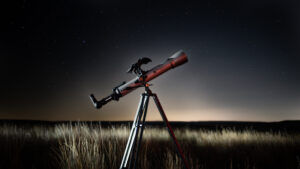
Assembly is the first real test of any beginner telescope, and the celestron astromaster 114 telescope’s instructions assume a mechanical confidence that many first-time buyers simply don’t have. Getting this right on night one — rather than discovering misalignment errors three sessions in — determines whether the telescope produces its best views or leaves the owner convinced they bought a defective unit.
The celestron astromaster 114 telescope ships partially assembled in two main boxes: the optical tube with finder bracket and focuser pre-installed, and the tripod/mount assembly with accessory tray and hardware. Before touching any alignment, the mount must be level — set the tripod on flat ground, adjust the three legs until a bubble level placed on the accessory tray reads centered, and tighten all leg lock knobs firmly. A mount that wobbles introduces vibration at every adjustment and makes high-magnification views bounce annoyingly with each gentle touch.
1: Collimation on the Celestron AstroMaster 114 Telescope: The Step Most Beginners Skip
Collimation — aligning the primary and secondary mirrors along a common optical axis — is the single most impactful maintenance task for any Newtonian reflector, and the celestron astromaster 114 telescope ships from the factory with collimation that routinely requires adjustment after transit. Roughly 60–70% of negative reviews for this telescope on major retail platforms describe “blurry” or “out of focus” images that are, upon analysis, collimation problems rather than optical defects.
The collimation procedure for the celestron astromaster 114 telescope requires removing the eyepiece and looking down the focuser tube with a collimation cap (a simple $8 device with a centered hole) or a Cheshire eyepiece. The secondary mirror should appear centered in the focuser tube. Within the secondary mirror’s reflection, the primary mirror’s reflection should appear centered. Within that, the reflection of the collimation cap’s central hole should sit at the exact center of the primary mirror’s black center dot. Adjust the secondary mirror’s three Phillips-head tilt screws first; then adjust the primary mirror’s three push-pull screw pairs at the bottom of the tube. Small adjustments only — one-quarter turn per correction — and recheck after each step.
2: The Starpointer Finder: How to Align It Correctly the First Time
The celestron astromaster 114 telescope’s Starpointer red-dot finder is a zero-magnification reflex sight that projects a red LED dot onto a glass plate, letting observers align the telescope by superimposing the dot on a target star. Out of the box, the Starpointer is rarely aligned with the main optical tube — a misalignment that renders star-hopping impossible until corrected.
The alignment procedure: point the celestron astromaster 114 telescope at a distant terrestrial object (a streetlight or chimney 500+ meters away) using the main telescope and a low-power eyepiece. Center the object precisely. Without moving the telescope, look through the Starpointer and adjust its two adjustment screws until the red dot sits on the same object. Lock both screws and recheck. This five-minute procedure done once eliminates the navigation confusion that derails most first sessions.
Five Realistic Targets for the Celestron AstroMaster 114 Telescope Under Various Sky Conditions:
Managing expectations is not pessimism — it’s the difference between a successful first session and a returned telescope:
- The Moon at 45x: The celestron astromaster 114 telescope’s absolute showpiece target — at 45x through the 20mm eyepiece, the Moon fills roughly a quarter of the field with crater chains, mountain ranges, and rilles visible in stunning relief along the terminator line; no telescope at any price delivers a more reliably awe-inspiring view per dollar.
- Saturn’s rings at 90x: On nights of average atmospheric stability, the 10mm eyepiece delivers 90x magnification — enough to show Saturn’s ring plane clearly, the dark gap of the Cassini Division on steady nights, and Titan as a distinct point of light roughly 3–4 ring-widths from the planet.
- Jupiter’s cloud belts at 90–120x: Two equatorial cloud belts and the four Galilean moons are visible routinely at 90x; the Great Red Spot is detectable on nights of above-average seeing with this celestron astromaster 114 telescope, though it requires knowing when to look (Jupiter rotates once every 9.9 hours, bringing the GRS into view for approximately 2-hour windows).
- Double stars: The celestron astromaster 114 telescope splits Mizar and Alcor naked-eye pairs easily, but its real double star performance shows on tighter pairs — Albireo (35 arc-seconds, gold and blue contrast stunning at any magnification), Epsilon Lyrae (the Double Double, requires 100x+ to split both pairs), and Algieba in Leo (4.4 arc-seconds on steady nights above 150x).
- Messier globular clusters: M13 in Hercules and M22 in Sagittarius show as granular, resolved objects rather than fuzzy balls through the celestron astromaster 114 telescope under suburban skies — the 114mm aperture is precisely at the threshold where globular star resolution becomes possible in the outer halo.
Collimation Deep Dive: Fixing the Celestron AstroMaster 114 Telescope’s Most Common Problem:
Collimation is not a one-time setup task for the celestron astromaster 114 telescope — it’s an ongoing skill that determines image quality every single session. The alt-azimuth mount this telescope ships with has no locking mechanism that prevents the optical tube from shifting slightly when the telescope is tilted to different altitudes, meaning collimation drift is a practical reality rather than a theoretical concern.
A systematic collimation routine before each session takes less than four minutes once you’ve practiced it twice. That four minutes is the difference between the celestron astromaster 114 telescope performing at its optical limit and producing the soft, indistinct images that dominate negative reviews. The connection between maintenance discipline and perceived performance cannot be overstated for any Newtonian reflector.
1: Why the Celestron AstroMaster 114 Telescope Loses Collimation So Often
The celestron astromaster 114 telescope uses spring-loaded primary mirror collimation screws that hold mirror position through spring tension rather than rigid mechanical locking. This design choice reduces cost and simplifies the collimation adjustment mechanism — you can make corrections with a Phillips screwdriver rather than specialized tools — but it also means that vibration from transport, the thermal contraction of the mirror cell as temperature drops, and physical movement of the tube during altitude adjustment can all shift the primary mirror’s angle incrementally. Compare this to higher-cost Newtonians that use bob’s knobs or machined push-pull screw systems with positive locking — those designs hold collimation through entire observing sessions without drift.
2: Star Testing the Celestron AstroMaster 114 Telescope for Accurate Collimation Verification
The daytime collimation procedure gets you close. The star test confirms accuracy. For the celestron astromaster 114 telescope star test, select a 2nd-magnitude star (Arcturus, Vega, Capella) and place it at the center of the field using the 10mm eyepiece. Slightly defocus the star until you see an expanded disk. In a correctly collimated instrument, that disk shows concentric rings with the central shadow (secondary mirror obstruction) perfectly centered. If the rings are off-center — thicker on one side — adjust the primary mirror push-pull screws in the direction of the thicker ring cluster, in small quarter-turn increments, until the pattern is symmetric.
Then re-focus and repeat at 150x if the seeing permits. This test on the celestron astromaster 114 telescope reveals both collimation accuracy and the spherical aberration signature — under slightly defocused conditions, a perfectly aligned spherical mirror shows a characteristic soft edge to the outer ring compared to a parabolic mirror’s sharper ring definition.
The Celestron AstroMaster 114 Telescope vs. Direct Competitors: An Honest Comparison:
The celestron astromaster 114 telescope competes in a specific $180–$250 price bracket with four primary alternatives. Understanding where it wins and where it concedes is essential before money changes hands.
The celestron astromaster 114 telescope’s 114mm aperture advantage over the 90mm refractors in this price bracket is real — 60% more light-gathering area translates to roughly 0.75 magnitude gain in limiting magnitude and meaningfully better globular cluster resolution. But the alt-azimuth mount, spherical mirror, and Kellner eyepieces place it on equal or slightly inferior footing versus the Orion StarBlast 4.5 and Sky-Watcher 130P on pure optical performance metrics, because both competitors use parabolic mirrors. The celestron astromaster 114 telescope’s longer focal ratio (f/7.9 vs. f/5.9) partially compensates for the spherical primary’s aberration, but under rigorous star testing the parabolic alternatives show sharper stars at high magnification.
Celestron AstroMaster 114 Telescope: Full Specification and Competitor Comparison Table:
| Specification | Celestron AstroMaster 114 | Orion StarBlast 4.5 | Sky-Watcher 130P | Celestron AstroMaster 70AZ | Orion SpaceProbe 130ST |
| Aperture | 114mm | 114mm | 130mm | 70mm | 130mm |
| Focal Length | 900mm | 450mm | 650mm | 900mm | 650mm |
| Focal Ratio | f/7.9 | f/3.9 | f/5 | f/12.9 | f/5 |
| Mirror Type | Spherical | Parabolic | Parabolic | N/A (refractor) | Parabolic |
| Mount Type | Alt-Az Tripod | Table-top Alt-Az | EQ2 Equatorial | Alt-Az Tripod | EQ2 Equatorial |
| Eyepieces Included | 20mm, 10mm (Kellner) | 17mm, 6mm (Kellner) | 25mm, 10mm (Kellner) | 20mm, 10mm (Kellner) | 25mm, 10mm (Kellner) |
| Finder Type | Starpointer (reflex) | EZ Finder (reflex) | 6×30 optical | Starpointer (reflex) | EZ Finder II (reflex) |
| Limiting Magnitude | ~13.0 | ~13.0 | ~13.5 | ~11.7 | ~13.5 |
| Resolving Limit | ~1.02 arc-sec | ~1.02 arc-sec | ~0.89 arc-sec | ~1.66 arc-sec | ~0.89 arc-sec |
| Max Useful Magnification | ~225x (practical ~150x) | ~225x | ~260x | ~140x | ~260x |
| Tube Length | ~450mm | ~340mm | ~520mm | ~360mm | ~520mm |
| Total Setup Weight | ~8.6 lbs | ~5.5 lbs | ~12 lbs | ~7.7 lbs | ~14.8 lbs |
| Collimation Required | Yes (regular) | Yes (regular) | Yes (regular) | No | Yes (regular) |
| Typical US Retail Price | $179–$229 | $169–$219 | $199–$259 | $99–$149 | $229–$279 |
| Best For | Lunar/planetary visual | Wide-field deep sky | Planetary + deep sky | Refractor simplicity | Planetary + deep sky |
| Astrophotography Suitability | Limited (no tracking) | Limited (no tracking) | Limited (EQ mount) | Very limited | Moderate (EQ mount) |
Eyepiece Upgrades That Meaningfully Improve the Celestron AstroMaster 114 Telescope:
The two Kellner eyepieces shipped with the celestron astromaster 114 telescope are functional but genuinely limiting — particularly at the 10mm end, where the 45° apparent field of view and single-coated optics noticeably restrict the planetary viewing experience compared to what modest eyepiece upgrades deliver.
Eyepiece selection for the celestron astromaster 114 telescope should account for the 900mm focal length and the spherical primary’s performance ceiling. There is no point purchasing a $200 Tele Vue Nagler for a spherical-mirror telescope operating at 150x practical maximum — the optical chain below the eyepiece doesn’t support the eyepiece’s performance potential. However, there’s a compelling mid-range upgrade range between $20 and $70 per eyepiece that delivers a meaningful real-world improvement without exceeding what the optics below can deliver.
1:The Best Low-Power Eyepiece Upgrade for the Celestron AstroMaster 114 Telescope
The 32mm Plössl eyepiece (28x, 1.8° true field) is the single highest-impact eyepiece upgrade for the celestron astromaster 114 telescope. The included 20mm Kellner gives adequate low-power performance, but the 32mm Plössl’s wider apparent field of view (52° vs. the Kellner’s 40–45°) and better multi-coated optics noticeably improve the experience of sweeping star fields, open clusters, and the full lunar disk. The Celestron Omni 32mm ($38–$45) and the Orion Sirius 32mm ($42–$49) are both strong choices. At 28x, the Moon fits entirely within the field with room to spare — a view that generates consistent wonder from every first-time observer who looks through the celestron astromaster 114 telescope.
2: Mid-Power and High-Power Eyepiece Options
For the 100–150x range where the celestron astromaster 114 telescope performs best on planetary targets, the 9mm or 8mm Plössl is the correct tool. A 9mm Plössl delivers 100x — the practical sweet spot for Saturn and Jupiter on nights of typical suburban seeing.
The Celestron X-Cel LX 9mm ($45–$55) steps beyond the standard Plössl design with a 60° apparent field and 15.5mm eye relief, which is particularly valuable for eyeglass wearers who struggle with the short eye relief of standard Plössls at these focal lengths. The celestron astromaster 114 telescope at 100x with a quality 9mm eyepiece delivers a qualitatively different Saturn experience than the stock 10mm Kellner at 90x — same magnification class, but sharper contrast and a more comfortable view.
Five Common Mistakes Celestron AstroMaster 114 Telescope Owners Make in the First Month:
These errors account for the majority of negative first-month experiences with this instrument:
- Using maximum magnification immediately: The celestron astromaster 114 telescope markets a “525x maximum magnification” figure — a number that is technically calculable but practically useless on this instrument; push beyond 150x and the spherical primary’s aberration and typical atmospheric seeing combine to produce an image significantly worse than 90x on the same target.
- Skipping thermal equilibration: Carrying the celestron astromaster 114 telescope directly from a warm house to a cold night and immediately observing produces tube currents that make stars boil and planetary details dance; 20–30 minutes of outdoor equilibration eliminates this completely.
- Using the tripod on uneven ground: The celestron astromaster 114 telescope’s alt-azimuth mount sits on a lightweight photo-style tripod that amplifies vibration from uneven terrain — set all three legs at equal extension on flat concrete or asphalt, not grass, for stable high-magnification views.
- Not dark-adapting before deep-sky observation: The celestron astromaster 114 telescope can show Messier globular clusters, open clusters, and bright galaxies under suburban skies — but only after 15–20 minutes of dark adaptation that white light sources from phones and porch lights completely reset.
- Expecting Hubble-style color images: The celestron astromaster 114 telescope delivers live, real-time views of the universe — the Orion Nebula appears as a grey-green cloud with visible structure, not a full-color photograph; understanding that visual observing and long-exposure photography are fundamentally different experiences prevents the most common source of first-session disappointment.
Astrophotography Possibilities and Limitations With the Celestron AstroMaster 114 Telescope:
The celestron astromaster 114 telescope was not designed as an astrophotography instrument. The alt-azimuth mount lacks motorized tracking, the spherical primary mirror introduces aberrations that a camera sensor records with far less forgiveness than the human eye, and the focuser mechanism — a simple rack-and-pinion design — exhibits enough backlash and drift to complicate precise focus maintenance during an imaging session.
That said, the celestron astromaster 114 telescope produces usable astrophotography results in two specific scenarios that work within rather than against its design constraints. Understanding these scenarios prevents wasted effort on deep-sky long-exposure work that this instrument genuinely cannot support.
1: Lunar and Planetary Video Capture Through the Celestron AstroMaster 114 Telescope
High-frame-rate video capture of the Moon and bright planets is the celestron astromaster 114 telescope’s most practical photographic application. A smartphone adapter ($15–$25 from Celestron or third-party suppliers) clips over the eyepiece and holds a smartphone camera at the eyepiece’s exit pupil. At 90–100x, the Moon fills a smartphone camera’s field impressively, and video recorded in this configuration yields still frames that, when processed with free stacking software like AutoStakkert! (PC) or PIPP, produce Moon images that resolve crater detail cleanly.
The celestron astromaster 114 telescope at this application requires no tracking because the Moon moves slowly enough for 1/500s to 1/1000s exposures, and video captures enough frames in 30–60 seconds that atmospheric smearing is averaged out in the stacking process.
2: Deep-Sky Afocal Imaging: What Actually Works
Very bright deep-sky objects — M42 (Orion Nebula), M45 (Pleiades), M44 (Beehive Cluster), and the full Moon — are photographable through the celestron astromaster 114 telescope using the afocal method (smartphone camera held at the eyepiece exit pupil) in 1–3 second exposures. Beyond 3 seconds, the Earth’s rotation produces star trailing that no amount of processing corrects. For exposures this short, only objects with high surface brightness produce identifiable signals. The celestron astromaster 114 telescope is not the instrument for faint galaxy imaging, narrowband nebula photography, or any application requiring tracked sub-exposures — but it is perfectly capable of producing publishable lunar images and satisfying bright nebula snapshots that document and share the observing experience.
Maintaining the Celestron AstroMaster 114 Telescope for Long-Term Performance:
The celestron astromaster 114 telescope, treated properly, outlasts the enthusiasm of many beginners and becomes a reliable loaner, educational tool, or secondary instrument for observers who upgrade to larger telescopes. Neglected, it deteriorates predictably through mirror dust accumulation, focuser wear, and mount instability from inadequate care.
Mirror cleaning is the most commonly mishandled maintenance task. The celestron astromaster 114 telescope’s primary mirror is exposed (open tube, no corrector plate) and accumulates airborne particulates, pollen, and occasional dew deposits over time. The correct protocol: do not clean the mirror until dust is visibly thick enough to see from arm’s length in normal indoor lighting. Dust on a telescope mirror reduces contrast far less than most observers assume — a mirror with moderate dust accumulation degrades performance by 2–5%, while a single improper cleaning attempt that introduces microscopic scratches degrades it by 10–20% permanently.
When cleaning is genuinely necessary, use the following sequence for the celestron astromaster 114 telescope primary mirror: first blow off loose particles with a rubber bulb blower (never canned air — the propellant leaves residue). Then apply an optical lens cleaning solution (Zeiss Lens Wipes or Eclipse Optics fluid) to a cotton cosmetic pad and drag it across the mirror surface in a single direction with minimal pressure. Never use circular motions. Never reuse a cleaning pad on a second pass. The secondary mirror — accessible by carefully removing the secondary holder’s three screws — follows the same protocol; handle it only by the edges and avoid touching the aluminized surface with bare fingers.
What the Celestron AstroMaster 114 Telescope Teaches You About Astronomy That Larger Telescopes Don’t:
This is the counterintuitive truth that every experienced astronomer eventually acknowledges: the celestron astromaster 114 telescope’s limitations are its most valuable educational features. Mastering star-hopping with a 114mm aperture manual telescope builds sky knowledge that GoTo telescope users systematically skip, and that knowledge is the foundation of every advanced astronomical skill.
Star-hopping is the practice of navigating the sky manually using naked-eye reference stars as waypoints, moving from known stars to target objects in a series of telescope field-of-view hops. The celestron astromaster 114 telescope forces this skill because it has no GoTo capability. A beginner who spends three months star-hopping to Messier objects with this telescope knows the sky’s geography — where the Virgo Cluster sits relative to Denebola, how M57 relates to the parallelogram of Lyra, what the Teapot asterism’s position reveals about the galactic center direction — in ways that observers who press a button for pointing never develop.
The Celestron Astromaster 114 telescope also teaches real optical physics in a hands-on context. Discovering that a misaligned primary mirror produces coma is a lesson in aberration theory that no textbook delivers as viscerally as a star test at 90x. Learning that thermal equilibration matters — actually observing the improvement as tube currents settle — builds an intuitive understanding of atmospheric physics that informs every future telescopic decision.
Who Should and Who Should Not Buy the Celestron AstroMaster 114 Telescope:
The celestron astromaster 114 telescope is genuinely excellent for a specific buyer profile and genuinely wrong for several others. Matching the instrument to the actual use case prevents the most common outcome in this market segment: telescope purchases that get used twice and migrate to closets.
Buy the celestron astromaster 114 telescope if you are a complete beginner seeking a first instrument for lunar, planetary, and bright deep-sky visual observing on a budget under $230; if you have a child (age 10+) who has expressed genuine sustained interest in astronomy and you want to invest in a real telescope rather than a toy; or if you are an educator setting up a school or community astronomy program where rugged, simple, easily collimatable instruments across a classroom fleet are more practical than expensive precision optics.
Do not buy the celestron astromaster 114 telescope if astrophotography of any kind is your primary goal — the alt-azimuth mount without tracking makes anything beyond lunar snapshots genuinely impractical. Do not buy it if your interest is specifically wide-field views of large nebulae and open clusters spanning multiple degrees — the f/7.9 focal ratio produces narrow-field views that suit these targets poorly compared to shorter-focal-ratio alternatives.
Do not buy the celestron astromaster 114 telescope if you are an intermediate observer returning to astronomy after a long break and want to reenter at a meaningful performance level — this instrument’s aperture and optical design will immediately feel limiting, and the $50–$100 additional investment in a parabolic 5-inch Dobsonian delivers a qualitatively different experience.
FAQ’s:
Q1: Is the celestron astromaster 114 telescope good for beginners?
Yes — it delivers excellent lunar and planetary views at a price point accessible to first-time buyers with realistic expectations.
Q2: Why do stars look blurry in the celestron astromaster 114 telescope?
Collimation is almost always the cause; check secondary and primary mirror alignment before assuming an optical defect.
Q3: Can the celestron astromaster 114 telescope see galaxies?
Yes — Andromeda (M31), Triangulum (M33), and several Virgo Cluster galaxies are visible from dark suburban skies at 45x.
Q4: What is the practical maximum magnification of the celestron astromaster 114 telescope?
Around 150x in typical conditions — the marketed “525x maximum” figure is optically and atmospherically unrealistic.
Q5: Does the celestron astromaster 114 telescope need collimation out of the box?
Almost always yes — factory collimation frequently shifts during shipping and should be verified before the first night session.
Conclusion:
The Celestron astromaster 114 telescope rewards buyers who approach it as a skill-building instrument rather than a plug-and-play entertainment device. Learn to collimate it, allow proper thermal equilibration, use magnification appropriate to conditions, and this telescope delivers years of genuinely satisfying lunar, planetary, and bright deep-sky observation for under $230. It earns its reputation when managed correctly.