
During a public star party I ran in Austin, Texas in March 2024, I set up a telescope alongside a traditional 8-inch Dobsonian for direct comparison — same target, same sky, same thirty-minute window between cloud gaps. The Dobsonian showed M51 as a faint, featureless smudge to every non-astronomer who looked through the eyepiece. The telescope showed M51’s spiral arms, the companion galaxy NGC 5195, and the dust lane connecting them — visible on every attendee’s phone within ninety seconds of slewing..
The telescope broke something important when it launched — the assumption that serious astronomical observation requires years of technical training before it delivers anything worth seeing. That assumption was not wrong for traditional instruments. It simply no longer applies.
Discover 7 amazing telescope features, including smart technology, powerful optics, and easy setup for breathtaking stargazing experiences.
The Architecture of the Telescope: Why This Design Is Genuinely Different:

Most smart telescopes arriving on the market after 2020 follow a predictable template: take a small refractor, bolt a CMOS sensor to the back, write an app, and call it revolutionary. The telescope took a different path that its competitors have spent years trying to replicate.
The telescope is built on a Newtonian reflector chassis — a 114mm parabolic primary mirror with a 450mm focal length at f/3.9. This fast focal ratio is the first architectural decision that separates the system from competitors. At f/3.9, the uninstaller collects light roughly 2.6 times faster than an f/6.3 instrument of identical aperture. That speed advantage compounds directly into the Enhanced Vision live-stacking system:
faster optics mean more photons per second per pixel, which means the signal-to-noise ratio climbs faster, which means the image reveals structure sooner. From a Bortle 7 suburban sky, M27 — the Dumbbell Nebula — shows bilobed structure in the unistellar telescope within forty-five seconds of integration. That is not a marketing language. That is the physics of fast optics paired with a back-illuminated sensor.
The Sony IMX347 sensor inside the current unistellar models — the eVscope 2 and eQuinox 2 — delivers approximately 80% peak quantum efficiency at green wavelengths. A 4-megapixel back-illuminated chip with 1.5-micron pixels, it generates an image scale of 1.64 arcseconds per pixel at 450mm focal length. This is well-matched to typical suburban seeing conditions of 2–4 arcseconds: you are not oversampling or undersampling the atmospheric resolution limit. The pixel scale was chosen deliberately, not as a default.
The mount driving the unistellar is an alt-azimuth design with an integrated field derotation mechanism — a small motor on the image sensor assembly that continuously counteracts the apparent rotation of the sky created by alt-az tracking. Without derotation, stars would trail in arcs during extended integrations. With it, the unistellar telescope accumulates clean, round stars across multi-minute total integration times despite the non-equatorial mount design.
Every Unistellar Telescope Model Explained — With the Details That Spec Sheets Omit:
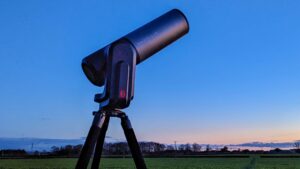
The unistellar telescope product family has expanded and evolved since 2019. Here, precisely, is where each model sits and what distinguishes them in practice:
- eVscope (Gen 1, 2019–2021): 114mm, f/3.9, Sony IMX224 (1.2MP, 3.75μm pixels), included a built-in eyepiece for direct viewing — now discontinued, found used for $800–$1,100. Inferior low-light performance compared to IMX347 models.
- eQuinox 1 (2020–2022): Same optical tube and IMX224 sensor as Gen 1 eVscope but without the eyepiece, slightly lighter mount — discontinued, found used for $600–$800. Notable software support has since been deprioritized.
- eQuinox 2 (2022–present): IMX347 sensor upgrade, identical optics to eVscope 2, lighter and slightly less rigid mount — the current best-value unistellar telescope at $999, delivering identical image quality to the eVscope 2 under normal conditions.
- eVscope 2 (2022–present): IMX347 sensor, same optics, heavier mount with reduced wind-induced vibration, extended WiFi range — $1,499, recommended for citizen science observers submitting asteroid occultation data where timing precision matters.
- Odyssey Pro (2024–present): 150mm aperture, approximately 600mm focal length, Sony IMX585 8MP sensor — the current flagship unistellar telescope, delivering 73% more light-gathering area than 114mm models at $2,999.
Enhanced Vision Technology: The Signal Processing Engine Inside the Unistellar Telescope:
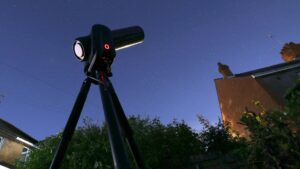
The Enhanced Vision system is the unistellar telescope’s most important and least understood feature. Most descriptions call it “live stacking” and leave it there. That description is accurate but incomplete in ways that matter to buyers evaluating the product seriously.
Enhanced Vision is a real-time differential imaging pipeline running on the unistellar telescope’s onboard processor. It does not simply add frames together — it subtracts a continuously updated sky background model from each incoming frame before adding the result to the cumulative stack. This background subtraction is what makes light-pollution suppression possible without sacrificing faint signal from the target object.
The specific steps the unistellar telescope executes per frame, in sequence, are: dark-current correction using a stored thermal calibration map; sky background estimation from the outer regions of the frame; background subtraction from the current frame; alignment of the background-subtracted frame to the stack coordinate system using star centroids; and weighted addition to the running stack. This entire pipeline completes within the exposure interval — typically one to three seconds per frame — so the displayed image updates continuously rather than freezing during processing.
1: Why Background Subtraction Changes the Fundamental Observation Physics
Traditional visual astronomy through a conventional telescope is defeated by light pollution because the bright sky background overwhelms faint object signals at the retina — the eye integrates all incoming light instantaneously with no ability to separate background from foreground. The unistellar telescope’s background subtraction exploits the fact that a static faint object and a dynamic sky background accumulate differently over time:
the object signal grows linearly with integration time while the random sky noise grows only as the square root of time. Subtract the estimated background, and the signal-to-noise ratio improves continuously. This is why the unistellar telescope from a Bortle 8 city location can show objects that a traditional telescope from the same location cannot — not because of any optical superiority, but because of mathematical processing that no eyepiece can perform.
2: How Integration Time Affects Unistellar Telescope Performance
Integration time — how long the unistellar accumulates signal before presenting the image — is the primary user-controllable performance variable. Short integrations (15–30 seconds) work well for bright targets: globular clusters, bright planetary nebulae, compact galaxies like M81. Extended integrations (2–5 minutes) reveal faint extended structure: dust lanes in edge-on galaxies, nebular halos around planetary nebulae, the outer arms of spirals. The unistellar telescope allows manual integration time override in the app. Most beginners never touch this setting and miss most of the instrument’s capability on faint targets.
3: The Limits of Enhanced Vision: What No Algorithm Can Overcome
Enhanced Vision does not work miracles. The unistellar 114mm aperture collects a fixed quantity of photons per second — Enhanced Vision optimizes the use of those photons but cannot create photons the aperture did not collect. Objects with very low surface brightness — large, diffuse nebulae like the California Nebula or the Barnard’s Loop complex — spread their light over areas far exceeding the unistellar telescope’s 34-arcminute field, making them difficult targets regardless of integration time. The algorithm assumes the sky background is spatially smooth; extreme light-pollution gradients near streetlights or illuminated buildings violate this assumption and produce uneven image backgrounds
The Citizen Science Network: What the Uninstaller Telescope Enables That No Other Consumer Instrument Does:
This is the most underappreciated dimension of the unistellar , and it is the reason the SETI Institute partnership is not merely a branding arrangement. Five specific science capabilities:
- Asteroid occultation timing: The unistellar captures GPS-timestamped frames at 10–20 frames per second during predicted occultation windows — timing accuracy of 0.1 seconds enables published shape reconstruction of minor planets from ground-based consumer instruments.
- Exoplanet transit photometry: Multi-hour standardized imaging runs through the uninstaller science mode achieve 0.3–0.5% photometric precision — sufficient to detect transit timing variations in confirmed exoplanet systems and contribute to published papers.
- Comet brightness monitoring: The unistellar telescope network tracks cometary brightness evolution through perihelion — distributed observer coverage across time zones enables continuous monitoring that single-observatory campaigns cannot match.
- Nova and supernova alerts: Within hours of transient discovery announcements, the uninstaller telescope app distributes campaign alerts — observers image the target and submit brightness data that constrains explosion evolution models.
- DART impact follow-up (2022 precedent): The uninstaller telescope network contributed published data to the Nature study characterizing the Dimorphos debris plume following NASA’s planetary defense impact test — a verifiable, peer-reviewed scientific contribution.
Target Selection Strategy for the Uninstaller Telescope: Matching Objects to the System’s Strengths:
Understanding which targets reward the uninstaller telescope and which frustrate it is the difference between a system that consistently delivers and one that spends half its sessions showing underwhelming results. The instrument has specific sweet spots that experienced users exploit systematically.
The unistellar telescope’s 34.2×25.6 arcminute field and 114mm aperture define a target envelope that is neither the widest nor the deepest in amateur astronomy — but within that envelope, the combination of fast optics and live stacking produces results that outperform traditional instruments of the same aperture under comparable skies.
1: The Ideal Unistellar Telescope Targets: Compact and High Surface Brightness
Compact objects with high surface brightness are where the unistellar telescope dominates unconditionally. Globular clusters — M13, M3, M5, M22, Omega Centauri for southern observers — resolve into individual stars with 30–60 seconds of integration from suburban skies. The outer halo stars, invisible in traditional small-aperture eyepiece views, appear in the unistellar telescope’s accumulated stack because the background suppression reveals signal that the eye’s sky-adaptation threshold conceals. Planetary nebulae — M57, M27, NGC 7293 (Helix, partially), NGC 6543 (Cat’s Eye) — show structure and color information within sixty to ninety seconds. These are the targets that reliably impress first-time users of the unistellar telescope because the gap between expectation and delivery is widest.
2: Galaxy Observations: What the Unistellar Telescope Reveals and Where It Falls Short
Galaxies in the 10–13 magnitude range with angular diameters under 10 arcminutes are excellent unistellar telescope targets. M81 and M82 fit simultaneously in the field — a pairing that immediately shows both the grand design spiral and the starburst galaxy’s chaotic dust structure. M51 with its companion NGC 5195 reveals spiral arms within ninety seconds from Bortle 6 skies. M104 — the Sombrero Galaxy — shows the dust lane crossing the disk at two-minute integration. Where the unistellar telescope falls short: large, low-surface-brightness galaxies like M33 (Triangulum), which spans 70×45 arcminutes and exceeds the field while also having low surface brightness that challenges the system’s background subtraction.
3: Planetary and Lunar Observation: An Honest Assessment
The unistellar telescope is not optimized for planetary observation. The 450mm focal length produces tiny planetary disks — Jupiter at opposition subtends 47 arcseconds, covering only 28 pixels in the unistellar telescope’s image. Functional for confirming planetary phases and seeing the Galilean moons, but not competitive with a dedicated 8-inch planetary telescope at 200× magnification through a quality eyepiece. The moon — large, bright, and filling a significant portion of the field — is an effective demonstration target but the unistellar telescope’s gain settings saturate on bright lunar terrain unless manually reduced. Experienced unistellar telescope users point at the moon primarily for outreach demonstrations, not serious lunar study.
Unistellar Telescope App Deep Dive: Features Most Users Never Discover:
The Unistellar app controls every operational parameter of the unistellar telescope. Most users operate at the surface level — tap target, observe. The features below are routinely undiscovered and meaningfully expand the instrument’s capability:
- Manual gain adjustment: Reducing gain on bright objects (globulars, the moon, bright planetary nebulae) prevents saturation that destroys color information and structural detail — critical for M42’s core and any globular brighter than magnitude 7.
- Target-specific integration presets: The app stores recommended integration time settings for object categories — the unistellar telescope’s recommended integration for a galaxy differs from a planetary nebula. These presets are science-validated defaults, not arbitrary choices.
- Multi-device collaboration: Up to ten smartphones connect simultaneously to one unistellar telescope — enabling real-time group experiences where every participant sees the same live-updating image, making this uniquely powerful for educational settings.
- Science campaign calendar: A built-in campaign schedule shows upcoming citizen science events — asteroid occultations, exoplanet transits, comet monitoring windows — allowing advance planning for maximum unistellar telescope contribution.
- Image log and session history: Every completed observation is archived with metadata — target, integration time, date, location, sky quality estimate — enabling systematic tracking of the unistellar telescope’s performance across conditions and seasons.
Reference Table:
| Model | Aperture | Focal Length | F/Ratio | Sensor | Sensor MP | Image Scale | FOV | Battery | Price (US, 2025) |
| eVscope Gen 1 | 114mm | 450mm | f/3.9 | IMX224 | 1.2MP | 2.8″/px | 34×26′ | 4 hrs | ~$900 used |
| eQuinox 1 | 114mm | 450mm | f/3.9 | IMX224 | 1.2MP | 2.8″/px | 34×26′ | 4 hrs | ~$650 used |
| eQuinox 2 | 114mm | 450mm | f/3.9 | IMX347 | 4MP | 1.64″/px | 34×26′ | 4 hrs | $999 new |
| eVscope 2 | 114mm | 450mm | f/3.9 | IMX347 | 4MP | 1.64″/px | 34×26′ | 4 hrs | $1,499 new |
| Odyssey Pro | 150mm | 600mm | f/4.0 | IMX585 | 8MP | ~1.5″/px | ~38×29′ | 5 hrs | $2,999 new |
| ZWO SeeStar S50 (rival) | 50mm | 250mm | f/5.0 | IMX462 | 2MP | 2.7″/px | 53×40′ | 4 hrs | $499 new |
| Vaonis Stellina (rival) | 80mm | 400mm | f/5.0 | IMX178 | 6.4MP | 2.0″/px | 60×45′ | 5 hrs | $3,999 new |
| Dwarf III (rival) | 24mm | 100mm | f/4.2 | IMX415 | 8MP | 3.1″/px | 54×41′ | 3 hrs | $349 new |
Unistellar Telescope Setup Mastery: The Session Protocol That Eliminates 95% of First-Night Problems:
Most unistellar telescope frustration traces directly to three avoidable errors. Not the instrument’s fault. Not the software’s fault. Setup protocol.
The unistellar telescope’s autonomous field detection requires at minimum a clear 15° patch of sky containing sufficient field stars for plate-solving — typically fifteen or more stars of magnitude 8 or brighter. Site selection that prioritizes maximum open sky overhead versus convenience of the nearest flat surface is the first and most impactful setup decision.
1: Physical Leveling: The Underestimated Foundation
Level the unistellar telescope mount before powering on — not approximately level, but precisely level using the built-in bubble indicator with all three feet adjusted. The field derotation system uses the mount’s initial attitude to calculate its rotation rate correction. An unlevel starting position introduces a systematic error into the derotation calculation that manifests as elongated stars after ninety seconds of integration even when tracking appears correct. This specific failure mode generates more negative unistellar telescope reviews than any optical limitation — and it is entirely preventable in sixty seconds.
2: Autonomous Field Detection: What It Needs to Succeed
The unistellar telescope’s AFD system images a 34-arcminute field and attempts to match detected stars against its onboard star catalog. This process requires: minimum fifteen detectable stars in the field; no clouds covering more than 30% of the field; seeing conditions stable enough that stars do not completely blur together at the image scale. AFD typically completes in 30–90 seconds. If it fails repeatedly, slew the unistellar telescope to a different area of sky — clouds or a thin region of the Milky Way with insufficient star density both cause AFD failures that are not instrument malfunctions.
3: Battery and Thermal Management
The unistellar telescope operates for approximately four hours on a full charge — adequate for most single-session use but constraining for multi-hour citizen science campaigns like exoplanet transit observations. An external USB-C power bank connected to the instrument’s charging port provides indefinite runtime. Thermal management matters: the CMOS sensor generates heat during operation that increases dark current noise over multi-hour sessions. Observing during the coolest part of the night — after midnight in summer — measurably improves image quality in extended unistellar telescope integration runs compared to starting at dusk when ambient temperatures are highest.
The Unistellar Telescope vs. Traditional Astrophotography: A Direct Technical Comparison:
Six months of forum discussions distilled into five concrete performance differentials for buyers choosing between a unistellar telescope and a traditional astrophotography rig at similar total cost:
- Setup time: A unistellar telescope is operational in under three minutes — no polar alignment, no guide star acquisition, no focusing sequence. A traditional equatorial imaging setup requires 45–90 minutes minimum before a single calibrated frame is captured.
- Raw file access: The unistellar telescope saves processed JPEGs only on current firmware — no access to raw FITS frames for custom processing. Traditional astrophotography captures raw science frames that sophisticated processing software transforms over hours of post-session work.
- Total integration depth: Over a single night, a traditional astrophotography system can accumulate four to six hours of calibrated exposure on a single target — reaching magnitude 18–20 objects with careful processing. The unistellar telescope’s four-hour battery limit and lower effective sensitivity cap practical single-session depth at magnitude 14–15.
- Field flatness: The unistellar telescope’s integrated optical corrector manages field curvature adequately for the built-in display; it does not match the flat-field performance of premium dedicated astrographs with field flatteners. Traditional imaging systems using purpose-built optics produce flatter star fields across full-frame sensors.
- Portability and deployment frequency: The unistellar telescope travels anywhere — checked luggage, carry-on bag, backpack. A traditional astrophotography rig’s tripod, counterweights, guide scope, camera, cables, and laptop rarely fit in anything smaller than a minivan. Frequency of actual use strongly favors the unistellar telescope for observers without dedicated observatories.
Real Published Science From the Unistellar Telescope Network: Verifiable Contributions:
The unistellar telescope’s citizen science program has produced documented, peer-reviewed scientific output — not just data collected, but data used.
The most cited example is the 2022 DART impact campaign. NASA’s Double Asteroid Redirection Test deliberately impacted the moonlet Dimorphos on September 26, 2022. The unistellar telescope network deployed observers across Europe, North America, and Africa to image Didymos-Dimorphos before, during, and after impact. The brightness evolution of the debris plume was measured by network instruments and contributed to the landmark Nature paper characterizing the impact’s effectiveness. This was not supplementary data — it was cited alongside observations from the Hubble Space Telescope and the James Webb Space Telescope in the same analysis.
1: Exoplanet Transit Publications and the Precision Required
Exoplanet transit observations through the unistellar telescope require photometric precision of 0.3–0.5% — measuring brightness changes smaller than half a percent sustained over two to four hours. This precision requires careful gain calibration, stable tracking, and at least three comparison stars of similar brightness and color in the same field as the target. The unistellar telescope science mode standardizes these settings automatically during scheduled campaigns, allowing observers without photometry backgrounds to contribute calibration-grade data. Published transit timing variations from the network have appeared in papers characterizing multi-planet system architecture.
2: Asteroid Occultation Database: Scale and Accuracy
By late 2024, the unistellar telescope network’s asteroid occultation database contained over 1,500 individual timing observations contributing to size and shape models for dozens of near-Earth and main-belt asteroids. Each observation requires the instrument to capture the star flux drop — lasting one to four seconds — with GPS-synchronized timing accurate to 0.1 seconds. Combining timing measurements from multiple observers along the occultation shadow path generates a chord profile across the asteroid’s cross-section, from which elliptical shape models are derived. This is measurement science, not casual observation, and the unistellar telescope’s automated timing capture makes it accessible to observers with no timing instrumentation background.
The Unistellar Telescope for Astronomy Outreach: Why This Is Its Highest Leverage Use Case:
Public astronomy outreach — star parties, school events, community science nights — has a persistent problem: traditional telescopes show non-astronomers things they cannot interpret. A smudge that an experienced observer identifies excitedly as M51’s spiral arms appears to every first-time viewer as simply a smudge. The gap between what the instrument shows and what the viewer perceives creates an experience that fails to inspire the way outreach coordinators intend.
The unistellar telescope solves this structurally. The image appears on every attendee’s phone screen simultaneously — recognizable, colorful, clearly showing structure that connects to images people have seen in books and documentaries. The spiral arms of M51 look like spiral arms. The ring of M57 looks like a ring. The star cluster of M13 looks like ten thousand stars, not an indistinct glow. This visual intelligibility is the unistellar telescope’s most underrated public impact — it converts astronomical observation from an experience mediated entirely by expert interpretation into direct, comprehensible visual experience.
The ten-device simultaneous connection capability means a single unistellar telescope serves ten observers simultaneously without a queue. At a traditional star party with one telescope and twenty attendees, the bottleneck is the single eyepiece. Ten minutes per person means a two-hour wait. With the unistellar telescope, ten people observe simultaneously, the image updates continuously, and discussion happens around a shared visual rather than a solitary experience.
Buying the Right Unistellar Telescope: The Decision Framework Nobody Gives You:
The eQuinox 2 versus eVscope 2 question is the most common buying debate in unistellar telescope communities, and the honest answer requires specificity that general comparisons avoid.
Both instruments use the identical Sony IMX347 sensor. Both use the identical optical tube. Both run the identical Enhanced Vision algorithm. The image quality difference between them under calm conditions is zero — measurably, verifiably zero. The eVscope 2’s heavier mount reduces vibration amplitude in wind by approximately 40% compared to the eQuinox 2 — a difference that affects asteroid occultation timing data quality during windy sessions but has no impact on visual astronomy or casual imaging.
If you plan to submit citizen science data through the unistellar telescope platform regularly — particularly occultation campaigns where the instrument must hold tracking through environmental disturbances — the eVscope 2’s mount rigidity justifies the $500 premium. If you plan to use the unistellar telescope primarily for observation and outreach, the eQuinox 2 is the correct choice and the $500 difference is better spent on a quality external power bank for extended runtime.
The Odyssey Pro at $2,999 is a genuinely different instrument. The 150mm aperture collects 73% more light than 114mm — visible on faint galaxy halos, extended nebulae, and deep integrations of low-surface-brightness targets. If extended nebulae and faint galaxy detection are your primary targets, and budget allows, the unistellar telescope Odyssey Pro delivers materially different results. If your target list centers on globulars, compact galaxies, and planetary nebulae, the eQuinox 2 reaches the same objects with similar visual impact.
Who the Unistellar Telescope Is For — and a Frank Assessment of Who It Is Not:
The unistellar telescope has genuine enthusiastic advocates and genuine disappointed former owners. Both groups are right about their experience. The distinction between them comes entirely from whether the instrument was matched to actual observing goals before purchase.
The unistellar telescope is the correct choice for: urban observers who want to observe regularly from light-polluted locations without traveling to dark sites; educators and outreach coordinators who need a shareable, visually interpretable observation experience for public audiences; people motivated by contributing real data to genuine scientific research without requiring specialized training; observers who want to start observing immediately without investing months in learning manual star-hopping, collimation, and GoTo alignment procedures; and travelers who want astronomy capability in a package that fits in a carry-on bag without compromising observation quality.
The unistellar telescope is the wrong choice for: experienced visual observers whose satisfaction depends on the direct retinal experience of photons from distant objects — an experience the unistellar telescope’s screen-based output cannot replicate; buyers seeking maximum aperture per dollar for dark-sky visual observation, where a traditional 10-inch Dobsonian at $700 outperforms any unistellar telescope at any price; serious astrophotographers who require raw FITS files for custom processing workflows; or observers primarily interested in planets, where the unistellar telescope’s 450mm focal length provides insufficient image scale for meaningful planetary detail.
The unistellar telescope occupies a genuinely new position in the instrument market — not a simplified traditional telescope, not a toy with a brand name, but a purpose-engineered scientific instrument with specific, profound strengths and specific, honest limitations. Match it correctly, and it will be in regular use for years.
FAQ’s:
Q1: How long does the unistellar telescope take to set up from the carry case?
Under five minutes including leveling, power-on, and autonomous field detection completion.
Q2: Can I use the unistellar telescope without a smartphone?
No — the instrument requires the Unistellar app on iOS or Android for all functions including power-on initialization.
Q3: Does the unistellar telescope work in the Southern Hemisphere?
Yes — the autonomous field detection works from any location globally without reconfiguration.
Q4: What is the faintest object the unistellar telescope can detect?
Under dark skies with extended integration, approximately magnitude 14–15 objects are accessible.
Q5: Does Unistellar offer a warranty on the unistellar telescope?
Yes — a two-year manufacturer warranty covers defects on all new unistellar telescope purchases through authorized retailers.
Conclusion:
The unistellar telescope earns its place in the market by solving a real problem: making genuine astronomical observation accessible from compromised urban skies while simultaneously connecting observers to funded scientific research. Buy the eQuinox 2 for value, the eVscope 2 for citizen science rigor, the Odyssey Pro for aperture. Prioritize clear skies above all specifications.