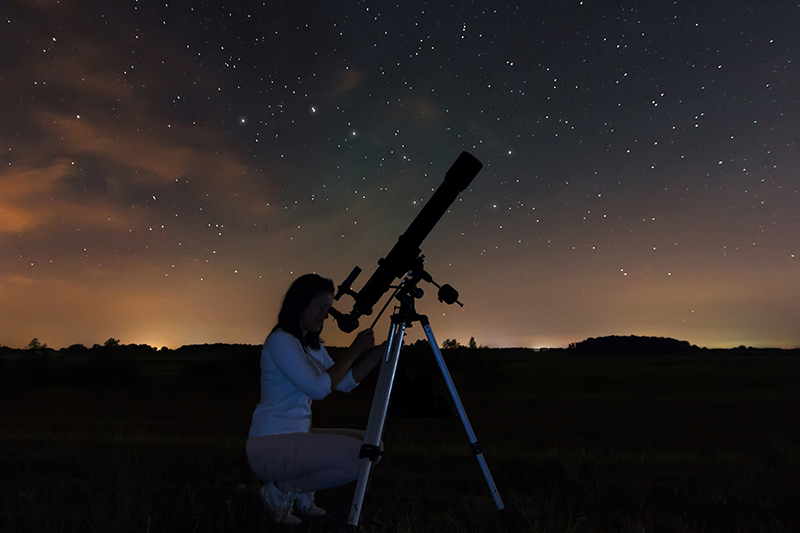
My first genuinely memorable astronomy session happened on a ridge in the Chiricahua Mountains of southeastern Arizona in October 2016, where I ran an Orion XT10 dobson through a four-hour Virgo Cluster sweep that netted 38 individually logged galaxies in a single night — something I had previously considered achievable only with professional observatory access.
The Dobson is the purest expression of aperture-first astronomy ever commercialized — maximum mirror, minimum cost, zero compromise on what actually matters at the eyepiece. Master this instrument and you master the night sky.
Explore the 7 best Dobson telescopes for beginners and experienced astronomers. Compare features, performance, and value to find the ideal telescope for stargazing.
What the Dobson Telescope Is and Why John Dobson’s Design Changed Everything:
The dobson is a Newtonian reflector telescope mounted on a ground-level alt-azimuth rocker box — a simple two-axis mechanical platform that allows the optical tube to rotate freely in altitude (up-down) and azimuth (left-right) without any counterweights, electronic drives, or precision polar alignment. The design was popularized by John Dobson, a Vedanta monk who spent decades building large-aperture telescopes from salvaged materials and sharing the night sky with the public on San Francisco sidewalks through the Sidewalk Astronomers organization he co-founded in 1968.
Dobson’s core insight was both obvious and radical: the equatorial mount that professional astronomy used was unnecessarily complex and expensive for visual observing. An alt-azimuth rocker box built from plywood, Teflon pads, and Formica laminate costs $20 in materials. It carries a 16-inch mirror as easily as a 6-inch. It requires no polar alignment, no batteries, no drive corrector, and no maintenance beyond keeping the Teflon pads clean. The Dobson is the direct commercial descendant of these homemade instruments, and its dominance in the aperture-per-dollar market segment is a direct consequence of how correct Dobson’s mechanical insight was.
The Newtonian optical design at the core of every Dobson uses a large concave parabolic primary mirror at the tube’s bottom end to collect and focus incoming light, and a small flat secondary mirror near the open top to redirect the focused beam to an eyepiece mounted on the side of the tube. The parabolic primary is the critical element: unlike a spherical mirror, a paraboloid brings all incoming parallel light rays — regardless of where they strike the mirror surface — to a single precise focus point.
This produces diffraction-limited performance at the eyepiece when the optics are properly collimated and thermally equilibrated, and it is the reason a well-set-up Dobson consistently matches or exceeds the planetary performance of computerized alternatives costing several times more.
Five Optical Specifications That Define Every Dobson Telescope’s Performance Ceiling:
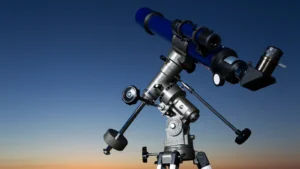
These numbers are what to evaluate before any dobson purchase — not brand names, not included accessories:
- Aperture diameter: The single most important specification in any dobson — an 8-inch (203mm) primary collects four times the light of a 4-inch, and a 12-inch collects nine time as much; every half-magnitude gain in limiting magnitude requires roughly 60% more aperture, meaning the jump from 8-inch to 12-inch is the most impactful upgrade available in the dobson market.
- Mirror type (parabolic vs. spherical): Budget dobson units sometimes use spherical primary mirrors that produce spherical aberration above approximately 150x; any dobson intended for high-magnification planetary or double star work needs a parabolic primary — verify this specification explicitly before purchasing.
- Focal ratio: Most commercial dobson designs use f/5.9 to f/8 primaries; faster ratios (f/4.5–f/5) give wider fields and require coma correctors for edge-of-field sharpness, while slower ratios (f/8) produce sharper stars across a wider apparent field and tolerate collimation errors more forgivingly.
- Mirror coating reflectivity: Standard aluminum coatings on a commercial dobson reflect 87–91% of incoming light; enhanced coatings with protective overcoats (SiO2, MgF2) achieve 94–96%, a measurable improvement for high-magnification planetary contrast and low-surface-brightness deep-sky targets.
- Focuser type and load capacity: A 2-inch dual-speed Crayford focuser, rated for at least 1.5kg of camera/eyepiece load without slipping, is the minimum standard for a serious dobson — rack-and-pinion focusers introduce mirror shift under load, degrading the precise focus position that high-magnification work demands.
The Dobson Telescope’s Optical Design: What Makes the Newtonian Reflector Work:
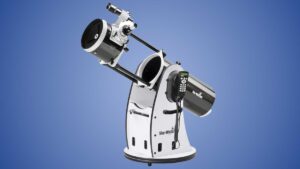
The Newtonian reflector at the core of every Dobson is the oldest and simplest of all serious telescope designs, having been in continuous use since Isaac Newton demonstrated the first example to the Royal Society in 1671. Its longevity is not inertia — it’s a consequence of genuine optical qualities that competing designs at equivalent aperture cannot match at equivalent cost.
The physics of large-aperture observing favor the dobson configuration in ways that become more pronounced as aperture increases. A 16-inch parabolic primary mirror of the type found in upper-tier Dobson instruments collects more than 1,500 times the light of the unaided human eye. The limit is not optics, at those apertures — it’s atmospheric seeing and the observer’s own retinal sensitivity. Understanding the specific optical relationships in a dobson design helps observers maximize what their instrument delivers rather than chasing modifications that cannot improve performance beyond the physical ceiling the atmosphere sets.
1: The Parabolic Mirror: Why It Matters for the Dobson Telescope
A parabolic mirror reflects all parallel rays of incoming light to a single focal point regardless of which zone of the mirror surface they strike. This property — called freedom from spherical aberration — is what allows a Dobson to achieve diffraction-limited performance: the theoretical maximum sharpness set by the wave nature of light itself, where the resolution limit equals approximately 116 ÷ aperture-in-mm arc-seconds per the Dawes limit formula.
At 203mm aperture, this is 0.57 arc-seconds — sufficient to split virtually any double star whose components are separated by more than 0.7 arc-seconds under good seeing. A spherical mirror achieves diffraction-limited performance only at the center of its focal plane, which is why a Dobson that claims high-magnification planetary performance with a spherical primary is making a claim the optics cannot support above roughly 100–150x.
2: Secondary Mirror Size and Central Obstruction in the Dobson Telescope
Every Newtonian Dobson has a secondary mirror — a small flat mirror that intercepts the focused beam from the primary and redirects it to the side-mounted focuser. This secondary mirror creates a central obstruction in the telescope’s light path, blocking a fraction of the incoming light and introducing a diffraction effect that reduces image contrast on low-contrast targets like planetary cloud belts and galaxy surface brightness gradients.
Standard commercial dobson secondary mirrors range from 47mm to 80mm in minor axis diameter, representing 23–39% linear obstruction ratios. The contrast reduction from a 35% linear obstruction is equivalent to reducing effective aperture by approximately 12% — a real but manageable trade-off that the Dobson aperture advantage over competing designs at equivalent price easily overcomes.
3: Tube Length, f/Ratio, and How They Affect the Dobson Telescope Experience
The dobson tube length is directly determined by the primary mirror’s focal ratio: an 8-inch f/6 primary has a 1,200mm focal length, producing a tube roughly 1,300mm (51 inches) long. An 8-inch f/8 primary stretches the tube to 1,600mm (63 inches). These dimensions determine transport and storage requirements, the eyepiece position height when observing objects near the zenith, and the minimum eyepiece focal length that produces a comfortable exit pupil for visual use. Faster Dobson designs (f/4.5–f/5) dramatically shortened tube length — a 12-inch f/5 is barely longer than an 8-inch f/8 — at the cost of requiring a coma corrector for wide-field visual and photographic work to maintain round stars across the full field.
Five Reasons the Dobson Telescope Dominates the Aperture-Per-Dollar Competition:
The market evidence is unambiguous: for observers whose primary goal is maximum light-gathering aperture at minimum cost, the dobson wins every comparison at every aperture above 6 inches:
- No mount premium: Equatorial mounts in the dobson aperture range (8–16 inches) cost $800–$2,500 by themselves; the rocker box that carries an identical optical tube in a dobson configuration costs $100–$200 in materials or is included in the OTA purchase price, representing 80–90% cost savings on the mount alone.
- No electronics required: A dobson operates with zero power — no batteries, no AC power, no charging infrastructure; this makes it reliable at remote dark sky sites where power access is limited and where battery failure at 2am is a session-ending event.
- Scalable to extreme apertures: The dobson rocker box design scales to 24-inch, 32-inch, and even larger mirrors that no equatorial mount could realistically carry; the world’s largest amateur telescopes are all dobson designs, often truss-tube variants built or modified by their owners.
- Immediate operability: A dobson no polar alignment, no two-star GoTo alignment, no calibration procedure; point, look, observe — the entire setup-to-observing time can be under three minutes for an experienced user with a pre-collimated instrument.
- Transparent upgrade path: Adding motorized altitude and azimuth drives to an existing dobson rocker box costs $200–$400 for a servo system kit; adding a push-to digital setting circle system costs $150–$300; the Dobson platform accommodates mechanical and electronic upgrades without replacing the core optical tube.
Collimation for the Dobson Telescope: The Skill That Unlocks Full Performance:
Collimation — the precise alignment of primary and secondary mirrors on a shared optical axis — is the most performance-critical maintenance skill in dobson ownership. It is also the aspect of the instrument most commonly cited in negative reviews by observers who are, in reality, experiencing the consequences of factory-shipping misalignment rather than any inherent optical defect.
A dobson that arrives from the factory or completes a road trip to a dark sky site is almost always misaligned to some degree. Vibration during transport shifts the primary mirror cell, the secondary holder, or both. The degree of misalignment determines the degree of image degradation: a dobson with severe collimation error produces coma on every star image — the characteristic comet-tail asymmetry that points in the direction of the misalignment — and softened planetary detail that observers attribute to bad seeing until they learn to recognize and correct the underlying cause.
1: The Four-Step Collimation Procedure for Any Dobson Telescope
The complete collimation procedure for a standard dobson runs through four sequential steps, each building on the accuracy of the previous one. Skipping or reversing steps produces either inadequate correction or active misalignment. Step one: center the secondary mirror under the focuser axis by adjusting the secondary holder’s spider vane position — the secondary should be centered in the focuser tube when viewed through the focuser without any eyepiece installed.
Step two: adjust the secondary mirror’s tilt using its three adjustment screws until the reflection of the primary mirror appears centered within the secondary. Step three: adjust the primary mirror’s tilt using its three push-pull screw pairs until the reflection of the focuser tube and secondary appear centered within the primary’s center dot. Step four: perform a star test at 150–200x on a 2nd-magnitude star to verify concentric diffraction rings under defocus, then apply fine primary mirror corrections to achieve perfect ring symmetry.
2: Tools That Make Dobson Telescope Collimation Faster and More Accurate
The bare-eye collimation procedure described above works reliably but requires experience and a controlled environment. Three specific tools accelerate the process and improve accuracy for dobson owners at any experience level. A collimation cap — a simple drilled plug that replaces the eyepiece and provides a centered viewing aperture — costs under $10 and eliminates parallax errors in the secondary-centering step.
A Cheshire eyepiece ($15–$30) adds a reflective flat surface with a central crosshair that makes primary mirror centering significantly more precise than bare-eye estimation. A laser collimator ($25–$60 for Chinese units, $100–$200 for precision units) projects a visible beam that shows optical axis misalignment instantly and enables the primary mirror adjustment step to be performed in a few seconds rather than several minutes.
What the Dobson Telescope Shows: A Target-By-Target Performance Guide:
The Dobson performance on specific targets is the most practically useful information any buyer can have — yet most buying guides substitute vague claims (“excellent for deep-sky objects!”) for the specific aperture-dependent performance data that allows informed target selection.
The performance of a dobson on any given target depends on three interacting variables: aperture (which sets the light-gathering and resolving ceilings), sky darkness (the single most impactful environmental variable, with Bortle 4 skies delivering 2–3 magnitudes more sensitivity than Bortle 7), and atmospheric seeing (turbulence that limits planetary detail even in apertures that could theoretically resolve finer structure). With those variables understood, what follows is the specific performance profile of the most commonly owned dobson aperture classes.
Dobson Telescope Specifications and Aperture Class Performance Reference Table:
| Aperture | Focal Length (f/6) | Focal Length (f/8) | Limiting Magnitude (Bortle 5) | Limiting Magnitude (Bortle 3) | Dawes Limit | Cassini Div. Visibility | Encke Gap Visibility | Globular Resolution | Moon Detail | Typical OTA Price |
| 6″ (150mm) | 900mm | 1,200mm | ~13.5 | ~14.5 | 0.77″ | Consistent | Rare | Halo only | Rilles, peaks | $250–$380 |
| 8″ (203mm) | 1,200mm | 1,600mm | ~14.0 | ~15.0 | 0.57″ | Consistent | Occasional | Outer halo | Rilles, scarps | $380–$550 |
| 10″ (254mm) | 1,524mm | 2,032mm | ~14.5 | ~15.5 | 0.46″ | Consistent | Regular | Full halo + edges of core | Fine rilles | $550–$750 |
| 12″ (305mm) | 1,830mm | 2,440mm | ~14.9 | ~15.9 | 0.38″ | Consistent | Consistent | Full core resolution | Very fine rilles | $700–$950 |
| 14″ (356mm) | 2,134mm | 2,848mm | ~15.2 | ~16.2 | 0.32″ | Consistent | Consistent | Complete resolution | Sub-arc-sec details | $950–$1,500 |
| 16″ (406mm) | 2,438mm | 3,250mm | ~15.5 | ~16.5 | 0.28″ | Consistent | Consistent | Core star counts visible | Ultra-fine | $1,400–$2,200 |
| 18″ (457mm) | 2,743mm | — | ~15.8 | ~16.8 | 0.25″ | Consistent | Consistent | Individual core stars | Professional | $2,000–$3,500 |
| 20″ (508mm) | 3,048mm | — | ~16.0 | ~17.0 | 0.22″ | Consistent | Consistent | Individual core stars | Professional | $3,000–$5,000+ |
Best Commercial Dobson Telescope Models by Aperture Tier:
Selecting a Dobson telescope from the commercial market involves a three-dimensional trade space: aperture (light-gathering), optical quality (mirror figure and coating), and mechanical quality (rocker box smoothness, focuser performance, mirror cell stability). All three affect observing experience, and price is the clearest proxy variable for where any given dobson sits on all three dimensions simultaneously.
The aperture tiers within the commercial dobson telescope market have different characteristics and different dominant players. Understanding these tiers prevents both underspending (getting a poorly made instrument that frustrates rather than rewards) and overspending (paying for mechanical quality that your current skill level cannot exploit).
1: Entry Tier: 6-Inch to 8-Inch Dobson Telescope ($250–$550)
At the entry tier, the dominant dobson models are the Orion SkyQuest XT8 ($379–$429), the Sky-Watcher 8-inch Traditional Dob ($399–$449), and the Apertura DT8 ($449–$499). These three instruments are closely matched in optical performance — all use 203mm parabolic primaries with 91–94% reflectivity coatings and 2-inch focusers. The meaningful differentiators are the focuser quality (Sky-Watcher and Apertura ship with dual-speed Crayfords; Orion uses a standard rack-and-pinion on the base XT8), the included accessories (Apertura’s DT8 includes a laser collimator and 9×50 finder that would cost $100+ separately), and the rocker box azimuth bearing smoothness (Sky-Watcher’s laminate ground board consistently receives the best first-session smoothness reports across user reviews).
2: Mid-Tier: 10-Inch to 12-Inch Dobson Telescope ($550–$950)
The 10-inch to 12-inch range is where the Dobson telescope’s aperture advantage becomes visually transformative — the difference between an 8-inch and a 12-inch is not a linear magnification step but a categorical improvement in the visibility of low-surface-brightness objects. The Sky-Watcher 10″ and 12″ Traditional Dobs and the Apertura DT10/DT12 are the standard recommendations. A 10-inch Dobson telescope shows the structural dust lane in M64 (Black Eye Galaxy) from a Bortle 5 site — something an 8-inch reveals only as a slight asymmetry. A 12-inch dobson shows the bar structure in NGC 1300 from Bortle 4.
3: Large-Aperture: 14-Inch to 18-Inch Dobson Telescope ($950–$3,500)
Large-aperture dobson telescope instruments in this range are typically truss-tube designs — the optical tube is divided into a lower mirror box (containing the primary) and an upper cage (containing the secondary, focuser, and finder), connected by removable metal struts. This design reduces the transported length of a 14-inch to 18-inch Dobson telescope from approximately 70–90 inches to two components of 25–35 inches each, making car transport practical without requiring a van or truck. The Orion SkyQuest XT14g, Celestron StarMaster 14.5, and custom instruments from builders like Crawford/AstroSystems, Obsession Telescopes, and Webster Telescopes serve this segment.
Five Upgrades That Genuinely Improve Dobson Telescope Performance:
Not every marketed accessory improves the Dobson telescope experience, but these five produce measurable real-world gains:
- Telrad or Rigel QuikFinder reflex sight: Replaces stock optical finders for star-hopping navigation — the Telrad’s concentric circle reticle (0.5°, 2°, 4°) projected at zero magnification onto a glass screen lets observers navigate star patterns with both eyes open, dramatically accelerating target acquisition for the Dobson telescope’s manual pointing workflow.
- High-quality 30mm wide-field eyepiece: The stock eyepieces shipped with commercial dobson instruments are functional but limited; a 30mm Apertura SWA or 35mm Baader Hyperion Aspheric adds a genuinely wide-field view (1.5–2° true field on an f/6 instrument) that transforms star-cluster and bright nebula observing.
- Primary mirror cooling fans: Reducing 8-inch to 12-inch dobson telescope equilibration time from 60–90 minutes to 20–35 minutes using a set of 12V DC fans mounted at the primary mirror cell is the single highest-impact modification for observers who frequently drive to dark sites and set up after sunset.
- Equatorial tracking platform: A motorized equatorial platform ($350–$600 from commercial makers) carries the entire dobson telescope rocker box on a curved-wedge that compensates for Earth’s rotation — enabling tracked visual observing and short-exposure imaging without any modification to the Dobson itself.
- Improved secondary mirror holder (laser-cut or machined): The spider vane and secondary holder that ships with most commercial dobson telescope units introduces diffraction spikes and occasional vibration from the vane’s thickness; aftermarket secondaries with thin vanes (0.5mm) and precision tilt adjusters reduce diffraction effects and improve collimation repeatability.
Astrophotography With the Dobson Telescope: Realistic Capabilities and Practical Methods:
The Dobson telescope was designed for visual observation, and it remains primarily a visual instrument. But the question of what astrophotography is possible — as opposed to what requires converting the Dobson telescope into a different kind of instrument entirely — deserves a specific, honest answer rather than either dismissal or overselling.
Planetary and lunar video imaging is the most practical and rewarding astrophotography application for the Dobson telescope. High-frame-rate video cameras (ZWO ASI224MC, ASI462MC) capture 100–300 frames per second of bright solar system targets; post-processing software stacks only the sharpest frames, effectively cherry-picking the moments of best atmospheric seeing from a video sequence. The Dobson telescope’s long focal length at high magnification — 1,200mm at f/6, extended to 2,400mm with a 2x Barlow — delivers an excellent planetary image scale on Jupiter, Saturn, and the Moon. No tracking is strictly necessary for planetary video, because each frame’s exposure is under 10ms and the target drifts only a fraction of a pixel per frame.
1: Deep-Sky Imaging From a Dobson Telescope Without Tracking
Deep-sky imaging without an equatorial tracking platform is possible from a dobson telescope in two specific scenarios. First, very bright objects (Orion Nebula M42, Andromeda Galaxy M31, open clusters) can be captured with a smartphone camera adapter at 1–3 second exposures before Earth’s rotation produces visible star trailing — these brief exposures produce usable JPEG images that document the observing experience and share it meaningfully, though they do not approach the depth of tracked multi-minute exposures. Second, lucky imaging on extended objects — using the same high-frame-rate stacking approach applied to planets — can produce short-integration deep-sky images of bright targets by selecting and stacking only the best frames from a 30–60 second capture sequence.
2: Dobson Telescope Astrophotography With an Equatorial Platform
The equatorial tracking platform fundamentally changes the Dobson telescope’s photographic capability. With a properly aligned equatorial platform, the dobson telescope tracks the sky with sufficient precision for 3–5 minute guided sub-exposures on deep-sky targets at focal lengths up to approximately 1,500mm. This enables the dobson telescope to be used with a dedicated astronomy camera and guide scope combination for serious deep-sky imaging — capturing galaxies, emission nebulae, and globular clusters at exposure durations that would be impossible without tracking. The trade-off relative to a purpose-built equatorial imaging setup is periodic error in the platform’s drive mechanism and the limited session length of a single platform run (typically 60–90 minutes before repositioning is required).
Dobson Telescope vs. Competing Telescope Types: Where the Design Wins and Loses:
The Dobson telescope wins the aperture-per-dollar comparison decisively at every aperture above 6 inches. Where it loses — honestly assessed — is in GoTo convenience, astrophotography tracking capability, planetary focal length per cost dollar, and portability for instruments above 14 inches in aperture.
Against a computerized Schmidt-Cassegrain telescope in the same price range, the dobson telescope consistently wins on aperture: a $800 purchase buys a 10-inch dobson telescope or a 6-inch computerized SCT. On a night of good seeing, the 10-inch Dobson telescope’s 56% larger aperture shows more planetary detail, not less, than the 6-inch SCT — the GoTo convenience of the SCT helps find targets but does nothing for what the eyepiece shows once they’re found.
Against an apochromatic refractor at the same price, the dobson telescope provides dramatically more aperture: a $800 APO refractor tops out at 80–102mm, collecting four to six times less light than a $800 10-inch dobson telescope. For visual deep-sky observing — which is what most amateur astronomers spend most of their time doing — the Dobson telescope wins this comparison by a margin that no optical quality difference can offset.
Transporting and Storing the Dobson Telescope: Practical Solutions for Real Observers:
The Dobson telescope’s physical size is the most commonly cited practical limitation, and it deserves a specific discussion because the solutions are more accessible than most buyers realize before purchasing.
A standard 8-inch Dobson telescope stores compactly — the tube (46 inches long, 10 inches diameter) fits along a wall or in a closet, and the rocker box (approximately 20 × 20 × 20 inches) stores beneath or alongside it. In a standard garage, an 8-inch dobson telescope occupies roughly the space of one bicycle. A 10-inch Dobson telescope adds approximately 4 inches of tube length and 4 inches of rocker box dimension — still manageable in most residential storage contexts.
The 8-inch and 10-inch Dobson telescope fit in any SUV, minivan, or hatchback with the rear seats down, loaded horizontally. A standard sedan with a folded rear seat accommodates the 8-inch tube along the length of the car. Transport padding — a cylindrical sleeping bag carrier or a purpose-sewn tube sock — protects the open tube from dust and the secondary mirror from contact damage during loading and unloading.
John Dobson’s Legacy and Why the Dobson Telescope Design Endures:
John Dobson died in 2014 at age 98, having spent more than four decades demonstrating that high-quality astronomy required neither professional credentials nor expensive equipment. His Dobson telescope design was never patented — he gave it freely to anyone who wanted to build one — and this openness is directly responsible for the instrument’s commercial success and continued relevance sixty years after he first built plywood rocker boxes in a San Francisco monastery.
The Dobson telescope’s longevity is not nostalgia. It’s a consequence of physics: an alt-azimuth rocker box made from correctly chosen materials carries any mass with appropriate bearing design. A parabolic primary mirror ground to lambda/8 wavefront error or better resolves at the diffraction limit. These facts don’t change as technology advances, and the dobson telescope design fully exploits both of them at lower cost than any competing architecture. Where the dobson telescope loses — tracking, GoTo, photographic versatility — technology has added solutions (equatorial platforms, digital setting circles, push-to systems) that integrate with the existing design rather than replacing it.
The instrument Dobson democratized is fundamentally the same instrument that professional observatories used before computer-controlled alt-azimuth mounts arrived in the 1980s. The difference is that Dobson’s version costs $400 and fits in a hatchback. His design’s persistence in the commercial market, four decades after his original instruments and a decade after his death, is the clearest possible endorsement.
FAQ’s:
Q1: What is a dobson telescope and how does it differ from other reflectors?
A Dobson telescope is a Newtonian reflector on a ground-level alt-azimuth rocker box — no motor, no tripod, no polar alignment required.
Q2: What aperture dobson telescope should a beginner buy?
An 8-inch Dobson telescope is the ideal first purchase — enough aperture for serious work at a price and weight that remains practical for regular use.
Q3: How often does a dobson telescope need collimation?
Check collimation after every transport; at a permanent site, inspect every 3–4 weeks and adjust when the star test shows asymmetric diffraction rings.
Q4: Can a dobson telescope be used for astrophotography?
Yes — planetary video imaging works excellently without tracking; deep-sky imaging requires adding an equatorial tracking platform to the rocker box.
Q5: Why doesn’t a dobson telescope have a motor to track the stars?
The classic dobson telescope design prioritizes simplicity and cost savings — motors can be added as upgrades without modifying the telescope’s core optical or mechanical design.
Conclusion:
The Dobson telescope remains the most cost-efficient path to serious visual astronomy at any aperture above 6 inches. Choose an 8-inch or 10-inch model from Sky-Watcher or Apertura, learn collimation before your first session, add a Telrad and a quality 30mm eyepiece, and the aperture advantage delivers results that computerized alternatives at identical prices simply cannot match.