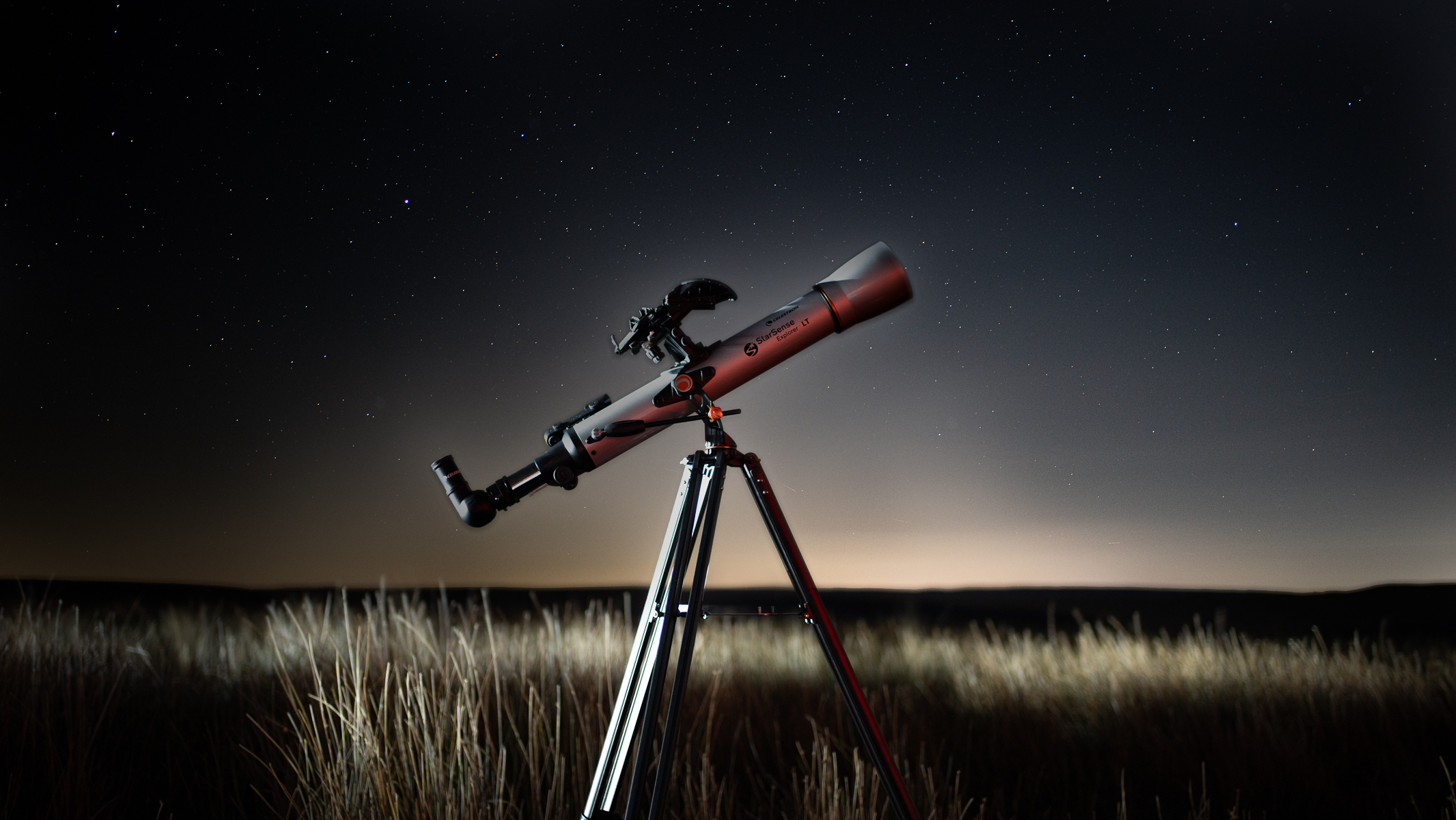
I packed a Celestron Travel Scope 70 into a daypack and drove two hours to Canyonlands National Park in Utah on a moonless January night — Bortle 2 skies, temperature at 18°F, winds calm. That instrument, retailing at $69 at the time, showed me Jupiter’s four Galilean moons in a clean line, the Orion Nebula with faint greenish tint in the core, and the Andromeda Galaxy as an unmistakable oval glow with a brighter nucleus. I have owned telescopes costing thirty times that price.
The best small telescope is not the one with the biggest number on the box — it is the one you actually carry outside on a Tuesday night without debating whether it is worth the effort. Size, weight, and setup time determine whether an instrument becomes a habit or a regret.
Discover the 7 best small telescope options for easy stargazing. Compare amazing features, portability, and performance for beginners and enthusiasts.
What “Small” Actually Means in Telescope Terms — and Why It Matters More Than You Think:
Small telescopes are not a marketing category. It is a physical and functional description that changes what an instrument can realistically do, where it can go, and who can operate it without frustration. Defining the term precisely before evaluating options is the only way to match an instrument to real-world use patterns.
In practical terms, the best small telescope occupies aperture ranges between 50mm and 130mm and weighs between 1.5 kg and 5 kg including tripod. These numbers correspond to an instrument that fits in a car trunk without a dedicated equipment compartment, sets up in under ten minutes without tools, and can be carried by one person from a parking area to an observing site without equipment carts or assistance. Above 130mm aperture, instruments typically exceed 6 kg with mount, require longer setup times, and demand more careful transport — they are excellent instruments, but they are not small telescopes in any meaningful sense.
Within the 50–130mm range, the best small telescope comes in three optical designs.
Refractors — lens-based instruments that seal the optics in a closed tube — dominate travel and grab-and-go use because they require no collimation, cool down fast, and handle rough transport without optical degradation. Short-tube Newtonians — mirror-based instruments in compact housings — offer more aperture per dollar in the 76–114mm range but require periodic collimation and more careful transport. Maksutov-Cassegrains — sealed catadioptric instruments like the Sky-Watcher Skymax 90 — offer the highest focal length in the smallest package, ideal for planetary observing, but slow focal ratios limit deep-sky performance.
The best small telescope for any specific buyer is determined first by primary observing target — lunar and planetary versus deep-sky — and second by portability requirement. A retiree hiking to mountaintop observing sites needs different specifications than a parent setting up in the backyard with children. The instrument category is the same; the winning model differs.
Five Specifications That Determine Real Performance in the Best Small Telescope:
Most buyers focus on magnification claims printed in large font on retail packaging. Wrong measure entirely. Here are the five specifications that actually determine performance in the best small telescope:
- Aperture (mm): The diameter of the primary lens or mirror — every other specification flows from this number. A 90mm aperture collects 2.5× more light than a 60mm aperture, which determines limiting magnitude, resolving power, and contrast on planetary detail. No marketing claim compensates for less aperture.
- Focal ratio (f/number): Short focal ratios (f/5–f/7) deliver wide fields and bright images — ideal for deep-sky and the Milky Way. Long focal ratios (f/10–f/15) deliver narrow fields and high contrast — ideal for lunar and planetary detail. The best small telescope for planets looks different from the best small telescope for nebulae.
- Focuser quality: A wobbly, plastic focuser with excessive play destroys high-magnification views more completely than optical imperfections. Look for metal rack-and-pinion or Crayford designs with smooth, drawtube tension adjustment — the underrated specification most reviews skip.
- Tripod and mount stability: A good optical tube on an unstable tripod produces worse views than a mediocre tube on a rigid mount. The tripod is structural — any vibration in the legs amplifies through the tube and makes stars bounce. Prioritize tripod weight and head design when evaluating the best small telescope packages.
- Included eyepieces: Stock eyepieces shipped with most small telescopes are functional starting points, not optimal performers. A 25mm Plössl and a 10mm Plössl represent an honest starter pair. Eyepieces labeled by magnification rather than focal length — “150× eyepiece” — are marketing inventions that correspond to no standard optical design.
The Best Small Telescope for Beginners: Matching Instrument to Observer:

Beginner is not a single category. A ten-year-old child, a retired physician, and a college student with a camping habit all qualify as beginners — and the best small telescope for each differs substantially in ergonomics, interface complexity, and target priorities.
Understanding the specific beginner profile before purchasing eliminates the most common source of early disappointment: buying an instrument optimized for the wrong use case. The best small telescope recommendations that follow are organized by observer type, not by a single ranked list that pretends one instrument serves all beginners equally.
1: The Best Small Telescope for Children Ages 7–12
Children in this age range need an instrument that delivers immediate visual reward without the frustration of complex setup. The Celestron FirstScope 76 — a 76mm tabletop Dobsonian retailing around $49 — is the best small telescope for young children precisely because it has zero alignment procedure, no tripod to level, and a point-and-look altitude-azimuth movement that children grasp intuitively. The moon fills the field beautifully at 15×. Jupiter’s moons are visible. The Orion Nebula glows faintly. These are exactly the views that convert a child’s interest into a lasting hobby without the friction of a complicated setup process. The tradeoff — limited aperture and no goto automation — is irrelevant to a child who simply wants to see Saturn’s rings.
2: The Best Small Telescope for Adult Beginners
Adult beginners with no prior astronomy experience typically benefit most from the Celestron NexStar 90SLT or the Sky-Watcher AZ-GTi 90mm Maksutov — compact GoTo instruments that automate target finding while still delivering the manual sky navigation learning opportunity through the hand controller’s planet tour function. At $279–$349, these represent the best small telescope at the boundary between pure beginner instruments and serious intermediate setups. The 90mm Maksutov on a GoTo mount shows Saturn’s rings clearly separated from the disk, reveals Jupiter’s cloud belts, and locates the Andromeda Galaxy automatically — experiences that hook adult beginners before the initial novelty can fade into frustration.
3: The Best Small Telescope for Experienced Visual Observers Who Want Portability
Experienced observers who already own large instruments and are seeking a grab-and-go companion need different specifications from any beginner category. The best small telescope for this profile is typically the Sky-Watcher Heritage 100P tabletop Dobsonian or the Orion SkyQuest XT4.5 Classic — instruments with genuine 100–114mm aperture, short focal ratios for wide fields, and no automation overhead. An experienced observer can navigate manually to any Messier object in minutes. What they cannot replace with skill is aperture and optical quality — so the best small telescope for this user is the one that maximizes those within the portability constraint.
Refractor vs. Reflector vs. Maksutov: Which Design Wins as the Best Small Telescope?
The optical design question gets more debate than it deserves and less specific guidance than buyers need. Here are five concrete, use-case driven distinctions:
- Refractors win on zero-maintenance portability: A 70–80mm ED refractor like the Skywatcher Evostar 80 or Celestron Travel Scope 70 requires no collimation, survives rough transport without optical degradation, and delivers clean star images from the moment you unpack it at any site — the best small telescope design for travel and camping.
- Short Newtonians win on aperture per dollar: A 114mm Newtonian astrograph costs $120–$180 and gathers 2.6× more light than a 70mm refractor at the same price — the best small telescope design for observers prioritizing faint-object access on a tight budget, accepting the collimation requirement.
- Maksutov-Cassegrains win on planetary contrast: The sealed tube, no spider vanes, and high focal ratio of the Sky-Watcher Skymax 90 or 102 produce the highest contrast planetary images in the small telescope category — the best small telescope design for observers whose primary targets are Jupiter, Saturn, Mars, and the Moon.
- Dobsonian tabletops win on simplicity and value: The Sky-Watcher Heritage 130P tabletop Dobsonian — 130mm, f/5, $149 — is the best small telescope for buyers who want maximum aperture without a tripod, accepting that observation requires a stable elevated surface.
- GoTo alt-azimuth refractors win on new-observer experience: The Celestron StarSense Explorer 80AZ uses smartphone plate-solving to guide users to targets by holding their phone over the eyepiece — the best small telescope for technology-native beginners who would otherwise spend their first year lost in the sky.
Top-Rated Best Small Telescope Models in 2025: Specific Picks at Every Price Point:
The market for the best small telescope clusters at five price points, each with distinct capability ceilings and clear leading models.
Every price point deserves a specific, named recommendation rather than generic category advice — the performance differences between competing models at the same price are real, measurable, and consequential for long-term satisfaction.
1: Under $100: The Best Small Telescope for Absolute Beginners
The Sky-Watcher Heritage 76 Virtuoso — 76mm tabletop reflector with a motorized alt-azimuth base, single-button GoTo for the eight brightest objects — retails around $79 and represents the best small telescope under $100 for any observer who wants more than a manual instrument but cannot yet justify a larger investment. Alternatively, the Celestron FirstScope 76 at $49 is the best small telescope under $100 for pure simplicity: no motor, no alignment, point at the sky and look. The moon is spectacular. Jupiter shows disk and moons. These instruments teach observers to recognize bright objects while delivering enough visual reward to sustain motivation.
2: $100–$250: Where the Best Small Telescope Starts Delivering Serious Views
The Sky-Watcher Heritage 130P tabletop Dobsonian at $149 is the best small telescope in this price range without meaningful competition. 130mm parabolic primary mirror, f/5 focal ratio, two included eyepieces (25mm and 10mm), and a collapsible truss tube that folds to 40cm for transport — all for $149. From a dark-sky site, this instrument shows the Virgo Cluster’s elliptical galaxies as distinct fuzzy points rather than a single glow, resolves the brighter globular clusters into individual stars at the periphery, and shows Saturn’s Cassini Division under steady seeing. Nothing else at this price point comes close. The best small telescope for budget-conscious observers who refuse to compromise on optical performance.
3: $250–$500: GoTo Automation Enters the Best Small Telescope Category
The Celestron StarSense Explorer 102AZ at $329 and the Sky-Watcher AZ-GTi 90mm Maksutov at $349 compete directly in this range. The StarSense Explorer wins on aperture (102mm vs. 90mm) and the unique smartphone star-finding system that requires no alignment procedure whatsoever — the best small telescope for technologically-comfortable beginners. The AZ-GTi wins on planetary contrast through its Maksutov optics and genuine motorized GoTo tracking, enabling video capture and basic astrophotography. Both are excellent. Choose the StarSense Explorer for deep-sky variety; choose the AZ-GTi for planetary focus.
The Best Small Telescope for Planetary Observing: Jupiter, Saturn, and Mars Specifically:
Planetary observing imposes different optical requirements than deep-sky observing, and the best small telescope for planets is not the same instrument as the best small telescope for nebulae. Here are five specific performance benchmarks for planetary observation:
- Minimum viable aperture for Saturn’s rings: 60mm — the rings are unmistakable but Cassini’s Division (the gap between the A and B rings) requires 80mm and steady seeing to detect reliably. At 90mm, Cassini’s Division is routine on average nights.
- Jupiter cloud belt visibility by aperture: 60mm shows two equatorial belts. 80mm adds irregular belt edge detail. 100mm shows festoons and the shadow of Io during transits. 130mm reveals cyclonic structure in the polar regions on good nights.
- Mars surface detail requires opposition timing: Mars ranges from 3.5 to 25.1 arcseconds in apparent diameter — the difference between a nearly featureless disk and a world showing Syrtis Major, Hellas Basin, and polar ice caps clearly. Even the best small telescope shows Mars well only during oppositions, occurring roughly every 26 months.
- Optimal magnification for planets in small telescopes: Maximum useful magnification equals approximately 50× per inch of aperture. A 90mm (3.5-inch) telescope tops out at roughly 175× useful magnification — beyond that, the image becomes large and dim rather than sharp. Most planetary detail in the best small telescope is visible at 100–150×.
- Atmospheric seeing dominates planetary detail: A 90mm telescope on a night of 2-arcsecond seeing shows more planetary detail than a 200mm telescope on a night of 5-arcsecond seeing. Check Meteoblue or Clear Outside seeing forecasts before setting up for planetary work.
Reference Table:
| Best Small Telescope Model | Aperture | Focal Length | F/Ratio | Design | Mount | GoTo | US Price (2025) | Best For |
| Celestron FirstScope 76 | 76mm | 300mm | f/3.9 | Newtonian | Tabletop AZ | No | ~$49 | Kids, first views |
| Sky-Watcher Heritage 76 | 76mm | 300mm | f/3.9 | Newtonian | Motorized tabletop | 8 objects | ~$79 | Kids + basic GoTo |
| Sky-Watcher Heritage 130P | 130mm | 650mm | f/5 | Parabolic Newt. | Tabletop AZ | No | ~$149 | Best budget aperture |
| Celestron Travel Scope 70 | 70mm | 400mm | f/5.7 | Refractor | Tripod AZ | No | ~$79 | Travel, daylight + night |
| Celestron StarSense Explorer 80AZ | 80mm | 900mm | f/11.25 | Refractor | Tripod AZ | Phone-guided | ~$229 | Tech-savvy beginners |
| Celestron StarSense Explorer 102AZ | 102mm | 660mm | f/6.5 | Refractor | Tripod AZ | Phone-guided | ~$329 | Beginners wanting aperture |
| Sky-Watcher AZ-GTi 90mm Mak | 90mm | 1250mm | f/13.8 | Maksutov-Cass. | GoTo AZ | Full GoTo | ~$349 | Planets + lunar |
| Orion SkyQuest XT4.5 | 114mm | 900mm | f/7.9 | Parabolic Newt. | Floor-stand AZ | No | ~$219 | Visual deep sky |
| Sky-Watcher Skymax 102 | 102mm | 1300mm | f/12.7 | Maksutov-Cass. | Tripod AZ | Optional | ~$299 | Planetary contrast |
| Celestron NexStar 90SLT | 90mm | 1250mm | f/13.8 | Maksutov-Cass. | GoTo AZ | Full GoTo | ~$349 | Auto-alignment beginners |
The Best Small Telescope for Deep-Sky Observing: What Small Aperture Can Realistically Show:
Deep-sky observing through the best small telescope requires calibrated expectations built on real aperture physics — not on marketing language about “professional views” from 60mm instruments.
The honest capability map for small telescopes on deep-sky targets divides cleanly by aperture tier and sky darkness. Neither variable alone determines what you see; the combination determines it. The best small telescope for deep-sky performance delivers aperture, optical quality, and a design that rewards dark-sky travel.
1: What a 70–80mm Best Small Telescope Shows on Deep-Sky Targets
A 70–80mm refractor under Bortle 4 dark skies is a genuinely capable deep-sky instrument. The Orion Nebula (M42) shows the four Trapezium stars resolved at 40× and nebular structure with hints of color — the greenish glow from oxygen-III emission that experienced observers recognize immediately. The Andromeda Galaxy (M31) is obvious and large, with the satellite galaxy M32 visible as a separate condensation.
The Pleiades fit perfectly in a wide-field 25mm eyepiece with fine star images across the field. The Double Cluster in Perseus is spectacular — two rich open clusters side by side in the same field. The best small telescope at 70–80mm finds approximately 60 of the 110 Messier catalog objects from dark sites, with the remaining 40 being either too large (extending beyond the field), too faint (below the aperture’s limiting magnitude), or both.
2: What a 90–130mm Best Small Telescope Reveals That Smaller Instruments Cannot
The step from 80mm to 130mm in the best small telescope category is not linear — it is transformative. The 130mm Heritage at f/5 gathers 2.6× more light than an 80mm refractor. That difference manifests in three specific ways:
globular clusters begin resolving into individual stars at the cluster periphery (M13 in Hercules looks like a star city rather than a cotton ball), faint galaxies in the Virgo Cluster appear as distinct elongated shapes rather than merged indistinct smudges, and planetary nebulae like the Ring Nebula (M57) show the ring shape clearly rather than appearing as a slightly fuzzy star. The 130mm best small telescope completes the full Messier catalog from Bortle 4 skies on a single long winter night — M1 through M110, every object detectable in a single session for an experienced observer with a printed star atlas.
3: Dark Sky Access: The Multiplier Effect on Every Best Small Telescope
No specification in any best small telescope compensates for light pollution the way dark sky access does. The same 90mm instrument that shows M81 as an indistinct glow from a Bortle 8 city reveals M81’s full elliptical disk with a brighter nucleus from a Bortle 4 rural site — not because anything changed about the instrument but because the signal-to-noise ratio of the observation improved dramatically. For observers committed to maximizing the best small telescope’s performance, identifying the nearest Bortle 3–5 dark site and visiting it monthly produces more observational impact than any upgrade in the $100–$500 price range.
The Best Small Telescope for Travel and Camping: Portability Without Sacrifice:
Travel astrophotography and travel visual observing demand a specific subset of the best small telescope market — instruments that survive airline baggage, set up in ten minutes on uneven ground, and deliver enough visual reward at dark-sky campsites to justify the space they occupy in a packed vehicle. Here are five non-negotiable travel specifications:
- Total system weight under 2.5 kg: The best small telescope for backpacking and hiking must fit this threshold — tripod included. The Celestron Travel Scope 70 at 1.1 kg with tripod and the Vixen Polarie portable refractor setup meet this benchmark; most larger instruments do not.
- Tube length under 35 cm: Airline carry-on compliance requires instruments that fit in overhead bin bags. A 70mm refractor at 30cm tube length qualifies. A 90mm Maksutov at 26cm qualifies. A 130mm Newtonian at 52cm tube length does not — even the Heritage 130P’s collapsible tube reduces to 40cm, marginal for carry-on use.
- Tripod quality on uneven terrain: Campsite ground is never flat. The best small telescope tripods for travel use rubber-tipped adjustable legs with independent height adjustment per leg — not fixed-height platforms. The Celestron Travel Scope 70 tripod meets this; the Sky-Watcher AZ-GTi’s tripod does not without aftermarket adapter plates.
- Optical performance on wide-field targets: Travel dark-sky sites reward wide fields — the Milky Way core, large nebulae, open clusters spanning multiple degrees. The best small telescope for travel should operate at f/5–f/7 for broad target coverage, not f/13 Maksutov designs optimized for planetary narrow fields.
- No required collimation at the site: The best small telescope for travel is a refractor or Maksutov — sealed designs that maintain collimation through transport without field adjustment. Newtonian reflectors in the travel category require collimation after each transport, adding ten minutes of setup time that compounds frustration at remote sites.
Setting Up the Best Small Telescope: A First-Night Protocol That Ensures Success:
Setup errors on the first observing night kill telescope hobbies. The best small telescope in the world produces a frustrating experience when set up incorrectly — a bad first night convinces beginners the instrument is defective when the problem is procedural.
The following protocol applies to any best small telescope with an alt-azimuth tripod mount — the configuration shipped with the majority of beginner instruments.
1: Daytime Alignment of the Finder Scope
Every best small telescope arrives with a red-dot finder or small optical finder scope that must be aligned to the main telescope before night use. Pick a fixed terrestrial target — a chimney, a cell tower, a far-away sign — at least 300 meters away. Center the target in the main telescope eyepiece at low magnification (25mm or longest focal length eyepiece). Without moving the telescope, adjust the finder scope’s two alignment screws until the red dot or crosshair sits precisely on the same target. This fifteen-second daytime procedure eliminates the single most common beginner complaint: “I can’t find anything.” An aligned finder means every target you can locate in the finder automatically lands in the main eyepiece field.
2: Thermal Equilibration: The Step That Actually Affects Image Quality
Glass and metal change dimension with temperature. A best small telescope brought from a warm house into cold night air develops internal thermal currents — air at different temperatures inside the tube bending light and producing a shimmering, unstable image that beginners mistake for poor optical quality. The cure is patience: allow any best small telescope at least twenty to thirty minutes of outdoor exposure before beginning serious observation.
Refractors with their small sealed tubes equilibrate fastest — fifteen to twenty minutes. Newtonians with exposed mirrors equilibrate in twenty to thirty minutes. Maksutov-Cassegrains with their thick meniscus corrector lenses take the longest — thirty to forty-five minutes for full equilibration. The image difference between a cold instrument and a thermally equilibrated one is immediate and significant.
3: The Moon as First Target for Any Best Small Telescope
New observers frequently attempt faint deep-sky objects as their first targets — and fail, because faint targets require dark adaptation, precise finder alignment, and sky familiarity that beginners haven’t developed yet. Start every first session with the best small telescope pointed at the moon. The moon is unmissable, fills the field dramatically at any magnification, and shows immediate, detailed, rewarding structure that validates the purchase decision within thirty seconds.
Craters, mountain ranges, and the terminator — the boundary between lunar day and night where shadows reveal topography — are visible and beautiful. After twenty minutes on the moon, the finder scope alignment is confirmed, the focus is set, the basic controls are intuitive, and the observer is ready to attempt planets and bright deep-sky objects with genuine skill.
Accessories That Multiply the Value of the Best Small Telescope:
The included accessories in most best small telescope packages are functional minimums. Three targeted additions — each under $50 — transform the observing experience without requiring instrument replacement:
A 2× Barlow lens doubles the effective magnification of any eyepiece already owned. For the best small telescope with two stock eyepieces, a Barlow lens effectively creates four eyepiece options from two. At $15–$25 for a functional plastic Barlow or $35–$50 for a quality glass-element Barlow, this is the single highest-impact accessory per dollar for any best small telescope owner who wants to push planetary magnification without replacing eyepieces.
A 32mm Plössl eyepiece delivers the widest true field of view compatible with 1.25-inch focusers — the standard focuser diameter in all best small telescope packages. At a 52-degree apparent field of view through a typical best small telescope, a 32mm Plössl produces the lowest-power, widest-field view available, transforming the instrument for sweeping star clusters, finding targets, and observing large nebulae. Cost: $20–$30.
A red astronomy flashlight preserves the twenty-to-thirty-minute dark adaptation that determines how faint an observer’s eye can see. Standard white flashlights destroy dark adaptation in seconds by bleaching the rhodopsin photopigment in rod cells. A pure red LED flashlight — under 620nm wavelength — does not trigger this bleaching response. Cost: $8–$15. The best small telescope combined with properly dark-adapted eyes performs observationally like a larger aperture instrument compared to the same telescope used with white-light-compromised eyes.
The Best Small Telescope for Kids: Age-Specific Recommendations That Build Lasting Interest:
Children aged five through sixteen respond to telescopes differently across three distinct developmental stages, and matching instrument design to developmental stage is what determines whether the hobby takes hold or the telescope collects dust.
Ages five through eight need tactile immediacy. The best small telescope for this age group requires no alignment step, no waiting for a GoTo system to initialize, and no searching — point and look, results immediate. The Celestron FirstScope 76 tabletop Dobsonian is the best small telescope for this group without caveats. Its rocker-box mount moves intuitively in any direction with no knobs, no locks, no procedure. A child can hold the base with both hands and sweep it toward the moon while an adult steadies the legs. The moon at 15× — enormous, detailed, obviously spectacular — is immediately visible. That is the experience that starts a lifelong hobby.
Ages eight through twelve can engage with a basic finder scope and a star map. The best small telescope for this group adds a red-dot finder and two eyepieces — the Sky-Watcher Heritage 130P tabletop Dobsonian serves this age range better than any other instrument under $200, providing the aperture to show meaningful deep-sky objects and the collimatable mirror that teaches an early lesson in optical principles. Children at this age are ready to understand why the Orion Nebula is a cloud of gas where stars are forming — the image through the telescope becomes an illustration of a concept, not just a pretty picture.
Teenagers with genuine interest in STEM can handle GoTo computerized systems and benefit from the database-navigation approach of instruments like the Celestron NexStar 90SLT. The best small telescope for this age group introduces coordinate systems, right ascension and declination, and the concept of precession through practical, hands-on use — every GoTo acquisition connects to real spherical astronomy concepts that appear in physics curricula. A motivated teenager with the best small telescope in this category can work through the entire Messier catalog in a single observing season, building systematic sky knowledge that persists through college-level astronomy.
Where to Buy the Best Small Telescope — and What to Avoid:
The purchase channel for the best small telescope affects warranty service, accessory availability, and the quality of support available when questions arise. Three purchase pathways exist with meaningfully different outcomes:
Specialist astronomy retailers — High Point Scientific, OPT Telescopes, Woodland Hills Camera, and Scope City — sell the best small telescope with pre-shipping inspection, expert phone support, and genuine manufacturer warranty fulfillment. These retailers attract staff with real astronomy experience who can answer optical and mechanical questions that general electronics retailers cannot address. Price premiums over Amazon typically run 5–10% — worth it for any best small telescope purchase above $150 where technical support may matter.
Amazon’s direct listings — not third-party marketplace sellers — provide competitive pricing and reliable returns on the best small telescope purchases from established brands. Celestron, Sky-Watcher, Orion, and Meade all sell directly on Amazon with manufacturer warranty backing. The risk is purchasing from third-party sellers who may ship gray-market units or incomplete packages without the warranty protection the manufacturer provides only through authorized channels.
Department stores and toy retail channels — Walmart, Target, Costco seasonal displays — sell the best small telescope through channels that prioritize packaging appeal over optical reality.
The instruments available at these retailers are typically the lowest-specification offerings from each brand, chosen specifically for price point rather than performance. The Celestron Travel Scope 50 rather than the Travel Scope 70. The 60mm department store refractor rather than the 80mm. These instruments are not failures — they function as described — but the best small telescope in the brand’s lineup rarely appears in these channels, and buyers selecting from department store displays are systematically choosing from the bottom tier of each manufacturer’s range.
FAQ’s:
Q1: What is the best small telescope under $150 for a complete beginner?
The Sky-Watcher Heritage 130P tabletop Dobsonian at $149 delivers more aperture and better optics than any competitor at this price.
Q2: Can the best small telescope see the rings of Saturn clearly?
Yes — any 70mm or larger instrument shows Saturn’s rings distinctly separated from the disk under reasonable seeing conditions.
Q3: Is the best small telescope for kids different from one for adults?
Yes — children need tabletop Dobsonians with no alignment steps; adults benefit from finder scopes, GoTo options, and more eyepiece flexibility.
Q4: How much magnification does the best small telescope actually need?
Most targets are best viewed at 50–150×; maximum useful magnification is roughly 50× per inch of aperture regardless of eyepiece choice.
Q5: Does the best small telescope work in a light-polluted city?
Yes for the moon, planets, and bright clusters — dark skies are needed for nebulae and galaxies even with the best small telescope available.
Conclusion:
The best small telescope is the one that removes every excuse not to observe — light enough to carry, simple enough to set up cold, honest enough in its optics to deliver a real view. Buy the Sky-Watcher Heritage 130P for maximum aperture under $150, the StarSense Explorer 102AZ for technology-native beginners, and the AZ-GTi Maksutov for planetary focus. Then go outside tonight.