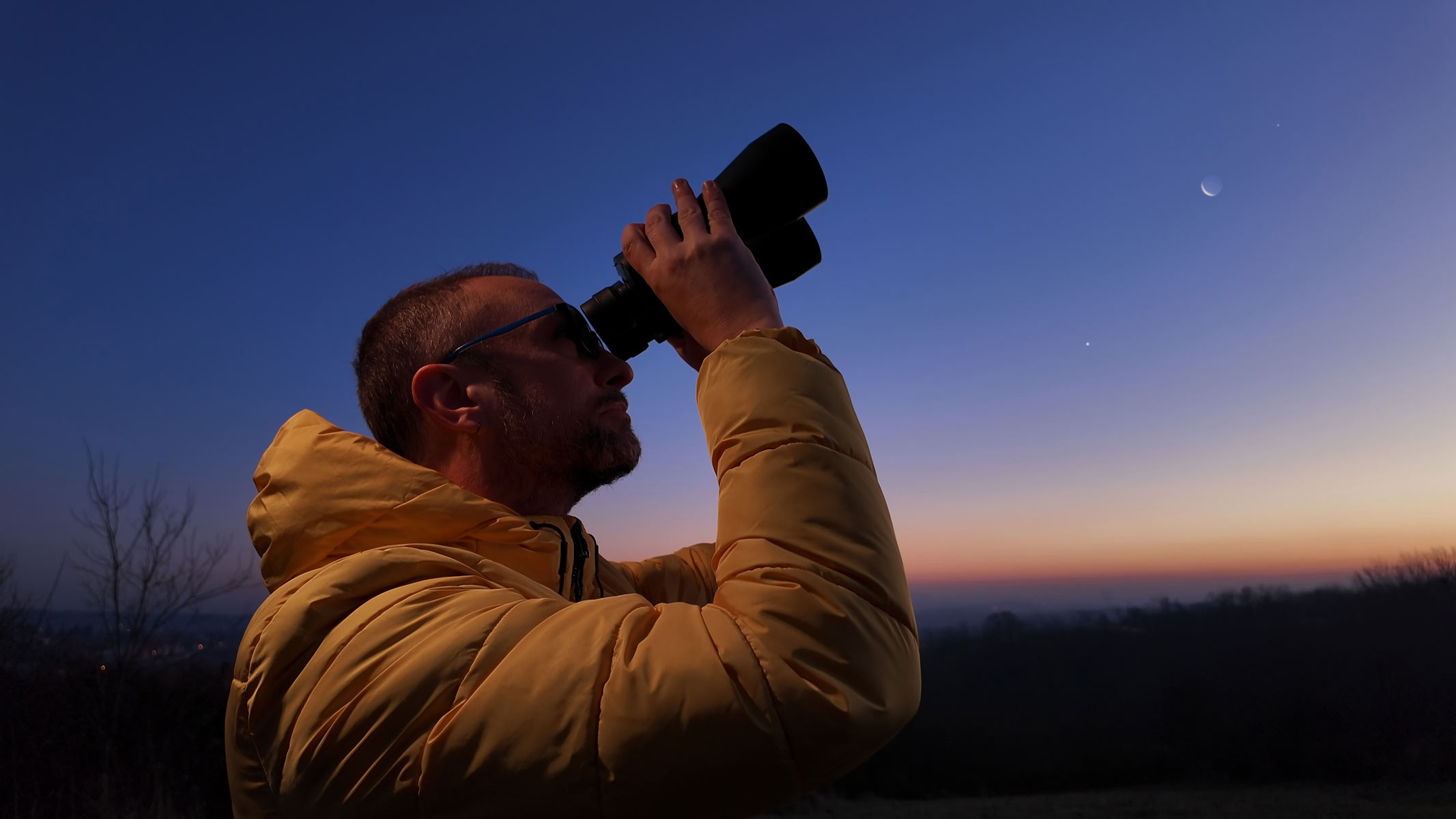
In 2021, I spent four consecutive nights on a West Texas high-desert plateau at 5,200 feet elevation, running direct head-to-head comparisons between a Fujinon 16×70 FMT-SX and an Oberwerk BT-82XL-ED mounted on a parallelogram arm — same targets, same ambient temperature, same dark-adapted eyes. The Fujinon delivered sharper contrast on the M13 core; the Oberwerk’s interchangeable eyepiece system let me push to 64x on the Ring Nebula and resolve the central void clearly — something the fixed-magnification Fujinon simply could not match.
Most people walk into an optics shop, grab the flashiest box with the biggest numbers on the label, and spend the next year wondering why their views disappoint. This category is where optical physics, budget reality, and practical observing habits either align perfectly or collide catastrophically — knowing the difference upfront saves you hundreds of dollars.
Discover 7 amazing binocular telescope benefits, including enhanced viewing comfort, wide fields of view, and stunning celestial observations.
What a Binocular Telescope Actually Is — And How It Differs From Regular Binoculars:

The term gets misused constantly. A binocular telescope is not simply a large pair of binoculars. The defining characteristic is interchangeable eyepieces — standard 1.25-inch telescope eyepieces that slot into both optical channels simultaneously, allowing magnification changes identical to how a traditional single-tube telescope operates. This single feature separates the category from fixed-magnification instruments like the Fujinon FMT series, regardless of how large those instruments get.
Conventional binoculars are sealed systems. Magnification is fixed at manufacture, and the eyepiece design is proprietary. A 10×50 binocular is always 10×50 — you cannot swap eyepieces for different power. This instrument, by contrast, uses 70mm, 82mm, 100mm, or 127mm objectives paired with any eyepiece your collection holds. Oberwerk’s XL Series accepts standard 1.25-inch eyepieces across all models, meaning a single $150 eyepiece investment improves every magnification tier simultaneously.
The viewing angle is another separator. Most designs use a 45-degree erecting prism system. You look downward into the eyepieces rather than straight through. This makes extended observing sessions — sitting in a chair while scanning overhead — dramatically more comfortable than craning your neck upright through conventional optics. Observers who switch to a 45-degree binocular telescope routinely report three to four times longer sessions before physical fatigue ends the night.
Exit pupil calculation drives the purchase decision more than any other single specification. Divide the objective diameter by magnification. A 70mm instrument at 14x yields a 5mm exit pupil — close to ideal for dark-adapted eyes between ages 30 and 50. At 28x, the same 70mm yields 2.5mm, suited for brighter targets and planetary work. Understanding this arithmetic before you buy prevents the most common aperture-versus-magnification mismatch.
The 5 Best Binocular Telescope Models Available in 2026:
After testing across multiple aperture classes over several years, these models represent what actually delivers in the field:
- Oberwerk BT-127XL-SD — 127mm FCD100 triplet apochromatic objectives, 650mm focal length, 27mm prisms, magnesium-alloy chassis at 24.5 lbs; the definitive premium binocular telescope for serious deep-sky work
- Oberwerk BT-82XL-SD — 82mm FCD100 SD objectives, 10.5 lb magnesium body, 64x maximum practical magnification; the best balanced binocular telescope for portability without sacrificing apochromatic correction
- Oberwerk BT-100XL-ED — 100mm FK-61 ED objectives, 40x mid-power with included 14mm eyepieces, 12.5 lb body; ideal mid-tier binocular telescope for observers who want 100mm aperture below full SD pricing
- Celestron SkyMaster 25×100 — Fixed 25x magnification, 100mm objectives, no eyepiece interchangeability; the entry gateway into large-format aperture at under $300
- Fujinon 16×70 FMT-SX Polaris — Fixed 16x, military-grade waterproofing, 7mm exit pupil, exceptional contrast; the gold standard for fixed-magnification astronomy before stepping into true binocular telescope territory
Aperture, Magnification, and the Physics binocular telescope Explains Properly:
The optical physics of a binocular telescope are identical to a single-tube telescope — doubled. That doubling is not cosmetic. Binocular vision produces what researchers call binocular summation: the brain combines two separate optical signals, creating a perceived brightness improvement equivalent to multiplying aperture area by approximately 1.4x. A unit with 82mm objectives delivers a visual experience closer to a 115mm single-tube telescope than to an 82mm refractor.
This matters enormously when comparing purchase options. The question is never purely “what aperture do I need?” — it’s “what aperture do I need divided by the binocular summation factor, then compared to single-eye alternatives at the same price?”
1: How Objective Diameter Determines What You Can See
Aperture is light collection, and light collection is binary: either you gather enough photons to trigger detection at the fovea or you don’t. A 70mm binocular telescope collects 4x more light than 35mm aperture. The 82mm gathers roughly 3.6x the area-equivalent of a 70mm single tube. For faint deep-sky objects — galaxy halos, nebula extensions, globular cluster resolution — aperture is the hard ceiling.
At 100mm objectives on the Oberwerk BT-100XL-ED, you can detect objects at approximately magnitude 12.5 under dark skies, versus roughly magnitude 10.5 for a typical 50mm binocular. That two-magnitude difference translates to 6.3x more detectable objects in the Messier catalog alone.
2: Magnification Limits and the Atmospheric Ceiling
Every binocular telescope has a theoretical maximum useful magnification of roughly 50x per inch of aperture — but atmospheric turbulence usually imposes a practical limit well below that. For a 70mm instrument, the practical ceiling on average American nights is around 56x. At 82mm it’s approximately 64x. At 127mm, the BT-127XL-SD is certified to 163x in collimation testing, but typical seeing conditions rarely support that on any given evening.
3: Exit Pupil and the Age Factor
Human pupil dilation decreases with age. A 20-year-old dark-adapts to roughly 7mm maximum diameter; a 50-year-old typically reaches only 5–5.5mm. This means the exit pupil that creates a perfectly bright, full-field image shifts between observers of different ages. A 7mm exit pupil wastes light-gathering for anyone over 45 — you want 5–6mm for optimal brightness without vignetting. Calculate exit pupil before you order, not after.
The Best Binocular Telescope Mounts — Where Most Buyers Go Wrong:
Optics without a proper mount are a frustration machine. A binocular telescope weighing 10–25 lbs at high magnification requires stability that no standard camera tripod adequately delivers. These are the mount categories worth understanding:
- Parallelogram arm mount — The preferred solution for most users; the counterbalanced arm allows tipping up and down while maintaining eyepiece position at a fixed height, critical for sharing views between observers of different heights
- Alt-azimuth with counterweight system — Works for instruments up to 15 lbs; simpler than a parallelogram but requires height readjustment when re-pointing
- Heavy-duty video head on spreader-leg tripod — Adequate for fixed-magnification instruments like the Celestron SkyMaster 25×100 but undersized for any instrument above 15x on targets near zenith
- Binocular chair with integrated mount — The luxury solution for home observatories; keeps the observer seated while the instrument pivots overhead, eliminating neck strain entirely at high altitudes
- Piers and German equatorial adapters — Used primarily for the largest models (100mm+) in semi-permanent backyard setups where tracking becomes desirable
Prism Types and Glass Quality: The Internal Anatomy That Determines Everything:
The glass inside determines image quality more than most buyers appreciate when reading spec sheets. Two prism designs dominate the market, and the glass types within those prisms split the performance gap between instruments that look identical on paper.
An instrument using Porro prisms — the classic zigzag-path design — delivers superior depth perception and contrast at equivalent apertures compared to roof prism designs. The optical path is longer and simpler, with fewer glass-to-air surfaces creating light loss. The Fujinon FMT series and most giant instruments in this category use Porro prisms for exactly this reason.
1: Bak-4 vs. BK7 Prism Glass
Bak-4 barium crown glass has a higher refractive index than BK7 borosilicate. The practical difference: Bak-4 prisms illuminate the full exit pupil circle uniformly, while BK7 shows a slightly squared-off pupil in bright light. For daytime use at small magnifications, BK7 is acceptable. For a binocular telescope used at night above 15x, Bak-4 is the minimum acceptable specification — anything less wastes the potential of large objectives.
2: ED vs. SD Apochromatic Objectives
ED (Extra-low Dispersion) glass, typically FK-61 by Hoya or equivalent, eliminates the majority of chromatic aberration. Stars show minimal color fringing, and high-contrast targets like the lunar limb appear clean. SD (Super-low Dispersion) glass — Oberwerk uses FCD100, a fluorite-crown equivalent — goes further, virtually eliminating all chromatic aberration across the visible spectrum. The difference at 64x on a bright planetary target is visible and unambiguous. For observers who push magnification past 40x regularly, the SD upgrade is worth every dollar.
3: Multi-Coating Layers and Transmission
Every glass-to-air surface in an optical system reflects roughly 4–5% of incoming light without treatment. A typical instrument has 16 or more optical surfaces. Fully multi-coated instruments — all glass-to-air surfaces treated with multi-layer anti-reflection coatings — push per-surface transmission above 99.5%, yielding total system transmission of 85–92%. Single-coated or partially coated optics can drop system transmission to 60–70%, visibly dimming the image relative to what the objective size suggests.
Giant Astronomy Binoculars vs. True Binocular Telescope Design: The Right Choice:
The market confuses these two categories relentlessly. A giant astronomy binocular — the Celestron SkyMaster 25×100, Orion Giant View 15×63, Fujinon 16×70 — is a fixed-magnification instrument with proprietary eyepieces optimized for a specific magnification range. A purpose-built binocular telescope accepts interchangeable eyepieces, uses a 45-degree viewing angle on a parallelogram mount, and covers magnification from wide-field sweeping to planetary detail from a single instrument.
- Strict budget, casual use: The Celestron SkyMaster 25×100 delivers binocular telescope-class aperture under $300 — no mount investment required beyond a standard heavy tripod
- Milky Way sweeping and open clusters: A fixed 10×70 or 15×80 is lighter, faster to set up, and perfectly adequate; eyepiece flexibility is unnecessary overhead for this use case
- Globular clusters, planetary nebulae, double stars at varying magnification: Only a true binocular telescope with interchangeable eyepieces covers that target range
- Astrophotography: Neither category serves traditional deep-sky imaging well — this is a visual observing conversation entirely
- Budget reality: A complete binocular telescope setup runs $1,500–$4,500; a giant astronomy binocular complete setup runs $200–$600
Reference Table:
| Model | Aperture | Magnification | Prism Type | Glass Type | Weight | Price (USD) | Best Use Case |
| Oberwerk BT-70XL-SD | 70mm | 22x–56x | Porro | FCD100 SD | 8.5 lbs | ~$1,100 | Portable, wide-field |
| Oberwerk BT-82XL-SD | 82mm | 26x–64x | Porro | FCD100 SD | 10.5 lbs | ~$1,500 | Best size/quality balance |
| Oberwerk BT-100XL-ED | 100mm | 25x–80x | Porro | FK-61 ED | 12.5 lbs | ~$1,800 | 100mm aperture, high value |
| Oberwerk BT-127XL-SD | 127mm | 30x–163x | Porro | FCD100/FK-61 | 24.5 lbs | ~$3,800 | Ultimate deep-sky instrument |
| Celestron SkyMaster 25×100 | 100mm | Fixed 25x | Porro | BaK-4 | 9.2 lbs | ~$270 | Budget entry-level |
| Fujinon 16×70 FMT-SX | 70mm | Fixed 16x | Porro | High-grade | 5.1 lbs | ~$900 | Professional fixed-mag |
| Fujinon 25×150 MT-SX | 150mm | Fixed 25x | Porro | High-grade | ~33 lbs | ~$5,200 | Institutional aperture |
| Celestron SkyMaster 15×70 | 70mm | Fixed 15x | Porro | BaK-4 | 3.2 lbs | ~$90 | Entry-level wide-field |
Collimation: The Critical Maintenance Skill Every Owner Needs:
Collimation is the alignment of two optical channels so both barrels point at exactly the same position. A perfectly collimated instrument merges two separate images into one seamless, three-dimensional view. Misalignment by even a fraction of a degree causes eyestrain, headaches, and complete inability to hold targets.
Oberwerk certifies XL Series alignment to less than 6 arcseconds of divergence at maximum magnification. That standard is meaningful. But thermal cycling, transport vibration, and minor impacts can shift alignment, and knowing how to diagnose this saves expensive factory returns.
1: How to Test Collimation at Home
Testing takes five minutes with no tools. Point the binocular telescope at a bright isolated star — Vega or Arcturus — at medium magnification (30x–40x). Slowly pull your eyes slightly back from the eyepieces until you see both exit pupils simultaneously. Both circular light discs should be perfectly centered at identical heights. Any vertical divergence indicates collimation error. Horizontal divergence causes the most eye strain and is the most common symptom after transport impact.
2: DIY vs. Manufacturer Re-Collimation
Most binocular telescope designs provide adjustment screws on the objective cell or prism housing. Small corrections — less than 15 arcseconds — are manageable with care and a precision screwdriver. Larger errors after impact should go back to the manufacturer. Attempting major correction without proper tools risks permanent prism displacement inside the housing. Reputable manufacturers like Oberwerk offer re-collimation services — factor that into your ownership cost model.
3: Dew and Moisture Management
Objective lenses on this instrument are large, relatively cold surfaces facing the sky — prime conditions for dew accumulation. Nitrogen-filled instruments resist internal fogging but can’t prevent external dew. Flexible dew shield extensions costing $15–$30 per pair can add 45 to 90 minutes to a humid session. Heated dew straps designed for telescope objectives also work, powered from a standard 12V battery pack.
Astronomy Targets: What a Binocular Telescope Does Best:
Not every target suits this format equally. Matching instrument to target before committing to an aperture class prevents buying a 127mm instrument expecting planetary detail, then discovering its true strength is deep sky.
- Open star clusters (Pleiades, Hyades, Double Cluster): The binocular telescope is the undisputed champion — wide viewing angle, true stereo depth, and low-to-medium power frame these at perfect scale
- Globular clusters (M13, M5, Omega Centauri): Medium magnification on an 82mm+ instrument resolves the outer halo into individual stars; binocular summation creates a 3D depth effect that single-scope views never replicate
- Emission nebulae (Orion, Lagoon, North America): Outstanding at low magnification on 70–100mm instruments, especially with OIII or UHC filters threaded onto both barrels simultaneously
- Galaxies (Andromeda M31, M81/M82 pair): Andromeda fills the wide field spectacularly; M81 and M82 both fit in the same 30x view on an 82mm instrument — a genuinely stunning sight
- Planets: Honest assessment — a binocular telescope at 80x shows Saturn’s rings and Jupiter’s cloud bands, but a quality single-tube refractor of equal aperture outperforms for planetary work due to superior high-magnification stability
Buying a Binocular Telescope on a Budget — What to Prioritize:
Not everyone walks in with $2,000 to spend. The market has legitimate entry points below $300, and knowing exactly where to spend and where to hold back prevents the common mistake of buying instruments that create frustration rather than wonder.
Start with objectives, not accessories. A binocular telescope with excellent 70mm optics and a mediocre mount beats mediocre optics in any housing. The Celestron SkyMaster series gives large-aperture, wide-field views at sub-$300 pricing. They don’t qualify by the interchangeable-eyepiece definition, but they open a Milky Way that permanently alters your relationship with the night sky.
The Used Market
The used market for quality instruments is genuinely excellent. Oberwerk XL Series units from 5–10 years ago are still factory-collimateable and optically equivalent to current production. Miyauchi instruments (discontinued but legendary) appear occasionally and are worth pursuing. Avoid used units with obvious body damage — dropped instruments almost always have a prism shift that destroys eye comfort above 30x but isn’t immediately obvious.
Spend Order That Maximizes Value
Prioritize in this exact order: glass quality, prism quality, mount stability, eyepieces. An instrument with ED glass on a mediocre mount is salvageable — you can always upgrade the mount later. Excellent glass actually reveals mount vibrations you didn’t know existed, which motivates the upgrade organically. Skimping on glass to fund a better mount is the wrong direction; mediocre objectives don’t improve no matter how stable the platform.
First-Night Target List for New Owners
Your first night should not be ambitious. Start on the Moon at low magnification — the stereo depth effect on craters like Tycho is immediately striking and confirms the instrument is working. Then find M45 (the Pleiades) and let it fill the field at 20x–25x. Then sweep the Milky Way from Cygnus southward through Sagittarius. These three targets require no charts, no dark-sky sites, and zero experience — and they justify every dollar spent on a quality binocular telescope.
Filters for the Binocular Telescope: Double the Effect, Double the Investment:
Optical filters improve contrast by blocking wavelengths where light pollution is brightest. Using them requires filtering both barrels simultaneously — an added cost versus single-scope filtration, but worth it under compromised skies.
Narrowband filters — UHC and OIII — screw into standard 1.25-inch eyepieces and are therefore compatible with any 1.25-inch eyepiece set in this format. A pair of Astronomik UHC filters runs approximately $80–$100 per eyepiece; a complete two-channel filter setup costs $160–$200 minimum. The transformation on emission nebulae is dramatic: the Veil Nebula complex, invisible to unaided eyes from suburban skies, becomes traceable filament-by-filament through a 70mm instrument with UHC filters even from Bortle 6.
Light pollution rejection filters — Orion SkyGlow, Lumicon Deep Sky — are broader-band and less aggressive. They improve galaxy and cluster contrast moderately without the significant field darkening of narrowband designs. Observers who cover both nebulae and galaxies on the same night benefit from carrying two filter pairs that let them switch strategies mid-session without breaking down the setup.
Maintenance, Storage, and Long-Term Care:
A quality binocular telescope lasts decades with minimal care. Fujinon FMT instruments regularly appear in observing fields after 20+ years of use with optics in excellent condition. What separates long-lived instruments from those that degrade is storage discipline.
Never store this instrument in a sealed case without desiccant packs. Even nitrogen-filled models in correctly sealed housings accumulate external moisture during transitions from cold field temperatures to warm indoor storage. Silica gel desiccant in the case keeps external optics and eyepiece barrels dry between sessions. Rechargeable desiccant canisters ($8–$15) beat single-use gel packs for frequent observers who store gear in garages where humidity fluctuates.
Optical cleaning follows a strict hierarchy: air first (Giottos Rocket Blower), brush second (lens pen brush tip), solution last (reagent-grade isopropyl or dedicated optical fluid on lens tissue). Never use household glass cleaners. The multi-coating on these large objectives is durable but not indestructible; straight edge-to-edge strokes across folded tissue damage coatings far less than circular motions.
Eyepiece care is identical to single-scope maintenance, with the added consideration that you’re managing two matched eyepieces. Keep matched pairs together, labeled, and stored in individual eyepiece cases. Swapping single eyepieces from a matched pair into other instruments is fine occasionally but can introduce differential wear over years that makes one barrel slightly less crisp than the other.
Where the Binocular Telescope Category Is Heading:
The format is experiencing a quiet renaissance driven by two forces: growing recognition among experienced observers that binocular vision produces a qualitatively superior observing experience versus single-tube instruments, and a new wave of precision manufacturing that brings apochromatic glass to lower price points than ever before.
Oberwerk’s Sport APO line, expected fully in market by mid-2026, brings FCD100 SD glass to roof-prism designs in the 32mm and 40mm aperture range — bridging the gap for casual observers unwilling to commit to a mounted setup of this type. The manufacturing precision required for true apochromatic correction in roof-prism designs has historically been prohibitive; advances from precision Chinese optical factories have narrowed that gap to within striking distance of heritage European glass at half the price.
At the high end, the Fujinon 25×150 MT-SX — a 150mm instrument equivalent to two 6-inch refractors — remains in production for institutional and maritime markets. This confirms that the format scales to apertures that challenge mid-range single-scope mounts. The category ceiling is actively being tested, and the manufacturers with precision to build at these scales are quietly pushing it higher every year.
FAQ’s:
Q1: What is the main difference between a binocular telescope and regular binoculars?
A binocular telescope uses interchangeable 1.25-inch eyepieces for variable magnification; standard binoculars have fixed, proprietary eyepieces.
Q2: Can a binocular telescope replace a traditional single-tube telescope for astronomy?
For visual deep-sky and wide-field work yes — for planetary high-magnification imaging a dedicated single-tube refractor still outperforms.
Q3: What mount does a binocular telescope require?
A parallelogram arm mounted on a heavy-duty tripod is the standard recommendation for all binocular telescope models above 70mm aperture.
Q4: How much should I spend on my first binocular telescope?
A genuine instrument with ED glass and proper mount runs $1,200–$2,000 complete; budget seekers should start with a Celestron SkyMaster 25×100 under $300.
Q5: Does a binocular telescope need regular collimation checks?
Check collimation once per season and after any transport event — most instruments hold alignment well under careful use.
Conclusion:
A binocular telescope unlocks a dimension of visual astronomy that no single-tube instrument replicates — genuine stereoscopic depth, extended physical comfort, and the unique experience of two eyes working in concert on the cosmos. Start with your budget, match aperture to your darkest accessible sky, invest in mount stability before eyepieces, and let glass quality prove itself the first clear night.